Kelly Breakall's Posts (43)

Sort by

12746866668?profile=originalPhotography is hugely popular among middle- and upper-class Indians. My fiancé got into photography about 10 years ago, and he has worked very hard to build a photography company over the past 3-5 years. It is called Snapoholic, and he describes it as a "global community for photographers". He teaches photography workshops, leads photography walks (called SnapWalks) and photography trips (SnapTrips). (His work is also published in National Geographic and has been displayed in European exhibitions, but that is neither here nor there.)

He often collaborates with Fujifilm, a major photographic equipment company, to organize workshops. He had one called "Travel Companion Workshop," and he used a photo of me (and his hand) from Rajasthan as the background for the flyer!

Read more…

Marvel movies (like Avengers and Wonder Woman) are HUGE in India. My fiancé tried to get a ticket for first few days of Avengers Endgame in Noida (near New Delhi). The ticket sales opened at midnight, and they were all sold within an hour!!

Here is a screenshot of my fiancé and I texting in Hindi about Marvel movies. I'm not a big fan, but he is a HUGE fan so sometimes he tries to explain it to me. The transcript is below.

12746867489?profile=original

Me: What is her name?

Him: Her name is Captain Marvel

Me: You like Marvel very much. Is Spider-Man Marvel?

Him: I like [Marvel] very much

Me: I read a Spider-Man book.

Him: Spider-Man was originally Marvel. But now the rights belong to Sony.

Read more…

SDLC 111: Learning Journal #8

This past week and a half, Abhi and I have been working on skills related to time and transportation. We discussed how to bargain for a rickshaw trip, how to tell a driver where I want to go, and how to tell time.

Telling time in Hindi is a little different than in English. Whereas Americans may say "It's 6:45", an Indian may say "pona saat", which means "quarter til 7". They use a lot more "quarter-til," "quarter-past", and "half-past" than we do.

In Hindi they also have an assumed 1:00 when telling time. Thus, if you want to say 12:45 (quarter to 1) you simply say pona (quarter to). Similarly, there is a special word for 1:30. Instead of saying sare ek (half past one), you say a unique word der which is used only for 1:30 o'clock.

I have an idea for an activity to tie together a lot of the topics I have studied this year. I can write a one-day journal with many entries. Each entry would contain the following:

  • the time
  • my location
  • what I am doing
Read more…

ranthambore-national-park-safari.jpg?profile=RESIZE_710xTigers do not ordinarily like to eat people. However, when a tiger is injured, old, or otherwise disturbed, they may adopt a diet of eating humans. In 1906 Jim Corbett, a British big game hunter, was called to India to protect the villagers from the man-eating tigers and leopards. Over the next 29 years, he killed a dozen of these animals which together had killed at least 1,500 villagers of northern India.

In the area where this all happened, India has enacted a national park called Jim Corbett Park. Oddly, it is a nature sanctuary and in particular a tiger sanctuary. The man who is famous for killing tigers got a tiger sanctuary named after him!

I have not directly visited Jim Corbett Park, but I have driven on a highway through it. It is beautifully preserved land. At one point during out journey, we saw a group of corn-roasters on the side of the road. We stopped and got to eat delicious freshly roasted and buttered corn in the middle of the jungle. The whole time there were monkeys watching us, and when we finished we threw the corn cobs into the jungle. The monkeys ran to gobble up the bits of corn from the cob. I hope next time I visit the north Indian mountains I can go to Jim Corbett Park.

Above is a picture of a tiger at the park. As you can see, safaris (jeep and elephant) are available.

Read more…

The Indian railway system spans from the lush tropical areas of southern India to the much colder Himalayan mountains in northern India. It has historically been viewed with romanticism and a little bit of mystery. There are of course the famous pictures of overcrowded trains, with people hanging onto every surface of the train - inside and out! Then there is the gourmet service of first-class trains, with delicious Indian meals brought out on fancy dinnerware. You can experience the extremes of SES on an Indian train, from the non-air-conditioned (with 120F heat!) 3rd class, to the luxurious 1st class. Each train is a little microcosm of India. Everyone from an illiterate villager to a high government official rides trains. In fact, if you ever get a chance to go on an Indian train, and especially a second-class sleeper train, you may notice a certain passenger has an armed guard accompanying him. That passenger is most likely a politician, and is guarded at all times to keep him safe.

Below is a picture from Business Insider showing how crowded Indian trains (especially 3rd class) can get. Good luck getting a seat there!

See the source image

https://www.businessinsider.com/indias-trains-are-insanely-crowded-2016-2#11000-trains-are-operated-every-day-in-india-3

Read more…

SDLC 111: Learning Journal #7

This past week I mostly followed my learning plan. I completed my goals for Duolingo and Mango lessons, and I wrote two essays totalling about 280 words. I also learned the construction for "I want/do you want?" and I can use it to ask for basic needs.

Originally I had planned to study both household/hospitality and transportation last week, but Abhi and I decided to study home vocabulary both meetings. After we reviewed pronunciation of the words, we practiced using them by role-playing a hotel guest scene. Home vocabulary (rooms, household items, kitchen items, cleaning supplies, etc.) is very important for me because I will be managing a household in India.

This coming week I plan to solidify the household vocabulary and practice them by writing another essay and a written dialogue. I plan to practice with both Abhi and Ashish (my fiance).

This coming week I also plan to complete another 3 topics in Duolingo and another chapter of Mango. I also plan to ask Abhi to write a short dictation exercise using the home vocabulary, to help me practice writing. For specific topic goals, I want to be able to do the following at the end of next week:

1. Ask for transportation (ie rickshaw)

2. Give/ask for directions

3. Clarify what time and place an event is 

These goals are very relevant because I will need to travel places in India (like to my language school in New Delhi) and Hindi is helpful to speak with rickshaw drivers.

Read more…

SDLC 111: Learning Journal #6

This week I wrote up a learning plan for the last four week of this semester. I used the ACTFL Can-Do statements to assess where I need the most work. I also reevaluated my practical goals for what I need to know to function in India. I wrote a 4-week schedule, with goals for each week in Duolingo, Mango, essential practical skills, vocabulary topics, and language partner meeting activities. 

I have been using Duolingo a lot, but it is getting tedious. All of the work is translating sentences to and from Hindi. While it was very helpful at first, it is now getting annoying to keep translating sentences like "Does she live in India or America?" and "Those men do not eat apples." over and over. I discovered that I could take the little tests to jump up levels, instead of slogging through every sentence. As long as I learn some new grammar and vocabulary, I still think it is helpful.

This week I also wrote a short writing assignment (160 words) introducing myself, my family, and my occupation. I did it in English script only because I don't know how to type in Hindi, but I know I should practice the Hindi script too. Because I use almost all online resources which have word banks, I am quite good at reading Hindi, but not at spelling and writing. If I want to test out of the beginner Hindi class in India, I will need to up my writing game.

I also need to start focusing on more vocabulary. Now I have a basic sense of how the language is put together (it's weird) so I really need more vocabulary to fill in the gaps. 

Read more…

Desi SpiderMan is a low-budget Indian film about an Indian Spiderman! It contains every essential element of a stereotypical Indian film - romance, fighting, comedy, damsel in distress, washing laundry, more fighting, and (most importantly) Bollywood-style music and dancing scenes!

The internet is not at all sure about the origin of this film. There are some rumors floating around that this is the brainchild of a man whose dream was to make a movie with all of his meager savings, and this (comedically low-budget) film is the result. The other and more likely explanation is that this film was meant to be a spoof of Indian film and culture. Either way, it is a very funny and silly film, enjoyed by Indians and non-Indians alike.

Below I have attached a dance video clip from the movie. In this, the woman sings "Spiderman, Spiderman, tune churaya mere dil ka chain . . . " which means "Spiderman, Spiderman, you have stolen the peace of my heart".

Also, fun fact. This was filmed in the city where my fiancé lives, and very close to where I am moving in June.

https://www.youtube.com/watch?v=M3sqEhA_wys

Read more…

SDLC 111: Learning Journal #5

This week I did not meet with my language partner because of scheduling difficulties. Instead I spent a lot of time on Duolingo, finding Hindi Discovery Channel videos to watch, and practicing Hindi with my fiance.

Interpersonal communication progress is slow, but it is going. I seem to progress faster when I talk with my fiance because, besides just giving me extra practice, I am more comfortable with him than anyone else, and so I am more willing to take language risks. This week I was able to speak 95% Hindi (very context heavy) for probably 20-30 minutes. I was able to tell him a short story that happened that day, tell him about an app that I want to get on my phone, and talk with him about various snack foods.

I met this week's Duolingo goal! I have also returned to Mango lessons after a couple weeks off, and they seem much easier now! I do Duolingo lessons in bed first thing in the morning and last thing at night - it has replaced my social media habit and I am much happier for it. I attached a screenshot of my current Duolingo tree.

My goals for this week:

Duolingo: get the next five lessons up to level 2

Mango: complete chapter 7 (transportation and payment)

Interpersonal communication: I'm not sure what goal. It may come to me.

Other: check out at least one Hindi Discovery Channel video12746867466?profile=original

Read more…

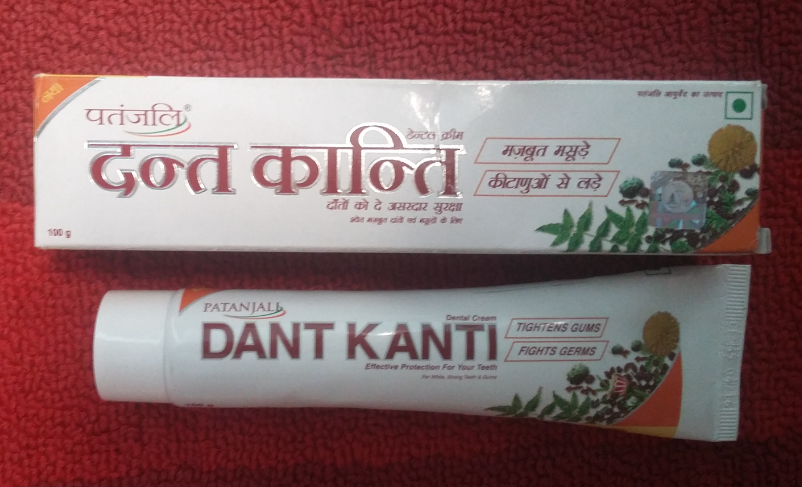
See the source image

Dant Kanti is a wonderful example of how India has herbal alternative "medicines" for almost everything! In Hindi it is called Ayurveda or Adurvedic Medicine. It is based on an ancient system of herbal remedies and an understanding of using natural products to achieve balance in the body and mind.

Dant Kanti is a toothpaste which is made all out of herbs in a calcium carbonate base. It can also have fluoride added, since Indians might not get fluoride from the purified water in India. Some of the herbs include neem, spearmint, clove, "porcupine flower", "false black pepper", turmeric, among many others which we don't have in the U.S.

The color of the toothpaste is a rich brown (it isn't like the sparkling white toothpaste in commercials!) and it tastes predominantly like clove. I think it tastes great - it's a nice change from the mint toothpaste I have been using my whole life.

As you can see, the packaging is in both English and Hindi. Most packaging and advertising in India is in at least two languages (English and the local language) so it makes it easier to me to find items I need in the shops.

Read more…

Kathak is one of the eight traditional dances of India, and it originates from Hindi-speaking northern India. Each dance is considered to be telling a story, with intricate feet movements and facial expressions explaining the narrative. The word Kathak comes from Sanskrit (a precursor to modern Hindi) for story (katha) and one who tells a story (kathakar). In fact, modern Hindi has retained those words, although I'm not sure if the pronunciation is the same. The original dancers of Kathak are thought to be wandering groups of performers, who would later play a role in entertaining the courts of north India.

There are three main forms of Kathak, with the distinctions being in the relative use of feet and arm movements, and facial expressions. They are performed with the purpose of expressing stories - usually of great religious or mythical figures - although now the people of India may not be knowledgeable enough of the art form to understand the "language" of the movements. Kathak can be performed with Indian classical instrumental music, as well as with Slokas and Bhajans, which are Sansckrit/Hindi religious songs of devotion to Hindu deities.

Gypsy Kathak dancers are thought to have influenced the development of movement art in Europe as well. In fact, some people believe that the popular Spanish Flamenco dance is based on Indian Kathak dance. If you watch videos of both, you will indeed see many similarities.

Here is a TED talk and performance of Kathak dance.

https://www.youtube.com/watch?time_continue=64&v=Fz_Tpp0q73A

Read more…

SDLC 111 Learning Journal #4

The past couple of weeks included Spring Break, so I took a break from all school-related tasks.

I have been working with Duolingo Hindi, and using my textbooks sporadically. In my meetings with Abhi, we have practiced conversations, with topics like shopping, food, family, and wedding plans. Grammar topics included past and future verb tenses, as well as some unique aspects of casual conversation.

Last month I saw a lot of growth in my Hindi learning, but the past couple of weeks I feel that I have plateaued. I feel discouraged about that, but I hope the way to get back on track is with proper planning.

I am seriously considering attending Zabaan Language School in New Delhi. They have a intensive beginner program and an intensive intermediate program - both are for 4 weeks each. I will probably do the beginner course to start, because it will help me with review.

This coming week I need to buckle down and get serious again - it's hard coming back from Spring Break! My goals for this/next week are as follows:

Writing/Reading goals: Reach level 2 on Duolingo skills "Animals", "Activity", and "Adjectives"

Interpersonal Communication goals: look through ACTFL benchmarks and decide accordingly.

Speaking/Listening goals: Mango next chapter

Course goals: start thinking about final research presentation

Read more…

I watched a documentary this week about Anglo-Indians and I would like to talk a little bit about that. The film is called "A Calcutta Christmas" and was produced in 1998. Some of the information may be a bit dated.

India was ruled by the British since the mid-20th century, and Anglo-Indians are remnants of that rule. They are the descendants of British-Indian marriages, and were meant to bring alliances between the two counties closer (and help business/British rule). While Anglo-Indians used to be mostly upper-class and lived a very privileged and separated life in India, they have now become a sort of half-way race between the cultures, not fitting into either. The British do not fully accept them, and India does not fully accept them.

According to the documentary, most of the wealthier Anglo-Indians have since moved to Britain or Australia. In fact, when India first gained independence, there was a large migration of Anglo-Indians moving to what they considered their "home country". However, many of the less affluent Anglo-Indians remained in India, serving as remnants of a previous era. This documentary in particular was about a group of destitute older people who lived in an old-age home called ". Some of them live in an old-age home called "Tollygunge Homes" in Kolkata.

Watching the film was a unique experience because to felt like stepping into a former time - one where Indian customs, mannerisms, and language sounds blended with British. Many of the mannerisms of the residents of Tollygunge Homes were very British - a particular way of the folding the hands, listening to Pavarotti, or dressing in suits and vintage British clothes. And yet other aspects were definitely from Indian culture - a certain way of eating rice with the fingers or the uniquely thick and musical Indian-English accent.

Some of the more salient parts of the film were the descriptions of racism and prejudice between Anglo-Indians and "pure" Indians. There was one Anglo-Indian man that was relatively darker skinned, and his wife felt the need to defend her decision to marry him. She said she didn't pay any thought to the color of his skin (even though his whole life he was mistreated for it) but she married him because he was a "very, very, very nice man". She said, in context of how people mistreated his for his color,

"What is the difference? He is a human being - he has as much feelings as anybody else has. They even told it to my face in this place, 'What did you see enough to marry him?' I saw something you all could not have seen. I don't look for the complexion or the features. I look for the nature of the person. And I have never regretted one day having married my husband. Never. And if I had to do it again, I would do it again and again. Because, honestly I'm not saying it because he's [here], but he's a very, very, very nice man." [Below is a photo of the couple.]

There is certainly a lot of animosity between differently perceived groups in the world, and India is no exception, but it takes one decision at a time like marrying a "very, very, very nice man" or helping those different from you, to make the world a better place.

12746867669?profile=original

Read more…

SDLC 111 Learning Journal #3

I have decided to write a progress journal every week instead of bi-weekly, because that will better support my motivation and learning goals. 

My goals from last week, with completed in italics:

  • Basic Hindi: Lessons 10, 12, & 13
  • Find children's book to practice reading. [Not yet. Considering if this will be worthwhile, since I am not focusing on reading.]
  • Role-play shopping experience.
  • Start translating a song either into or from Hindi. [Not yet. Still on my bucket list.]
  • Study Hindi at least one hour per day. [I averaged 30 minutes per day.]

This week I learned more about post-positions, possessives, and numbers. My main two topics (and subjects of meetings with Abhi) were shopping and hobbies. To practice shopping, Abhi and I role-played very silly shopkeeper/customer situations. It was very fun and allowed me to practice language structures that I learned from Mango lessons, as well as learn new (like, We don't have it in stock!). To practice hobbies, Abhi and I simply took turns asking each other about our interests/hobbies, asking for details and reasons why we like them.

I also practiced with my fiance this week: we spoke in Hindi about how I want to attend a certain language institute in Delhi. He also made a pun, which was my first in Hindi. Sleep and gold are the same word sona in Hindi, so I asked him "Aapko sona chahiye?" [do you want to sleep?] and he responded "Nahi! Mujhe silver chahiye!" [no, I want silver!].

Today I used the Can-Do language statements to determine my level. I am between the different beginner levels in the different categories. It gives me insight into what to work on.

This week my goals are as follows:

  • Mango lessons 29-37 [restaurant theme]
  • Role-play restaurant scene
  • Role-play another shop scene to practice
  • Start learning how to verbally explain schedule
  • Study Hindi at least 45 minutes per day.
  • Try to watch a Hindi Discovery Channel video

Read more…

SDLC 111 Learning Journal #2

These past two weeks I have experienced a lot of progress in Hindi. I was having a frustrating time because I felt like, even though I have studied Hindi for several months now, I couldn't communicate anything. Then, this week it seemed that suddenly all the little things I had been learning started to click together into meaningful language. I had several moments of creative communication in Hindi this week.

I had three main topics of study these two weeks:

1) Food/cooking: I was able to discuss liked/disliked foods, as well as explain in very simple Hindi how to cook my breakfast (grits). 

2) Shopping: I have been using Mango lessons to learn how to ask for and purchase items at a local shop in India. This includes some colors and items (neeli kitaab for blue book) and verb phrases (Yeh kitne ka hai? for How much is this?). I know numbers 1-10, but I haven't been brave enough to tackle the rest of the number system yet.

3) Grammar: I have introduced myself to grammatical cases in Hindi. So far, I have learn about the direct case and the oblique case of nouns and adjectives. The oblique case is used when the noun or adjective is governed by a postposition.

The resources I used included the Elementary Hindi textbook, the Basic Hindi textbook, Duolingo, Mango, and a Youtube channel called Hindi University.

As I mentioned before, I was experiencing frustration with myself at the beginning of the semester. However, I am striving to be kinder to myself in all areas of life, and I think this has positively influenced my Hindi learning. I am looking forward to learning more in the coming months.

My goals for this coming week are as follows:

  • Basic Hindi: Lessons 10, 12, & 13
  • Find children's book to practice reading
  • Role-play shopping experience.
  • Start translating a song either into or from Hindi.
  • Study Hindi at least one hour per day.
Read more…

SDLC 111 Learning Journal #1

This week I had my first meeting with my new language partner, Abhi. He is from Gujarat, and speaks fluent Hindi as a second language. I actually find that encouraging, because, since he also learned Hindi as a second language, it removes the fear of potentially sounding silly by speaking in the language.

For our first meeting, we first reviewed briefly the grammar structures that I had studied from my textbook. These included the postposition "ka", adjective gender-number agreement, and pronouns.

Next we practiced reading by reading a textbook dialogue and then I asked questions and answered them in Hindi about the dialogue.  I felt this was a helpful exercise, because Abhi helped me with pronunciation and also with understanding how to properly phrase and answer questions. We also discussed (in English) cultural things related to the dialogue. I also practiced reading the text on a 20 rupee note he had.

Next we practiced speaking, with simple Q&A's in Hindi about location, items in close proximity, etc. This was a very helpful exercise to help me understand how language is used in real life situations, as opposed to textbook dialogues.

For coming weeks, I plan to continue to study with my textbook and increase my conversational skills. Abhi is also going to find some short videos in Hindi and help me work through those.

Read more…

SDLC 110: Cultural Post #8

For my final cultural post, I would like to talk about dating/marriage culture in India.

Historically, India relied on an arranged marriage system, where the parents would choose a suitable spouse for their child. This was usually done when their son/daughter was an adult, but there are instances of younger teens being promised for the future.

Currently, the arranged system is still used, but other systems are gaining recognition. One is the "love marriage" system, which is what Westerners consider "normal", and the other is matrimony websites. Love marriage simply means that the couple chose each other based on shared love, instead of based on their parents' recommendations or societal/economic pressure. When I go to India and walk with my fiancé, even then people in public will ask "love-relationship?". Matrimony websites are similar to dating websites, except the goal is marriage! Each candidate enters all pertinent information about themselves (height, weight, age, income, religion, language, etc.) and wait for a "matrimony match"! When they get matched with someone, it doesn't mean they are required to get married, of course. It simply means that they are alerted to a potentially good partner for marriage.

A funny story is that the very evening before my now-fiancé told me he liked me, he had a phone call with a matrimony match. He said she was "not repelling" but he didn't seem too excited. The next day I believe he called her back and called off the match. :)

Read more…

SDLC 110: Learning Journal #8

For my last learning journal, I would like to explain a specific task I have been working on over the past week or so. I work in a neuroscience rat lab on campus, and I made a little presentation about my lab in Hindi! I will share the text from the presentation. I would love to continue this task when I am able to express more in Hindi - I am very passionate about my work in the lab.

All script is written in English letters, because it's easier to type in English and also easier for others to read.

Yehe mera lab hai.
Mera project lab mein hai.
Yeh mere chuhe hain.
Vo kale safeid rung ke hain.
Unke pas do ghar hain.
Ye ghar isgharke uper hai, au rye ghar isgharke beech hai.
Unke pas ek ghar hain.
Darvaza hota nahi hain.
Yehe chuha so raha hai.
Yehe chuha khana kha raha hai.
Unko fruit loops pasand hai, aur mujhe bhi fruit loops pasand hai.
Leken ham fruit loops baant kar nahin khate hain.
Christmas ke liye, bare ghar ko sajaya hai.
Main ugley semester mein, chuho ko gari chalana sikhaungi.

It means:

This is my lab. My project is inside the lab. These are my rats. They are black and white in color.

These have two houses. This house is above this house, and this house is below this house.

They [other rats] have one house.

There are no doors.

This rat is sleeping. This rat is eating.

They like fruit loops, and I like fruit loops, but we don't share the fruit loops.

For Christmas, we decorated the house.

Next semester, I will teach the rats to drive cars.

Read more…

SDLC 110 Learning Journal #7

This week Atul and I reviewed everything in preparation for the final assessment. We spent 90 minutes on Sunday reviewing and doing a practice test, with the majority of the time spent going very slowly through a Hindi YouTube video for kids. Understanding spoken Hindi is definitely more difficult for me than understanding written Hindi, so it was good practice.

The final assessment itself had three components. First was reading: I read a paragraph of Hindi text - it was a story about visiting a church and a temple, and then I briefly summarized (in English) what it said. Second was listening: I watched a minute of a Hindi kids' story read aloud on YouTube, and then I again summarized what I understood from it. Third was speaking: I responded to some basic questions about my daily life in Hindi.

Read more…