
Kate Park's Posts (25)
Sort by
For the last week of classes, we recorded the podcast and talked about our most memorable lessons and asked some questions to our language partner. I mentioned how I liked the time when we read the news report on the weather in Korea and when we read through the dialogues our language partner created for us. Reading the news report was a great reminder of how much Korean I have forgotten. I also realized how different it is to read something in your head compared to reading something aloud. When you just read in your head, I think it’s easy to gloss over the text quickly and not pay attention to the pronunciation of the words. When I read the article aloud, I realized that I suddenly became more self-conscious. Not only do you focus on the pronunciation, but you also become aware of where the natural pauses are and when to raise your tone. I think it’s good practice if you don’t have someone to talk in Korean to. If you do have someone to practice with, I recommend going through scripted dialogue for a variety of different scenarios. I think these could benefit those who want to try to get a better feel of practical conversation.
I think this semester even though I at first wanted to use a textbook to learn harder vocabulary and grammar, I think it was a rewarding experience to also just take a step back and review the foundations of Korean. I learned a lot more than I expected to. It was also fun to learn in a group setting. Seeing through the eyes of others gives a whole another way of learning.
But there were times when I thought that I should be learning more. Compared to back in high school when I studied for the Korean SAT subject test, I have forgotten so much. Now reading long passages and articles are not very pleasant to look at it. Sometimes it feels like a mountain of text, and I also tend to run out of patience. It becomes easy to give up. I also felt this way when I was practicing my Korean typing skill. I was extremely slow at first. Even typing a sentence was very difficult and time consuming, but compared to now, I think I somewhat improved. Typing in Korean became a little bit easier. I still type relatively slowly, but I have memorized the layout of the Hangeul characters on the keyboard.
I think my original goal, which was to use textbooks to improve vocabulary, grammar, reading comprehension, and writing can be my long term goal for the next semester since I will not be taking Korean. I have a change of plans this fall semester, but for next year, it might be a good idea to use a textbook so that I don’t have to constantly think of and find something to learn. Using a textbook can be a good way to keep myself in check.
For the last cultural artifact blog post, I wanted to learn more about the different dialects in South Korea. Because my parents were both originally from Seoul, I grew up hearing and learning the standard Korean language, which is called 표준어 in Korean. I remember once during some time in high school, I went over to a friend’s house and met her parents. I was shocked because it was my first time hearing the Gyeongsang dialect. My friend’s parents were from Busan. When they were talking to me, at that time, it felt like I could only understand about half of what they were saying. Unlike the dialects in American English, I think the dialects in Korean are much more different from each other, having distinct grammatical characteristics and completely different phrases.
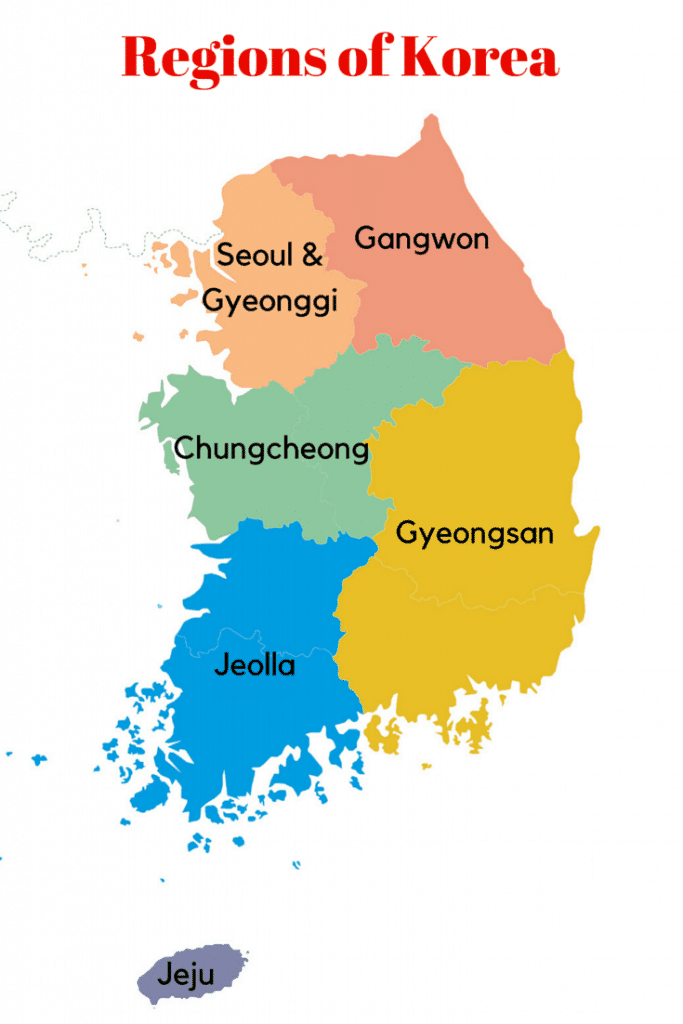
I learned about the dialects in the following six regions: Gyeonggi, Gangwon, Chungcheong, Gyeongsang, Jeollado, and Jeju, but for this post, I will only focus on the first three. The first region, Gyeonggi, is where Seoul is in, so the dialect here is the standard Korean. A few characteristics of the standard Korean language is that many people tend to change ㅗ sounds to the ㅜ sound. So for example, "먹고 싶다” (meokgo sipda/I want to eat) would be “먹구 싶다” (meokgu sipda). In this case, the “go” in “meokgo” became “gu” so “meokgu”. I find myself doing this all the time. Another characteristic, which I didn’t know about was adding an extra consonant like ㄹ to a word. For instance, “이거로” (igeoro/this one) becomes “이걸로 or 이걸루” (igeollo or igeollu). Do you see the extra consonant? Because this dialect is the standard language, I forget that it is actually a dialect itself.
The Gangwon dialect is used in Gangwon, which is in the Northeastern area of South Korea. This is where the Pyeongchang Olympic was held last year. The people here then to pronounce words with the double ㅆ consonant as if they were a regular ㅅ consonant. So, “쌀” (ssal/rice) is pronounced as “살” (sal). The sound of words like this would become softer. They change theㅏ to the ㅓ vowel when it is at the end of a sentence. For example, “합시다” (hapsida/let’s do this) becomes “합시더” (hapsideo). Also, many different words such as -나, -노, -고, -가 are used to end a question like 비오나? (biona?/is it raining?) Instead of 비 와? (bi wa?).
The Chungcheong dialect is spoken in many various areas, but it is most commonly used in 충청북도 and 충청남도, which are both below Seoul, Gyeonggido. One of its characteristics is that if the last word of a sentence ends with either the ㅐ or ㅔ vowel , it changes to the ㅑvowel. So for example, “피곤해” (pigonhae/I feel tired) is spoken as “피곤햐” (pigonhya). Notice the hae changing to hya. Another example is the word for snake, “뱀” (baem). This changes to 뱜 (byam). Also, if the last word of a sentence ends with 야, it changes to 여. So, “아니야” (aniya/it’s nothing) becomes “아니여” (aniyeo) and “뭐야?” (mwoya?what is it?) changes to “뭐여” (mwoyeo).
Within the last two weeks, we only had class last week because of Thanksgiving break. At that time, we mainly focused on practicing conversational Korean. We practiced going through three conversations in different situations with each person taking the role of each character. In the first situation, there were two people where they talk about their plan to meet up to watch a movie and have dinner together.
The conversation basically went like this in English.
Hello, how have you been?
Hello, I've been doing well. If you have time this weekend, would you like to go watch a movie together with me?
Sounds good! Which movie should we watch?
How about the movie 'Joker'?
That's fine with me! On which day shall we meet?
How about Wednesday night?
I have an exam on Thursday , so I have to study for my test on Wednesday night. I don't think Wednesday night is going to work.
Then, how about Friday night?
Friday night is okay! Then before we watch the movie, shall we eat dinner?
Yes, then what time should we meet at?
Shall we meet in front of the restaurant at around 6 o'clock?
Yes, I'll see you at 6.
In the second situation, two people are at a Korean restaurant, and they give their orders to the employee.
The conversation went like this.
Hello, what kind of beverage should I get for you?
One cup of water for me please.
One cup of water for me as well.
Okay, sure.
Here are two cups of water. Would you like to order your meal?
I would like one kimchi stew.
I would like one bulgogi fried rice.
Okay got it.
In the third situation we practiced, the same two people are now at the movie theater trying to buy movie tickets and snacks.
I will buy the movie tickets. Could you buy the snacks and drinks?
Yes, that's a good idea.
Hello, how may I help you?
Hello, I would like two tickets for the 7 o'clock showing of 'Joker.'
Sure. That will be 17 dollars.
Thank you.
Hello, how may I help you?
Hello, I would like one medium sized popcorn and two small drinks.
Sure, that will be 17 dollars.
Thank you.
These conversations are probably at the introductory level of Korean, and I speak in Korean with my family everyday, but I don't know why but I still feel a bit nervous when having to speak it in a more formal setting like in a class and with people I normally don't speak it with. I guess it takes time to become more used to it. Even with the basic conversations, I remember having to mentally prepare myself before saying it aloud. I feel like I unconsciously just dedicate speaking in Korean with only family members since I don't really have a need to use Korean otherwise, so it feels almost wrong to do so with people who aren't family. I'm not sure if that makes sense.
Also, as I've been watching videos by Korean YouTubers, recently there was this one slangy sentence ending pattern that was used frequently. Instead of ending a sentence with 요 (yo), they would end it with 연 (yeon). For example, I heard "좋아연" and "아니구연".
https://drive.google.com/file/d/1ZYKBm2JxBXMTsXpssH9IuAKBGyHZIB9I/view?usp=sharing
Last week, we went over the number systems in Korean, learning how to say and read all the numbers. This was very basic introductory level material, but I think there was value in reviewing it. So, there are two systems of counting numbers in Korean, and they are used for different purposes most of the time. I had no idea but telling the time is actually the one exception for this. Telling the time uses a mix of both systems. I was surprised. This whole time, I’ve been saying the hours and minutes without ever realizing that I was using both systems. We use the Sino-Korean system, which originates from China, for minutes, and we use the native Korean system for the hour. I found this to be very interesting. In general though, the Sino-Korean system is typically used for the names of the months, money, measurements, phone numbers, and more. The Korean system only goes up to 99 and is used for counting people and objects and just counting in general.
We also briefly went over a few common counters, which are nouns you use along with the thing you’re counting. For examples, in English, the “slices” noun in the phrase “two slices of bread” would be the counter. In Korean though, there are counters for almost everything. Depending on the thing we’re counting, the counter we use for it and also the number system used changes. The ones we went over during the lesson were very basic, so I went ahead and reviewed some of the more harder ones to remember. Some of the ones I have trouble remembering are 채, 두름, 단. 채 is used for counting buildings, 두름 is used for counting bundled objects, and 단 is also used for counting bundled objects. For the counters, 자루 (trees), 그루 (long objects), 켤레 (shoes/socks), 권 (books), I tend to unknowingly just use the basic counter for some reason. For instance, I would just say “연필 한 개” for one pencil instead of “연필 한 자루.” I will try to use the more appropriate counter when I have to count things.
Also, there are some numbers I just never really use in my daily life, and so I always forget. The numbers I have trouble remembering for the native Korean system are the numbers, 60, 70, 80, and 90. In Korean, they are 예순, 일흔, 여든, and 아흔. I think I normally just use the Sino-Korean equivalent. Another set of numbers I have a lot of trouble with is counting very large numbers like over 100,000. I don’t know why but the separation by 10,000 instead of 1,000 always throws me off and takes me a long time to process. So, 100,000 is 십만 which is 10,0000, and 1,000,000 is 백만, which is 100,0000. Then 10,000,000 is 천만, which is 1000,0000. The 100,000,000 is 억, which is 1,0000,0000. I hear these words very frequently because the Korean bills consist of 1000, 5000, 10000, 50000, which are roughly speaking, 1, 5, 10, 50 in dollars. Since the numbers become large very easily, when I’m back home I become lazy and just ask my mom how much the amount is. I should practice becoming more familiar with extremely large numbers.
During last week's lesson, we focused on learning about words related to clothing. There were a few new words I came across. They were 상의, which means upper half or tops, and the opposite, 하의, which means bottom half, or bottoms. Many of the clothing words are easy for anyone to remember because a number of them are just borrowed words from English. For example, these include the following: 셔츠, 스웨터, 자켓, 코트. In order, they are shirt, sweater, jacket, and coat. I find it interesting that the word for shirt can actually refer to both a regular t-shirt but also to a formal button down shirt. I think in English shirt is usually used just for casual t-shirts. Another interesting one is the word for dress, 원피스, which literally means one piece. Other vocabulary words we went over were 운동화 (sneakers), 구두 (high heels/male dress shoes), 부츠 (boots), 슬리퍼 (slippers), 긔걸이 (earrings), 목걸이 (necklace), 팔찌 (bracelet), 손목시계 (wristwatch), 핸드백 (literally handbag/purse), 안경 (glasses), 선글라스 (sunglasses). We then learned some verbs that are used with the clothing/fashion related items. In English, there isn't much of a variety for the verbs associated with clothing. You can wear clothes or wear a shirt or put on a shirt. You can wear sneakers or wear long pants, or wear a hat or put on earrings. Essentially you can use wear or put on for almost any clothing item, accessory, and shoes. However in Korean, there are separate verbs for wearing clothes, wearing shoes and accessories. I remember when I was younger I would accidentally switch these up. Here are some of them. 입다 is for wearing clothes. 신다 is for wearing shoes. 쓰다 is for wearing things like hats and glasses, 끼다 is used for things you put on your hands like gloves or rings. At the end of the lesson, we watched fashion YouTube videos which used most of these words. I recommend watching similar videos for those who become confused with the several different to wear verbs.
This week, we learned about spacing rules in Korean. This was something I really needed to brush up on. Whenever I text a message in Korean, I always just guess and put a space if it looks I need or not. I was never very sure. I learned in class that there should be a space between an adjective and a noun, an adverb and a verb, a noun (with/without particle) and a verb, a noun and another noun. On the other hand, there should not be a space between a noun/pronoun and its following particle and also between longer words such as some title or organization name. However, there are a few exceptions. Words that form fixed expressions can be written together without a space like 남자친구. Also for the form noun + 하다 does not need a space. For example, the word for to study, 공부하다, does not have a space. Now, I feel more confident when putting a space or not.
For this cultural post, I will talk about Korean spicy food. I think Korea is known for some of its spicy food. I really love eating spicy food even though my tolerance for spice isn't that high. It is almost like an addiction. I always crave spicy food especially Korean spicy food. I'm sure there isn't anyone who doesn't know about the Korean fire noodles. The fire noodle challenge was very popular on YouTube, and even now you can see many YouTubers even non-Korean YouTubers eating them. The fire noodles are by Samyang, and in Korean the noodles are called Buldak bokkeummyeon. The regular one looks like this.

These noodles are very spicy. There's actually an even spicier version called nuclear spicy noodles, and there are also a bunch of different flavors. Some of the most popular ones are the cheese and carbonara. My brother eats the regular ones all the time, but I don't like it that much anymore. You can get these at any Korean grocery stores and online like Amazon. Also, there is now a Buldak dipping hot sauce.
Another well-known dish is Yeopgi Tteokbokki, which is just spicy Korean rice cakes, but this place puts it into a giant bowl, and drizzles cheese on top. This is also very spicy. I don't think I can ever try the challenge level, even the normal level is pretty spicy, and I have heard that for some people, even the mild level is extremely spicy. Before I had Yeopgi teokbokki, or yeoptteok for short, I never realized how good cheese with spicy rice cakes is. It is a great combination. Yeoptteok is based in Korea, but they have two locations in Los Angeles, and I think another one in New York as well.

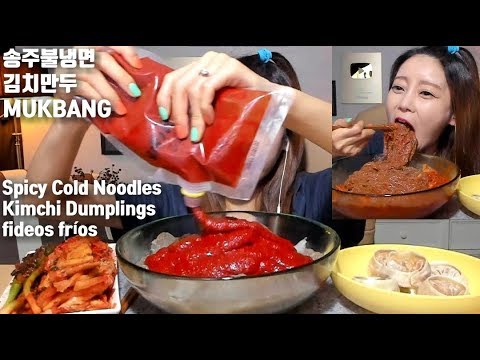
The next one is something I have never tried. It seems too spicy. It is called Songju Fire Naeongmyeon. A few of the pictures I've seen scare me a bit. In some pictures, the color of the sauce looks extremely bright red. Here is a picture of a Mukbang YouTuber eating it. Naeongmyeon literally means cold noodles, and there are various types like there is one with cold broth and one without broth and just sauce you mix and even Pyeongyang (North Korea) style naeongmyeon. The spiciest food I have ever had was actually naeongmyeon not the Sonju one though. I think the place I went to was in the Jamsil area in Korea. I searched it on Google and found it. It is called Haeju Naengmyeon. Don't add in too much of their red sauce. It is very spicy. I added too much, and I almost died, but it was still very good. I really want to go there again. It was also the best naengmyeon I've had in general. Their hot self-serve broth was also extremely good. It was perfect with the naengmyeon, and sometimes I think about how good it was and remember that I can't eat it unless I go to Korea.
This one isn't exactly traditionally Korean, but I still want to mention it since I'm sure only Korea has extremely spicy tonkatsu, or pork cutlet. Here's a picture.
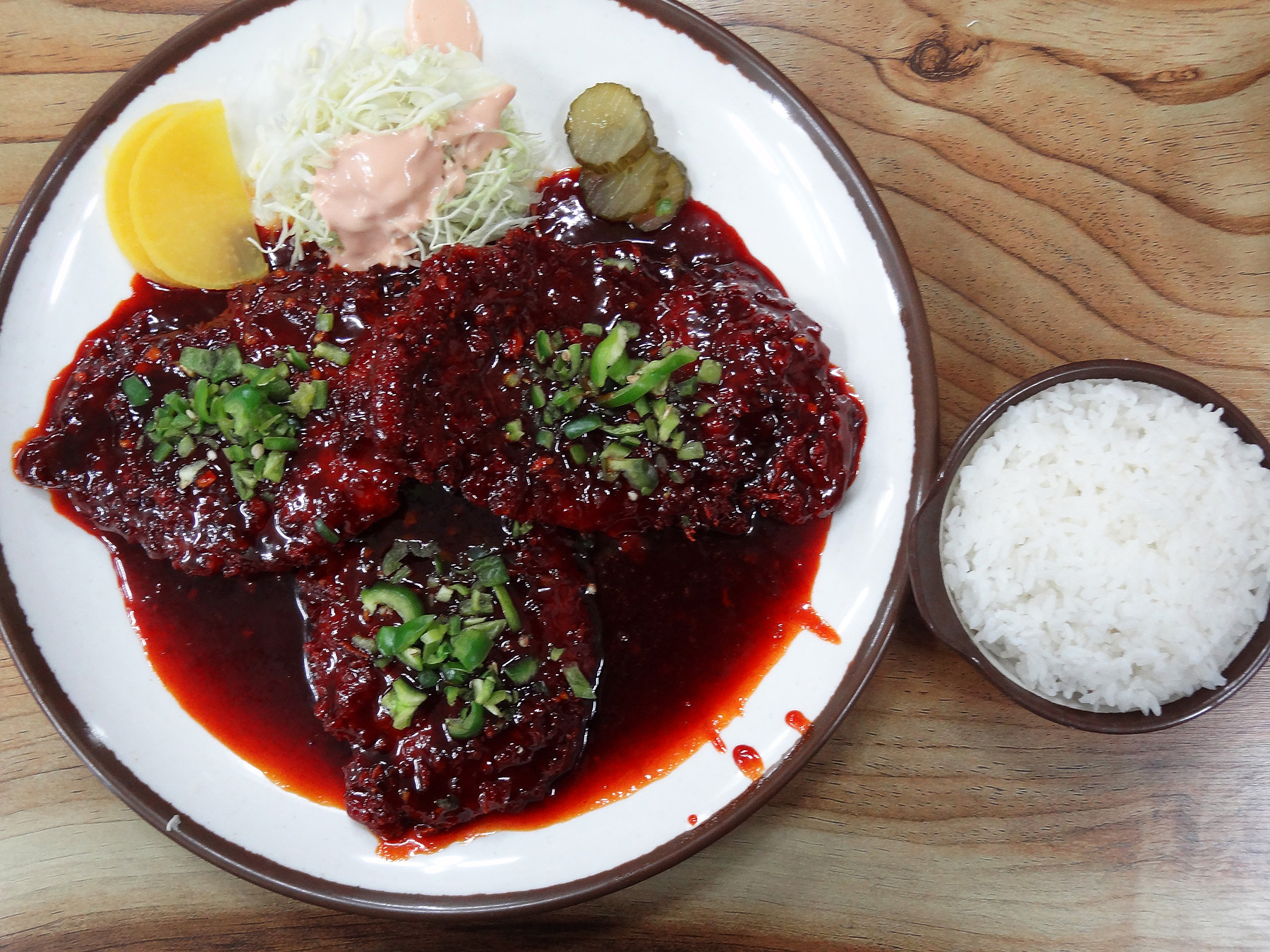
I don't think I could ever handle this.
Last week, we learned about house/furniture/appliance related vocabulary words such as bedroom, living room, kitchen, sink, bathtub, bed, vanity, mirror, lighting, fridge, microwave, and more. I was already familiar with a majority of them, but a few of them were words I somewhat knew but never used or heard often. I didn't realize that there were two ways to say sink. A sink in the bathroom is called 세면대, while a sink in the kitchen is called 싱크대. My family tends to just say 싱크, or sink for all the sinks, so I haven't really heard the Korean word for a bathroom sink that much. Another word that I didn't hear often was a full body mirror, which is 전신거울 in Korean. Also I was a bit surprised by the spelling for the Korean word for kitchen, 부엌. I didn't know that the second syllable ended in a ㅋ consonant. We also learned some vocabulary that describes texture like for some surface or skin and sometimes personality depending on the word. The ones that were new to me were the following: 푸석푸석하다 (dry), 꺼끌꺼끌하다 (scratchy), 맨들맨들하다 (smooth/shiny). We then watched a couple videos where Korean YouTubers give an apartment tour. Most of the vocabulary we learned was mentioned in the videos.
This week we talked about Korean food, what a typical meal looks like, and the variety of Korean dishes. We read an article explaining how the author followed Baek Jo Won (a very famous Korean chef)'s 김치찌개, or kimchi stew recipe. It included step by step instructions with some modifications and tips. We also watched a video on this recipe. It was actually Baek Jo Won's video on his YouTube channel. Talking about Korean food made me really miss homecooked Korean food.
I also practiced typing in Korean on my computer. I practiced typing this.
오렌지 립의 성패는 발색에 달렸다. 오렌지 톤의 워터 틴트로 입술 톤을 정돈하고, 립 펜슬로 입술 안쪽부터 꼼꼼히 덧발라 발색을 높인다. 마지막에 같은 색상의 아이섀도를 가볍게 찍어 바르면 발색은 물론 매트한 텍스처를 오래 지속시킬 수 있다. 여기에 여름에 돋보이는 아쿠아 블루 네일로 청량한 기운을 더할 것. 이때 한 손가락에만 페인트처럼 쨍한 녹색으로 포인트를주는 것도 좋은 방법이다.
Typing this took a very long time. Since I don't have the Hangul letters on my keyboard, it was really difficult because I didn't know which key was which. On a website called 10fastfingers, I got 13 WPM, which is really slow. Then on another day, I tried using this website. https://tadaktadak.co.kr/taja/sentence.html
You type sentence by sentence. This one feels like a game because if your accuracy is off, then your health goes down. Hopefully, this will help me become faster at typing in Korean.
Also during fall break, I decided to read more Korean webtoons, so I practice reading Korean even more. The webtoons are very interesting and fun to read, so I think it's a great idea for anyone who wants to practice reading in Korean more.
Last week in class after a brief review of the previous class's lesson, Jenna, our language partner, gave us a Korean weather forecast article. From the article, we learned many new vocabulary words that have some relation to weather. These words include nouns such as inland, daily range, clouds, air temperature, sea, fine dust, the lowest/the highest and some verbs like to fall/precipitate, to be expected, to forecast, and more. Even though I was familiar with many of these words, we also came across many other words that I normally don't use or saw for the first time. These words are the following: 지표 (the surface of the earth), 가시거리 (visibility/range of visibility), 유의하다 (to pay attention), 미만 (under/below/less than), 형성되다 (to be formed/built/developed), 대기 (atmosphere), 원활하다 (smooth/smoothly), 확산하다 (spread/disperse/diffuse), 농도 (concentration), 권역 (limited area), 천문조 (astronomical tide), 만조 (high tide), 저지되다 (be blocked), 침수 (flooding), 대비 (preparation). After reading it aloud and going over the article together, we answered some reading comprehension questions. Then we also watched some YouTube videos on weather forecasts.
I was very surprised that the article was only about ten sentences long. I didn't know that such a short article about weather would have so many new vocabulary words. I have realized how lacking my range of vocabulary is. It was great to learn more technical/scientific words, because those are the type of words I don't ever use in daily conversations.
This week the day we had class happened to fall on 개천절, or National Foundation Day, so we learned more about it for our lesson. It was on October 3rd, and it is believed to be the day of the traditional founding of Korea in 2333 B.C. Jenna explained to us the folktale of the founding of Korea, which is also the ancentry legend of god-like King Dangun, the founder. One day, a bear and a tiger prayed to Hwanung, the prince of the heavens, that they want to be human. Hawnung told them that if they want to become humans, they have to eat only garlic and mugwort inside a cave without sunlight for a hundred days. After twenty days, the tiger gave up and left, while the bear persevered and eventually become a woman. The bear/woman ended up marrying Hwanung and giving birth to a son named Dangun. Dangun Wanggeom became king and founded the kingdom of Gojosen, or ancient Joseon. We then watched a video that explained this story in Korean. This week's lesson was very interesting. I had not heard about National Foundation Day even though I think I heard the story with the bear and tiger before. It was nice to learn about the history of Korea.
We also review what we learned last week by reading another news weather article in Korean. This article used many of the same vocab words in the article from last week. This time though, I recognized the words we learned and made reading it much smoother. I think reading the vocabulary words in another article made it easier to remember.
I am an avid watcher of Korean TV, especially dramas. In fact, the only things I watch in general are YouTube, Korean dramas, and Korean variety shows. Here at school, I usually watch them while I eat to save time, but back at home, I watch with my family. Recently, the drama I have been watching since March of this year just finished. The drama in English is called “Mother of Mine,” while the literal translation from Korean is actually “My Prettiest Daughter in the World”. I think “prettiest” in this case is actually more like “precious” and not the physical aspect of it. I find the English title to be very interesting. “Mother of Mine” is from the perspective of the mother’s three daughters, while the Korean title is from the perspective of the mother. I do not know the intent behind flipping the title. Maybe the original title was too long, or maybe it is the difference in culture?
Anyway, this drama captures the importance of family in the Korean culture. The drama features Park Sunja, the mother who runs a seolleongtang, or ox bone soup restaurant alone and her three daughters. The oldest daughter, Kang Misun, is married with a daughter of her own and finds herself in many frustrating and difficult situations with her husband, daughter, and in-laws. She struggles with balancing a career with expectations and responsibilities of being a mom. The second daughter, Kang Miri, is a hardworking career woman who seems unapproachable and intimidating at work, but with her family, she’s completely different. Out of the three daughters, she truly expresses how much she loves her mom, who isn’t actually her real mom. As she engages in a relationship with her coworker, the son of the family who owns the company they work at, she ends up in a complicated situation where she finds her birth mother, who is actually the aunt (by marriage) of the man she loves. Lastly, the youngest daughter, while immature and lazy, was once a promising author, but had been in a writer’s block for years until she meets the son of her past editor/publisher. After somehow sealing a contract with him, she eventually writes a book about her mom and her sisters.
By watching this drama, you can learn about family in Korean culture. Koreans are generally very family-oriented. Parents’ primary goal is to see their children grow up to become more successful and educated than them, so most are devoted to their children’s success and well being. In the drama, the mother says how hard it was to send all three daughters to college all on her own with her restaurant. She takes care of her granddaughter, so her first daughter can go to work without upsetting her mother-in-law. She goes over to both her first two daughters’ apartments without them knowing in order to clean for them since they’re so busy. She also takes care of her youngest daughter who lives with her without a job.
This might be a huge spoiler, but when the mother is later diagnosed with end stage lung cancer, the daughters are shocked as the thought of her mother dying never crossed their minds. They realize how badly they treated their mom as they were so busy with their own lives. They feel an immense amount of guilt as they try to convince their mom to receive treatment, which only hurts her more. As I watched this drama, not only did I cry buckets of tears, but it made me realize how far my mom goes for me and she’s only becoming older and more tired. But overall, this drama was great and I highly recommend it.
Also this is a picture of seolleongtang. It tastes really good.
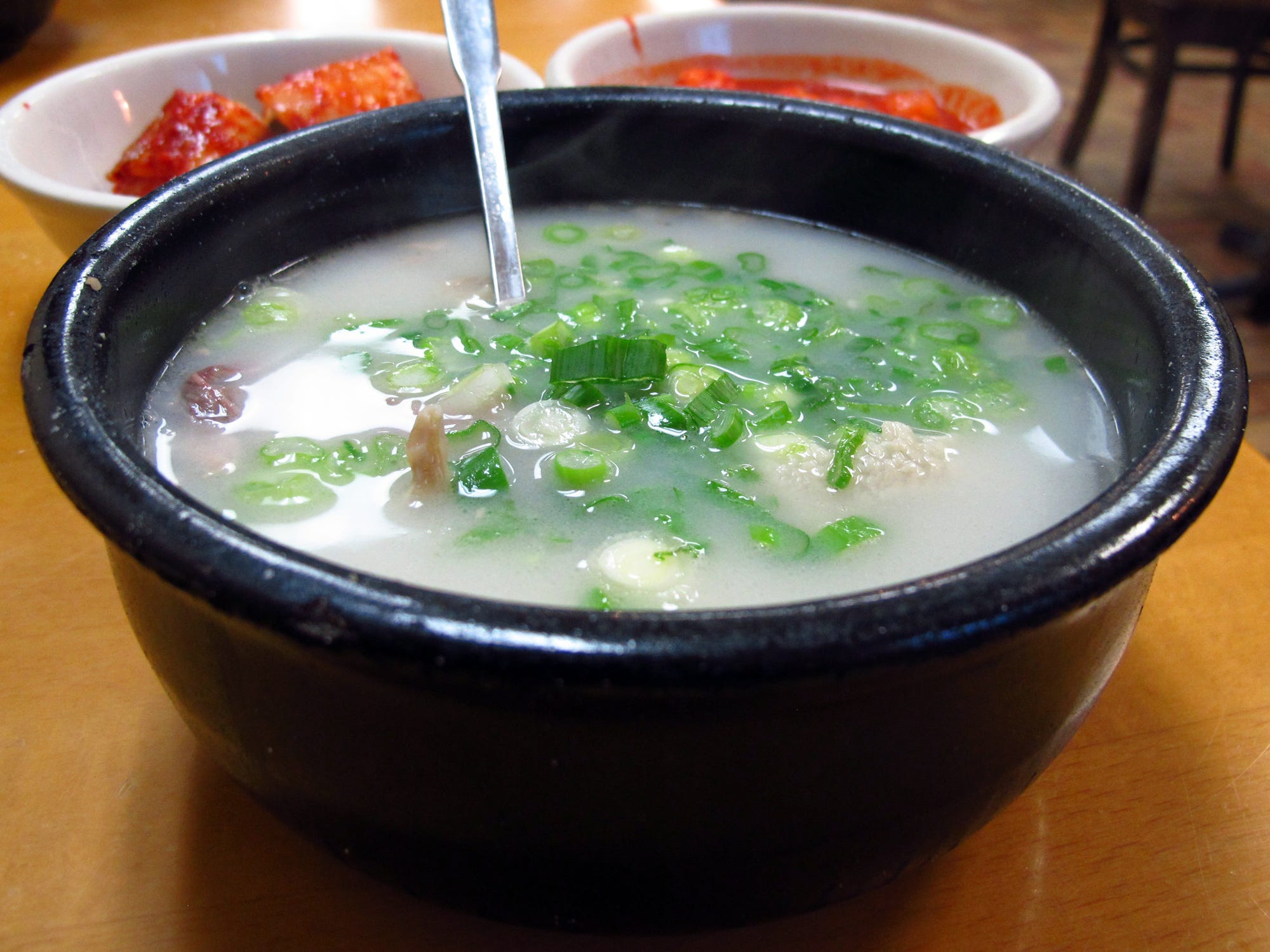
And here is a picture from the drama.

This week we had our first Korean lesson with our language partner. Since it was the first one, our language partner focused on teaching the basics. We started off learning how to introduce ourselves in Korean. This included saying the greeting and names. We practiced saying it aloud. Since I already knew how to introduce myself in Korean, I added other details in my introduction such as my age, where I came from, etc. Even though I can already speak Korean to a certain degree, speaking in Korean with those other than my family made me a little bit nervous. It seems a bit awkward and difficult to suddenly speak in another language especially when you are used to speaking in English with those people. But this is just the beginning, so I am sure that I will become adjusted to it soon.
After leaning self-introductions, we moved onto learning some vocabulary, which consisted of the Korean version of words like Korea, China, Japan, weather, cold, hot, warm, dog, cat, and more. I have already learned these words when I was a child, so this wasn’t much of a challenge, but watching Maggie, the other student in our class, also learn was an enjoyable experience.
After vocabulary, we learned basic grammar. The grammar structure was the Korean way of expressing am/is along with the negative counterpart and also like/dislike. Like earlier, this was anything particularly new, but we were told to write down some sentences using the grammar points, and it was a great refresher. I haven’t handwritten something in Korean since about 4 or five years ago. As I was writing down the sentences, I asked my language partner a question about the spelling of the word for vegetables. After she told me the correct spelling, she also explained that usually for most nouns, they typically use the ㅐ vowel instead of ㅔ , which is commonly used more for verbs. This was eyeopening. I never realized it. I was always terrible at writing in Korean because Korean spelling can be very confusing. Doing this grammar and writing exercise was easy yet meaningful.
Also, we watched a YouTube video clip from a Korean variety show. It incorporated some of the vocabulary we learned, and it was just a very funny video that showed natural Korean conversation. I thinking watching videos is a great way to learn a language because being able to listen to the language and consciously or even unconsciously pick up details about some word that was used, a pun/joke, etc. gives insight about the culture and also tests my level of understanding. Even though the video we watched had English subtitles, I realized that I would have understood it the same without them.
After the lesson was over, I talked with my language partner about learning about things I already knew from the lesson, and she decided that she would get some reading comprehension material for me. I also thought about checking one of the Korean books at the Global Studio. I think incorporating other learning materials with the class would be a good challenge and practice.
How have you started to write in the target language? Do you prefer to type or write free hand? Have you started to see patterns emerge in the structures between words, clauses, and sentences? What is the relationship between simple and complex sentences? How does your knowledge of parts of speech, government, and agreement affect your ability to communicate in written contexts? Provide a sample of several short meaningful writing exercises from your target language.
Since I am not currently in the actual Korean class, I haven’t been actually studying the language, but for writing, whenever I text my parents, I attempt to write the messages in Korean. Writing in Korean is my weakest area. Writing texts in Korean is hard because I haven’t truly learned the grammar. So, I tend to write short, casual sentences. I also rely heavily on autocorrect, because spelling in Korean is so confusing and hard.
Here are some examples of a few of my recent text messages with my mom.
하이 엄마 —> Hi mom
아이패드로 문자를 보냈다 ㅋㅋㅋ —> I sent that message with the iPad lol
(Context: I recently got a new iPad.)
Since I only practice Korean writing when I text, I have only been typing instead of also writing on paper. Writing free hand would help me remember what I learned better, but I don’t have a big reason to do so for now. Because I‘m taking Japanese, I noticed that its basic overall grammar structure is very similar to Korean’s. I realized that Korean also relies on patterns with particles that indicate the topic/subject, direct object, and even prepositions. When I speak in Korean, I tend to drop most of the particles, so practicing writing is a good way to force myself to use correct grammar. Knowing more about the parts of speech and agreement helps me to be more conscious of the grammar structure when speaking the language. I think Korean becomes very complex because there are many different phrases to express the same or similar thing or idea.
How do languages go extinct? Respond to the readings, and reflect on what happens when a language dies? How can linguists help preserve a language? Can a ‘dead’ language ever be brought back to life?
According to David Harrison, there are about 7000 languages, and half is expected to go extinct at a rate of one language every two weeks. Because 80% of the world's population speaks the major languages, which consist of about 84 languages, there are thousands of languages that are on the verge of becoming extinct. There are many reasons why a language can go extinct. One is because the speakers of a certain language are taken in by a dominant language or group. When there are no speakers left, the language is essentially dead. Passing down an obscure language to the next generations becomes difficult and unpredictable especially since children may choose to stick with another language. When a language dies, some aspects of a culture is lost. It is unfortunate to see a language that has ties to one's cultural identity, past, etc. die.
It is possible to help preserve a dying language and even resurrect a dead language. With the help of linguists, an American Indian tribe whose language, Siletz Dee-ni only had 5 speakers left, was able to create a dictionary that helped record and preserve the language. Now, it is being taught until sixth grade at a public charter school in Siletz.
While the true origin of the Korean language is debatable, some believe that it belongs to the Altaic language family, which includes Turkish, Mongolian, and Japanese. Korean was also influenced by Chinese even though it belongs to a different language family. Before the invention of the Hangeul writing system, which was created by King Sejong in 1443, Korean used Chinese characters. Because the sounds in Chinese and Korean were very different, the Chinese characters could not fully express all the sounds of Korean. The implementation of Hangeul, a phonetic writing system, gave the common people access to and ease in learning how to read and write and even later helped contribute to one of the world's highest literacy rates.
Korean definitely has traces from and similarities to Chinese and Japanese. For instance, I know my parents had to learn Chinese characters, or Hanja, which refers to the borrowed Chinese characters that have Korean pronunciation. In the past, Hanja was used in newspapers and scholarly papers. However, the use of Chinese characters has drastically declined. I think it's almost rarely used in a practical sense, but I do see them sometimes. I would see Hanja used in news broadcasts and on TV shows, occasionally using it for emphasis. Korean is also very similar to Japanese. Because I'm currently learning Japanese, I noticed just how similar they are. The basic grammar structures are essentially the same, and since Japanese is also heavily influenced by Chinese, many words sound almost the same. They both use a system of topic particles and the order of subject, object, and verb, and both have complex honorific systems.
The following quote gives a few examples of the striking similarities.
"The sentence ending particle ね (ne) has the exact same some sound and function as the Korean counterpart 네 (ne). The Japanese particle が (ga) corresponds with the particle 가 (ga) in function and sound. The honorific ending for questions in Japanese is か (ka), similar to ~까 (gga) in Korean."
Learning Japanese grammar and vocab was much easier for me since I knew some Korean, but learning Kanji, or the Chinese characters used in Japanese is very difficult. For the older generation in Korea, it would be even easier for them to learn Japanese because they have learned Hanja in school.
The sounds, words, writing systems, and etc. of Korean underwent many changes as time passed. At one point in the past, the Koreans and the Chinese were even able to understand each other through writing even though verbally they were different. Once Hangeul was created, Korean became less and less dependent on Chinese characters. Also, with the Japanese invasions, Korean was influenced by the Japanese language.
Since I am not taking the actual self-directed Korean language class this semester, I am not learning Korean, so it's difficult to say whether anything changed or not. But, after watching my PanOpto recording, I think I realized how ambitious I was because realistically, the tasks I mentioned would be hard to consistently complete especially with other classes and work. Even now, I haven't been able to practice and keep up with learning Korean. It's difficult to call my parents everyday, and when we do call each other, phone conversations are usually not that long. Also, I just don't need to speak the language here. It's interesting how sometimes I think I speak more Japanese than Korean. Even though I'm not actively learning through textbooks or with a teacher, I continue to watch Korean dramas and variety shows to immerse myself more into Korean culture. I also frequently watch Korean YouTubers and attempt to read more Korean comments. I think passively learning a language through entertainment can help one not only understand more of the language, but also the culture because language is the core of culture. By watching funny variety shows, you can learn about jokes and puns along with Korean humor. Through dramas, you can see what family relationships are like while learning the terms people use to call each other.
Learning through entertainment is enjoyable, but to really improve my communicative competence, I want to focus on grammatical competence and discourse competence. Learning passively and only listening to the language will only get you so far. To really use it, speaking is essential, so I want to learn more grammar and have a stronger foundation in order to speak fluently one day. Because I have never learned that much grammar, I realized that I tend to make more mistakes, sometimes questioning myself if what I said made sense or not or thinking about a different, simpler way to phrase my thoughts. I think knowing grammar would be very helpful for creating sentences and going farther than just simple conversations.
Even though I grew up surrounded by Korean culture, I've never learned about the differences between the Korean language in South Korea and that of North Korea. I've heard from my mom that my grandfather was forced to leave his family in North Korea in order to move down to South Korea, so I think this would be a good opportunity to learn more about the history and how the separation influenced the language. For my final presentation, I may want to dive a bit deeper into the spelling, grammar, vocabulary, and pronunciation differences between North and South Korea. As I research, I think the phonetic transcriptions we learned about in class would help.
This is a table of some words that North and South Korea pronounce differently.
And this is another table that gives some examples of the grammatical differences.
I think it's interesting to see how the language in both countries changed and developed over time.
Other topics I might want to do for my presentation are food, dialects, and maybe the differences between the Korean language of the past and today.
The Korean alphabet, Hangeul, consists of 24 letters: fourteen consonants and ten vowels. They are pieced together into blocks of syllables and produce a combined sound. For example, the "han" in Hangeul is a combination of the [h] consonant, [a] vowel, and the [n] consonant. There are sounds in Korean that do not exist in English, and there are also sounds in English that do not exist in Korean. A few English sounds that don't exist in Korean are /v/, /f/, and /r/. In Korean, the [v] sound is actually pronounced as a [b] sound. "Vitamin" would be pronounced "bitamin." The English [f] sound is pronounced as a [p] sound in Korean. Instead of "phone," it's pronounced like "pone." Since Korean has a [l/r] sound that's different from the English [r] sound, many native Koreans usually have a difficult time saying words like "girl." Also, because English doesn't have that [l/r] sound, many native English speakers struggle with it. Also, there are five Korean consonants that have a "double" form, which does not exist in English. For instance, the word "bul" ([b̥ul]) is different from "ppul" ([pul]) which is also different from "pul" ([pʰul]). The /pp/ is the double consonant of the /b/ sound.
Knowing more in depth about the sounds in Korean and learning the phonetic transcriptions will help me understand and improve my pronunciation. Even though I have some prior knowledge about the language, I still struggle with certain sounds. For example, I do not understand the difference between the /ae/ ([æ]) vowel and the /e/ ([e]) vowel. I also have trouble with /wae/ ([wæ]) and /we/ ([we]). They sound the same to me. I think paying more attention as I'm listening to Korean and going back to the basics and repeatedly practicing would help me improve.
