
Korean Mythology is a very interesting aspect of Korean culture. Although there are many similarities to neighboring cultures, Korean mythology is its own area that is frequently explored in media. There are heavy ties with Korean religion and its thoughts on gender roles and the afterlife so I thought it would be an interesting topic to delve into. This presentation goes into more depth than my previous look into Korean ghosts and I hope it will be interesting to you as well.
Victor Chen's Posts (35)
Sort by
There is little question why the South Korean beauty industry has been on the boom these last few decades. The rise of K-pop and globalization allows industry producers to innovate their products using new ingredients and push products with high-value commercial deals. The nearly $6 billion dollar domestic beauty industry is a reflection of the cultural shifts in South Korea but are these changes beneficial for the people or have the standards been warped so much by the materialistic market that the populace has become a victim of its own ideals.
South Korean women spend twice as much of their income on skin and beauty products than the American woman equivalent while South Korean men spend more than any other men in the world on these beauty products. This is a result of the myriad of advertisements that cover the view of commercial hubs like Myeong-dong, Seoul. The adverts usually have popular Korean celebrities showing off the products as the newest hot trend for the people to use. Thus, the mainstream beauty standard in South Korea is to have perfect skin and hair that looks like the celebrities. This also leads to extensive skin care regime with products claiming to fix or enhance your skin. I can not speak for the validity of every single product but I have heard about the popularity of South Korean skin products. In fact, many different people end up coming to South Korea to purchase these goods or buy South Korean exported goods online.
But South Korean beauty is not limited to skin care as more extreme options are actually pretty common. For example, cosmetic surgery is extremely prevalent in South Korea as the majority of South Korean women have had something augmented by the time they graduate university. Similar to the appeal of the South Korean commercial hubs, many people come to South Korea to have cosmetic surgery performed on them. It may seem a bit strange to other countries, but when the opportunity to change how one looks is so readily available, safe, and cheap, it is no surprise that many Koreans have embraced the opportunity. This is not to say that the entire society is welcome to these more extreme options however. People with tattoos are generally looks down upon as rebellious and anti-social and plastic surgery is often a controversy for the idols in the K-pop industry. In the big picture, South Korean society is pretty conservative so the beauty industry is in a weird place where many youths embrace it as a part of their lifestyle but the older generations scorn the industry.
The narrative that the celebrities and the cosmetics industry pushes is that looking good is essential and many people do not disagree. We see this happening everywhere in the world. However, right now the boom in the beauty industry has halted because of the pandemic so we may see the makeup sales stagnate enough that people's perceptions change. Though that is an unlikely outcome, it will be interesting to see how beauty standards in South Korea shift over time.
During these last few sessions, my language partner and I focused on reviewing the grammar that I had studied during the most recent chapter of the textbook. In addition, I was quizzed on sentence construction using the vocabulary of this chapter as well. Although I had a good idea of how to build the sentences, I still had to look back on my notes to remember the characters. I have had trouble memorizing the words and I should spend more time on the vocabulary. Besides reviewing the chapter grammar and vocabulary, we also recorded our podcast to review the work we have done this semester and it was fun to look back on these last few months. It is a bit sad since I will be graduating this year so I won't be able to participate in these sessions anymore but I am grateful to have found such a fun and helpful department for learning about linguistics, language, and Hangul. One of the things that I really enjoyed this semester with learning Korean was that we had a textbook to look into during lessons and studying. I found that last semester I spent a lot of time on worksheets, which was still really helpful but a textbook offers structure and direction that is invaluable. With that in mind, I really enjoyed this most recent chapter on purchasing goods. One of the main uses of a language is understanding cuisine and being able to apply the language in buying stuff. Learning about Korean currency was also quite interesting and required a bit of numbers as mentioned in the previous learning journal.
My language partner also learned the deep dive on Korean grammar as well and she commented on how the Korean particles was not something she thought about but just did naturally as a native speaker. It makes me wonder about what parts of the English language I take for granted as a native speaker and may be difficult or nearly impossible to distinguish for the English learners out there. Sometimes English words can differ only by a couple letters and can be confusing and I can see similar issues popping up when learning Korean.
I hope to continue learning Korean and applying it after graduation as learning it was quite fun. I know that my career most likely will not require the use of Korean but I initially picked it up as a way of supplementing my hobbies and interests in Korea comics and variety shows. Not to mention Korean music is becoming even more popular abroad so knowing the language may be interesting when the Billboard music list is filled with Korean Artists. I might also pick up another language after Korean and strive towards becoming a polyglot though that is wishful thinking because I do not have the motivation to learn that many languages without purpose. Although my experience in SDLC was limited because of the Covid-19 pandemic, I hope that future students here will get to experience the community of the department and the engaged learning that comes with studying face to face.
The idea of ghosts or spirits is a prevalent culture phenomenon in many countries in the 21st century and Korea is no exception. In Korean culture, ghosts or 귀신 (gwishin) are believed to be deceased who have not fulfilled their life's purpose or have unsettled grudges against the living. The idea of ghosts stems from the spiritual beliefs of Shamanism, a type of religion that is still actively practiced in Korea. Shamanistic rituals are often performs to appease these ghosts and help them past over to the figurative other side of the afterlife. There are typically four variants of ghosts that Korean culture depicts. These are "cheonyeo gwishin" (처녀귀신), “mongdal gwishin” (몽달귀신), mul gwishin (물귀신), and “dalgyal gwishin” (달걀귀신).
Cheonyeo gwishin are female virgin ghost that have passed without becoming a mother or having a husband. These ghosts are typically depicted as having pale white faces, blood red lips, white mourning gowns called "sobok" (소복), and their hair down. Korean women had it tough as their role in society was to serve her father, her husband, and her children. Although these ideas are fading, gwishin are representative of generations of belief in this idea.
The male equivalent of Cheonyeo gwishin are mongdal gwishin. These are male bachelors that led unfulfilled lives by not having a spouse. These are less common than the female ghost in media generally. Shamanistic rituals are performed to bring together these two ghosts to fulfill their lives spiritually and help them pass on to the afterlife.
Mul gwishin are water ghosts who died of drowning and are often depicted as lonely but spiteful spirits who try to pull the living into the water to die like them. The final type, the dalgyal gwishin, is the strangest of the bunch. It is an egg shaped ghost with no facial features or limbs that instantly kills anyone who looks at them.
Although these ghosts are most likely fictional, they still play a large role in Korean culture and are a reflection of the standards of Korean society. These ghosts demonstrate the importance of gender roles and of familial relations. Shamanism and the media continue to perpetuate the ideas of ghosts in Korean society.
Two recent Korean shows that focused on ghosts or spirits are Hey Ghost, Lets Fight! and Hotel Del Luna. Hey Ghost, Let's Fight! follows the story of the young man who has the ability to see ghosts and the ability to physically interact with them. He fights ghost at the request of others for money and soon accepts the help of a ghost to fight along side him against other ghosts. Hotel Del Luna follows the story of a ghost hotel in the middle of Seoul and its ill-mannered owner who was cursed to manage this hotel because of a crime she committed but does not remember. Each show illustrates some of these ghosts variants and makes the idea of ghosts humorous but scary at times. I would highly recommend either of these shows to anyone who enjoys a good rom-com with some Korean ghosts to add!
Since last time I have continued to another chapter that focuses on the process of purchasing goods in Korean. This new section introduces some vocabulary related to currency, food, and counting. This section also touched briefly on the sentence construction of polite phrases. One interesting fact about the Korean language is that it has two different number systems that are used in counting. The native Korean number system is commonly used for smaller units of counting, whereas the Sino-Korean number system is used for much larger units. This generally starts at around 100. I drew comparisons here with the process of counting time in Korean as when people count time in Korean, both numerical systems are used. For counting currency, the Korean currency system has four types of coins (10 won, 50, won, 100 won, and 500 won) and three kinds of notes (1,000 won, 5,000 won, and 10,000 won). The conversion rate between Korean won and USD is about 1 to 1000 so 1,000 won would be about $1 and 500 won is about $0.50. The actual rate at the moment for accuracy is $1 = 1,129.00 Korean won. The process of creating numbers in Korean is actually pretty straight forward as it is just combining smaller numbers characters with the larger number characters. For example, the number 3 in Korean is 삼 (pronounced sam) and the number 100 in Korean is 백 (pronounced bek). To say the number 300, all you have to do is combine 3 and 100 like so, 삼백 (pronounced sambek). This process carries over linearly to higher degrees of numbers. It was actually refreshing to see and perform number construction in another language because I do not really think about it in English. I remember that this simple process ties back to the initial intentions of the language in making it as convenient and straightforward as possible, especially in modern times. Although having two number systems still is a bit confusing.
One interesting thing I learned from this section is that when counting units, the Korean language has a specific word to enumerate different things. This is similar to the English language where we refer to socks as pairs of socks when implying more than one sock. In Korean, pairs would be 켤레. The sentence structure would be socks + count + pair (켤레) in Korean. Additionally, the Korean language has a general enumeration word 개 (pronounced ge), for counting things that do not have a unique enumerator.

Parasite, or 기생충 in Korean is a highly acclaimed South Korean movie directed by Bong Joon-ho who co-wrote the film with Han Jin-won. The film explores the issue of class disparity in South Korea by following the fictional life of a poor family that infiltrates the home of a rich family as unrelated individuals. Parasite uses a mix of dark humor and thrill that keeps the audience on their toes with anticipation. No spoilers in here because it is really a film to experience first-hand. What is phenomenal about this film however is how well received it was worldwide. Parasite received the Palme d'Or, the highest award at the Cannes Film Festival. The Cannes Film Festival is one of the most, if not the most prestigious events globally and the fact that a South Korean film won this award was publicized greatly. Parasite also won numerous and spanning victories at the Academy Awards. This movie was also considered one of the best movies of 2019 by many critics and the common audience, with a nearly perfect score on Rotten Tomatoes. Its box office numbers were also fantastic as it grossed over $258 million worldwide despite only having a budget of about $15 million. Despite all the hype about the awards and recognition that both the film and the director received in 2019, the real talking point here is the subject of the film. Social classes are something that is often explored in films so Parasite is not exactly original in that respect. In fact, the director Bong Joon-ho also directed Snowpiercer, an American Film from 2013 that showed the consequences of oppression and rebellion. Parasite seems to be an attempt to carry the success of Snowpiercer to the South Korean market in a relatable way. Not relatable in that every viewer has a magnificent estate or is in crippling poverty, but to illustrate the subtle struggle between the wealthy and the poor in a way that was not possible with the dystopian plot driving Snowpiercer. It is no surprise that the narrative that Bong Joon-ho presented in Parasite has some mass appeal because South Korea has growing economic inequality despite being one of the most equal countries in the world. This issue has been exacerbated by the Covid-19 pandemic all around the globe and South Korea is no exception.
One of the main things that stands out in Parasite is the fantastic action sequences and the music. There is a famous scene in this movie that really demonstrates the effectiveness of professional directing in influencing the audience's emotions. There are various YouTube videos that break down the masterpiece that is this sequence that I would highly suggest anyone interested to watch after viewing Parasite. In conclusion, Parasite is a fantastic movie that tackles the issue of economic inequality in South Korea using dark humor and thriller scenes that exploded into the global film scene in 2019 by winning multiple prestigious awards at a myriad of film festivals/ceremonies.
It has been a month since my last learning journal and I have learned quite a bit about the Korean language and culture during this time. Although I spent my first two weeks reviewing content that I learned the previous semester, that did not stop me from learning new things weekly. One of the main differences between this semester and the previous was that I now have a dedicated textbook for learning Korean and specific topics in the Korean language. This textbook is called Alive Korean: Speaking Korean for Beginners. My language partner, Jannette gave me a digital copy of this textbook so that I could follow along during lessons and also study independently. I have found that having a textbook, though digital, can be very useful for planning ahead in what I want to learn and is useful in leading discussions. Although it has become a sort of guidebook, I don't want everything I learn to solely originate from that book. What I have learned from the book has been self-introductions, countries, places, and prepositions, in that order. Self introductions have been more complex than just giving a name, we went over the specific occupations that might be mentioned in this scenario. Regarding countries, we went over the appropriate Korean names for the U.S, France, Russia, China, Japan, and Korea. Some occupations we went over were cooks, teacher, and doctors. During this self-introduction snippet, I found that combining these vocabularies in the sentences helped me retain the memory of them much better. In terms of prepositions, the textbook provided a diagram with a sphere in different positions around a hollow cube. For prepositions, I found that the easiest way to remember them was to map a pattern of prepositions in my head while imagining the sphere's position around the cube. This pattern was above, inside, below, beside, in front, behind, and between in Korean. The chapter about prepositions also introduced more grammar to complement this sentence formation and new relevant vocabulary that focused on furniture and items typically found within a bedroom. The next chapter that I am currently starting on will focus on purchasing items so there will be even more interesting sentences to build.
During this month I have also zoom chatted with other students learning Korean this semester with Jannette. I have found the experience to be quite fun and engaging. We have watched Sky Castle, a Korean drama, together, and have had Korean Fried Chicken as a cultural experience of sorts. A topic of concern has been the general increase of hate crimes against Asians and Pacific Islanders in America, not to mention the ongoing pandemic and how it had affected our lives on campus. Although these are trying times, I hope we will persevere through it and I hope that people will embrace cultures like the activity in the SDLC program. Looking forward to learning more Korean during this next month and onward!
P.S.: I wonder if Korean BBQ would be a good experience for SDLC students once this pandemic ends. I won't be here to experience that but I sounds like fun.
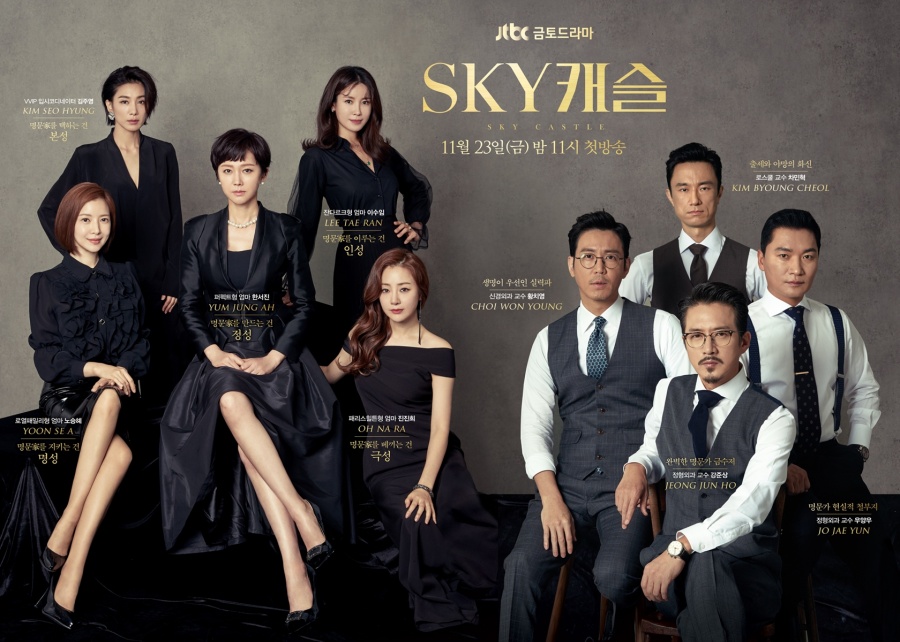
Sky Castle or SKY 캐슬 is a South Korean Drama that focuses on the politics and interpersonal relations between several families that live at a luxury neighborhood aptly named Sky Castle. Each parent wants their children to succeed at life and improve their standing and reputation at any costs. The neighborhood is one that is limited even among the higher class citizens and wealth itself is not sufficient to join their ranks. The drama explores how South Korean culture glorifies wealth and encourages cutthroat behavior among the youth in education. I currently have only watched the 1st episode but the drama grasped my attention at nearly every moment. But not every person in the show revolves their life around this wealth/politics; some of the younger kids have shown their discontent with the status quo and have considered running away to escape this overbearing lifestyle. On the contrary, some kids have been shaped by this environment so much that they really do believe in the traditional definitions of success that the parents and the community emanate. This disparity between the young opinions is a reflection of greater conflict in South Korean society. Although this is just a drama, the situations that it depicts are actually reality for many Korean students. Their lives are determined by the education that they receive and the connections they have. Perhaps because of this societal pressure, South Korea has one of the highest suicide rates in the world. In the show, parents try to get their kids into Seoul National University, the best university in the country. Although they themselves are wealthy professors and doctors, they also have expectations to raise a family that is successful through numerous generations. We see in the first episode how these unrealistic expectations go back to even before their marriages and creates a tumultuous relationship to watch. Their materialistic mindsets contrast with the people who live out more simple lives albeit less comfortable financially. The drama briefly touches on this satirical nature of the neighborhood in that one of the housewives is confused that someone outside of their community is unwilling to communicate with them despite the assumed benefits of such connections.
I am looking forward to seeing where Sky Castle goes plot wise since the first episode was left on quite the cliffhanger. Additionally my expectations for this drama are quite high because it was recommended by many other people and it is the second highest rated Korean drama in cable television history. As a result of its commercial success, Sky Castle is the recipient of many awards ranging from Best Director to Best Drama Series. Sky Castle is currently a drama that I am watching with my learning partners so that we can dissect the drama and see what parts of relevant and reflective of South Korean culture. I will try to avoid spoilers and justly will not reveal anything significant in this review but I would suggest anyone who is studying Korean or just interested to check out Sky Castle.
I spent the first two weeks of this new semester reviewing my Korean notes regarding grammar and vocabulary that I had learned last semester. Although I am rusty with my Korean, reviewing my notes actually did get me up to speed quickly. I noticed some of the issues that I still need to work on for this semester to truly gain some fluency and proficiency in Korean. One of these is sentence construction. I spent most of last semester learning the intricate grammar rules and vocabulary in Korean and I did not do a lot of sentence construction or comprehension. I hope to expand greatly in this respect this semester and will try to increase the amount of spoken Korean during my learning sessions with Jannette. I also need to heavily practice Korean particles in conjunction with sentence construction.
I recently have been reading Korean webtoons on Naver to practice my reading comprehension but I still need to use translators to understand the meaning of most phrases. This significantly slows down my reading speed; this is a good thing for comprehension. But, I still find that retaining most words in my vocab difficult. I have seen phrases that I studied last semester showing up in the texts, which is nice. Spoken Korean is still a blur though since it takes me too much time to understand what native speakers say sometimes.
I did plan on reviewing Korean earlier during winter break using the KORLINK app but I found it difficult to do so without a Korean speaker to interact with weekly. Weekly sessions helped to remind me why I learning Korean could be so fun. I initially started to learn because I saw it as a instrument for enhancing my hobbies in Korean culture but interacting with native speakers in their own language turned out to be pretty fun. One thing that I did pick up recently was texting in Korean. The Korean keyboard apps are pretty intuitive and I had lots of fun texting Somyung and Jannette in Korean. Typing Korean isn't nearly as easy and writing it though and I found handwriting to be pretty forgiving when it came to autocomplete. One strategy that I will continue doing this semester is writing down vocab and phrases that I can look back on in my notebook. Many of the insights that I had last semester carried over well in that regard.
I spent the first learning session with Jannette introducing ourselves and our background and interest in Korean. She is a native speaker that moved to America in her youth so I am grateful to learn from her and her expertise. Although Covid makes meeting up extremely difficult, we still plan to have two sessions per week. One session will be one-on-one and the other will be in a group setting. This is for scheduling convenience and also testing the ability to communicate in Korean in a classroom like setting. We will also be delving more into Korean history and culture during these group sessions. This will extend into the authentic cultural assignments for this SDLC.

Solo Leveling or 나 혼자만 레벨업 (Na Honjaman Rebereop) is a South Korean web novel written by Chugong. The story follows Sung Jin-woo, the weakest hunter in all of South Korea, who supposedly died but awoke with newfound powers. Like Sung Jin-woo, others hunters have supernatural abilities that they use to seal portals that appear around the world. However, Sung Jin-woo's powers seem to follow a video game system where he can complete quests for rewards, items, weapons, and information. We observe as Sung Jin-woo investigates this power in depth and how this transformation affects his personal life and the world of hunters in general. I won't spoil any plot points so if you want to see how this story pans out Solo Leveling is available to read in Korean at Kakao Page. The interesting thing is that the web novel itself has been adapted into a webtoon/digital comic on Kakao Page and thus is much more visually enticing. The web novel itself is quite good and is far ahead of the current web comic. Solo Leveling is also available in English on certain websites. The official source for the English translation is Tappytoon Comics. So even if there are people here that are not learning Korean, Solo Leveling is still a good read.
As for why I chose to cover Solo Leveling for my authentic cultural artifact, I really enjoyed exploring language through entertainment. What better way to stay engaged in a language then if the content itself is engaging. Although most of my reading of Solo Leveling had been in English ( I read this before starting Korean SDLC ), I intend to reread Solo Leveling using the Korean that I have built up so far. It will take more time to process the dialogue since I will have to jump to a translation machine every once in a while. Despite that, I think that I can learn Korean using this web novel/comic.
One of the reasons that I enjoyed Solo Leveling was because of its fantastic art direction. Their illustrations are done by Dubu (Redice Studio). This studio works on a variety of manhwas and has shown great work consistently. The action sequences have dynamic long screen spreads that are often background worthy. The story, although not original, is quite interesting in how it brings the world of video games into an already fantastical world. This combinations feels very much like a fun thought experiment about what we would do if we had a second chance at life. I am sure many people have entertained this idea in their daydreams and Solo Leveling takes that idea and adds fantastic visuals to our vague imaginations. I would say that the weakest part of this work is the characters in that they aren't that complex. There is not anything ground breaking in how they handle characters and the premise does feel a bit recycled. Despite this, I still find myself wanting more content every week. I would suggest Solo Leveling to anyone who enjoys a power fantasy story and appreciates clean digital art.
During this session, So Myung and I mostly worked on the final podcast interview. We outlined the topics that we wanted to cover that we studied over the course of the semester into a Google Docs and took time from the meeting to record our podcast. It was quite fun to go over all the topics that we had touched on and I was surprised by how much content we covered. We mostly went over topics chronologically and focused on the subjects that we really enjoyed. Of course my favorite section was the section where we talked about Korean cuisine. That is why I made my final cultural presentation in SDLC 105 about Korean cuisine. It was really interesting to hear So Myung's experience in teaching Korean and what she enjoyed about the process and what topics really piqued her interest. If I remember correctly, her favorite topic was covering the Korean number systems (there are two of which) and the Korean time system. These two ideas go hand in hand since the Korean time system utilizes both Korean number systems. She mentioned that her presentation was on Korean number systems and it was fun for her to revisit her previous presentations for information and she was ecstatic that a student was adamant on learning the complex Korean number systems. I did not shy away from this topic since I knew that numbers was a fundamental topic necessary for fluency in a language. Even if the Korean number systems made little sense at first, it was very fun to learn about its complexities.
Besides the podcast, we also talked about what Korean dramas we have been getting into. I have noticed that this is a popular topic in the Ning Blog posts (some of it is just me giving reviews lol). We mentioned Hospital Playlist and the Reply series as possible suggestions for me to watch in terms of just entertainment and I suggested Kingdom, which I have already done so in my blog as both a horror thriller and also an educational piece on historical Korean politics.
Presentation on Cultural significance of Korean Cuisine and introduces a few traditional Korean foods.
Sources in slides.

An unexpected addition to the Netflix library is Kingdom (킹덤), a fictional historical horror thriller set during the Joseon Period after Japanese invasions in the 1590s. The series is the first Korean Netflix Original and is based on a Korean web comic called Kingdom of the Gods. Although Kingdom is a zombie thriller, do not let that put you off. It masterfully explores the dynamics of political crises in Korea during the time of kings and also delves into the nuances of class struggles. When dealing with a zombie outbreak, there will inevitably be a discussion regarding who deserves to survive, after all this is one of the most compelling questions that humans must face in the time of extreme crisis. Kingdom takes that idea and pushes it to its limits by combining it with challenges for the throne in Korea. Survival is not between small groups of people, the antagonist, Lord Cho Hak-ju, is willing to sacrifice the populace to steal the throne from the Crown prince, Lee Chang. Thus this amalgamation of themes ends up being very similar to Game of Thrones, which I am sure most people will have heard of. The zombies end up becoming a tool of political conflict and creates a very interesting experience for the audience.
The main value that Kingdom offers is not found in the fantasy elements but in how Korean politics worked during the Joseon period. It is a good introductory media for Korean learners that is both entertaining to watch and also educational if you ignore the guts and blood lol. In my opinion, Kingdom is a fantastic watch that is an authentic cultural artifact that exceeds quality expectations. Most zombie thrillers are pretty bland when it comes to story but Kingdom does a fantastic job of fleshing out Korea in the Joseon period, and covers a wide range of character perspectives that keep the experience fresh. One criticism of this show is how sometimes the characters have plot armor and deus ex machina becomes a problem as the series progresses. This is a necessary issue with horror thrillers though since keeping the protagonists alive is necessary for story purposes. At times the situation becomes a bit unbelievable despite the fantastical nature of the show. I won't reveal any spoilers for this critic though.
Also despite that Netflix produced this show, the actors are all professional Korean native actors. It is not a bastardization of source material like Dragon Ball Evolution. Thus, the performance and audio is basically a typical Korean drama but with more CG. Unsurprisingly, Kingdom received critical acclaim for its fantastic visual effects, acting, and writing. It was nominated for Best Drama at the 56th Baeksang Arts Awards, a major awards ceremony in South Korea, and also won numerous awards at the 2nd Asia Contents Awards.
There are currently two seasons released on Netflix which currently conclude its story but a special episode called Kingdom: Ashin of the North is set to be released in 2021.
There was a lot that we covered during these two weeks. One of the most important topics we covered was the Korean number system. This was quite a challenge since Korea has TWO number systems that they use for different contexts. As someone who has only ever used one number system, there was a culture shock to me. Korea uses the Sino Korean number system for dates, money, time, addresses, numbers greater than 100, and phone numbers. It uses Native Korean for numbers of occurrences, counting, and ages. That was quite the mouthful and I definitely have to practice this over time. During the lesson, Somyung and I practiced speaking, reading, and writing the numbers. We did exercises such as telling the time and also telling each other our birthdays in Korean.
In addition to the number system, I also learned some more vocab about transportation and common items such as glasses or mask. One interesting thing is that the word 자 is used in both bicycle and car and independently already means car. A bit of redundancy here but no problem..
The next big topic that we dived into was expressions that are commonly used conversationally. This mainly came in the form of expressing emotions. Some examples of these are happy, anxious, tired, busy, sad. We also reviewed some more extreme emotions that built on the basic expressions. From these expressions we also learned how questions are the same as statements about oneself except for the tone of the speaker at the end of the expression. Simply with an inquisitive tone will do in expressing a question. This can be done in English as well but people don't usually do this.
If I received a research grant to conduct a linguistic study of Korea and Hangul I would not know what to do with it. But if I had to do this research I would most likely focus on how the culinary world and Korean language are intermingled and how the culture of Korea is defined by cuisine. This is actually a pretty common approach to culture; after all food is an accessible avenue to experiencing a culture. In order to tie this back to linguistic studies, I would have to see how language plays a role in food in Korea. There are many YouTube channels that have done this, such as Strictly Dumpling and Korean Englishman. These channels sometimes explore Korean cuisine from the perspective of a foreigner, which is where my perspective lies. By exploring Korean culture through food, I have learned how certain aspects of Korea come to light. Some examples of these are the need for pickling food and the focus on convenience.
Going back to the prompt, if I had a research grant, visiting South Korea would be a no-brainer. In order to really understand the culture and conduct a linguistic study, the researcher would have to be there in person. When it comes to implementing different structural components presented in class, I am not really sure how syntax and semantics will come into play. Perhaps there may be some underlying linguistic structures that are found in cuisine vocabulary, such as in French. I am not sure but if I had a research grant, this may be worth exploring.
Another part of Korean culture worth exploring is how it is affected by its neighbors, especially when it comes to cuisine. Since the main theme of this research seems to be tied to the next presentation, I am trying to connect these prompts as well as possible. Further research will reveal some important things to be learned from connecting Korean culture, linguistics and cuisine.
I have started to write in Korean by keeping a notebook where I practice writing down vocabulary and sentences or phrases. I prefer to write in freehand since it allows me to practice my stroke order. I have started to notice patterns emerging in the structures between words, clauses, and sentences. One such pattern is the fact that certain Korean words are commonly used in formal and informal contexts. The character 요 is commonly used at the end of formal phrases. I did not notice any explicit patterns in the words of a specific topic. Even though I learned a lot of vocabulary topic by topic there has not been an immediate connection in what letters are used. The relationship between simple and complex sentences can often be just an omission of certain words in the sentences even though the overall meaning is the same. Thus, the complex sentences can be stated more succinctly. I have not made any complex sentences on my own since most of my sentence building has been done in the conversational introductions or one off phrases. Knowledge regarding parts of speech, government, and agreement have been essential in communicating in written contexts because grammar is fundamental to sentence construction.
Some short meaningful writing exercises from Korean that I have recently worked on are telling time, naming the body part, introducing oneself, naming the animal, the date, and my favorite: naming a food. :0
During these past two weeks I learned about the complexities of the Korean language regarding the names of relatives. One thing that greatly differs between Korean and English is that the relatives have different names depending on which side of the family they are on. This process goes all the way back to the grandpa and grandma status from what I have learned about.
Another topic that we touched on again was the importance of conversational Korean phrases. I learned some essential phrases such as excuse me and you are welcome. Though it is interesting that you’re welcome is implied in Korean and rarely used. This is similar to how I already speak so that was nice. The conversational phrases are also affected by who you are speaking to. The informal and formal usages are extremely important here as to complement the prose of the person you are talking with. One aspect of Korean culture that naturally arose from this conversation is the ritual that Koreans have before eating a meal. They often say ‘I will enjoy this food’ and ‘I have enjoyed this food’, respectively before and after eating a meal. This process is absent in American culture and in Chinese culture to my knowledge but is present in Japanese culture though it is out of my scope of study. We also learned how to say it's delicious and it is not particularly good. This is especially important as I can use the phrase in practice during a meal. I extrapolated from this to learn what tastes bad was in Korean.
Another topic that I really enjoyed learning about was food. I think that food is an essential part of understanding a culture and by extension a language. Additionally, I was hungry so learning about food helped prepare me for lunch. We learned about the basic types of food such as meat, rice, noodles, egg, vegetables, and more. A couple of interesting facts here is that the side dishes are very common in Korean meals and are often irreplaceable. Additionally, some important words that we dived into are red chili paste and salted seafood. Thus I learned the importance of rice, spice, and seafood in Korean cuisine. In terms of learning planning, food is an effective avenue of learning a language since it is useful anytime you go out to eat that culture’ food. It is a bit sad that right now eating out is not appropriate for health guidelines but I hope that next semester there are more opportunities to use food vocabulary to study Korean. In line with that, I heard that in previous years language partners would go out and eat together to study that culture’s cuisine and practice the language they were studying. I hope that Somyung and I can share a Korean meal before I graduate next semester.
So far repetition has been an effective way of keeping up with my growing list of vocabulary. Although I can’t use all of them, slowly I will incorporate certain words into my Korean inventory.
Languages go extinct when there is no one left to speak it conversationally and documentation of the language becomes sparse. One point of interest on this is that many speakers of dying languages are elderly and the language tends to degenerate with the speaker’s health. When a language dies it is quite difficult for it to recover since oral teaching is significant when it comes to linguistics. One technique that has become prevalent for languages is to record one’s language phrases and send them online. This has happened with American Indian Languages like the one mentioned in the New York Times article. Initially the language recordings were limited to those who belonged to the tribe but by sending the audio online, the tribe and recorder learned how much of an interest there was to learn languages abroad. However, the article did note that just understanding how to say a few phrases in a language does not constitute a speaker status since competency is lacking in such a case. Although recording phrases and the language as a whole is a way for linguists to help preserve a language, it is not entirely sufficient because there are ideas that can not be expressed simply through speech. Things like grammatical rules can fall into the category of ideas that require a more complex perspective to understand than simple audio recordings. Another way linguists can help preservice languages is to create educational text alongside these audio recordings which requires significant effort and luck because many dying languages are difficult to learn in the first place because the speakers are ill elderly. One idea is that languages can consume each other to create hybrid languages but overall reduce the number of languages out there or cause language to go extinct as a result. This may be more common in more centralized areas as the need for a unified system exacerbates.
A dead language can be brought back to life given that there were resources left behind by the original speakers and enough interest or requirement to speak that dead language. The American Indian language that was supposed to die has recovered slightly but completely dead languages require those complex resources to revive them. Some efforts currently underway to document linguistic diversity would be the work of linguists like David Harrison and also the enabling of diverse foreign language options in schools. One thing that was mentioned that was quite interesting was the education system stifled the development of dying languages. Since there were fewer speakers in a language, often schools would not offer certain languages despite having a language requirement. I understand that personally as I witnessed how few options students were given in high school and middle school regarding language choices. Even here in UR, there are only a few languages that are not in the independent language student program that I am sure many students would appreciate the opportunity to learn. Thus programs like the Self Directed Language Acquisition Program also help to document linguistic diversity here.
