
Justin Park's Posts (32)
Sort by
One final notable movie that me and my partner watched this month is the popular 살인의 추억 (Memories of Murder) by Bong Joon-Ho. Released in 2003, the movie is a black comedy, crime drama based on the true story of the Hwaseong serial murders that occurred in the 1980s. Set in a rural town, the film follows two detectives, the seasoned Park Doo-man and the more methodical Seo Tae-yoon, as they investigate a series of brutal murders of young women. Their investigation is continuously hindered by the lack of technology and their own stupidity. The murders continue as they investigate, causing frustration and desperation to build within the detectives. The film goes into the themes of obsession, guilt, and of course the effects of the serial murders. In the end, the killer’s identity is tragic and shocking.
Believe it or not, the movie, like mentioned above, is based on the true serial murders in Hwaseong conducted by Lee Choon-jae. These murders were the first serial murders in Korea, and were unsolved for years until very recently in 2019. The way the crime was solved was also by chance and luck.
The film may be a murder mystery in the 1980s, but it also provides a deep insight into the Korean world during that period and how vastly different it was. Firstly, it shows the rural side of Korea that many people do not know about and how isolated/”not cared for” it was back then. Nowadays in Korea, crimes are solved at a significantly higher rate than the west (specifically the US) because of the presence of security cameras everywhere. But this wasn’t the case back then, especially in a rural setting. Thus, it made it much harder to investigate the serial murders properly. Overall, it shows just how far the country has gotten within the 20+ years between the actual murders and the film’s release.
In Bong Joon-Ho’s signature style, the film starts off as a black comedy which is purposeful to create a lighter mood despite the situation in hand. In the middle, this tone rapidly switches to a very dark, grim, and serious tone. As mentioned before, this is purposeful to let the audience truly understand how serious the situation is. Innocent lives are being lost because of the detectives’ carelessness. This makes people think how sad these series of crimes were in reality back when technology and knowledge was limited, especially in South Korea which was still very far behind the Western world.
Without spoiling, the ending scene may be one of the most chilling and well done endings.
A figure that many people might know about in Korea is 신사임당 (Shin Saimdang). Real name 신인선 (Shin In-seon) and also known as 어진 (Eojin: Wise Mother) was a female Korean artist, writer, calligraphist, and poet during the Joseon Dynasty. She was born in 1504 and was regarded as a model for her Confucian ideals on women, the main belief system in Korea during the Joseon Dynasty.
However, she’s mostly known as being the devoted mother of her son 이이 (Yi I), who became one of the most prominent Confucian scholars of the Joseon Dynasty. His mother was able to set a strong foundation for Confucian values, emphasizing the importance of education, moral integrity, and piety. Her teachings to him provided the ethical framework that guided Yi I's personal and intellectual development. Shin Saimdang's own artistic talents also inspired Yi I and fostered his appreciation for the natural world. Her paintings and calligraphy likely influenced his own artistic sensibilities and aesthetic philosophy as he became a scholar.
Furthermore, Shin Saimdang was able to influence women in Korean Confucianism during the time. Through her persistence, commitment to education, and artistic achievements, she challenged traditional gender roles and stereotypes, demonstrating that women could maintain Confucian values while pursuing intellectual and creative achievements as well. As a devoted mother, she imparted Confucian ethics of piety and family harmony to her children, emphasizing the importance of moral responsibility and respect for elders. However, while doing this she was able to break through with her work in art and poems. Part of this was because she had no brothers, allowing her to live at her father’s home who helped and taught her how to do these things.
Shin Saimdang's legacy continues to be celebrated in South Korea, where she is revered as a national icon and an inspiration for women in the arts and academia. She has been honored on South Korean currency, and her image is depicted on the 50,000 won bill. In fact, her son Yi I is also on the Korean paper currency as the 1000 won bill. On the back of the currency, her art work is also displayed, enabling people to remember her not as just the mother of Yi I, but also as someone who was able to be independent and choose her own life. Additionally, her life and achievements have been portrayed in various works of literature, film, and television, further cementing her place in Korean cultural history.
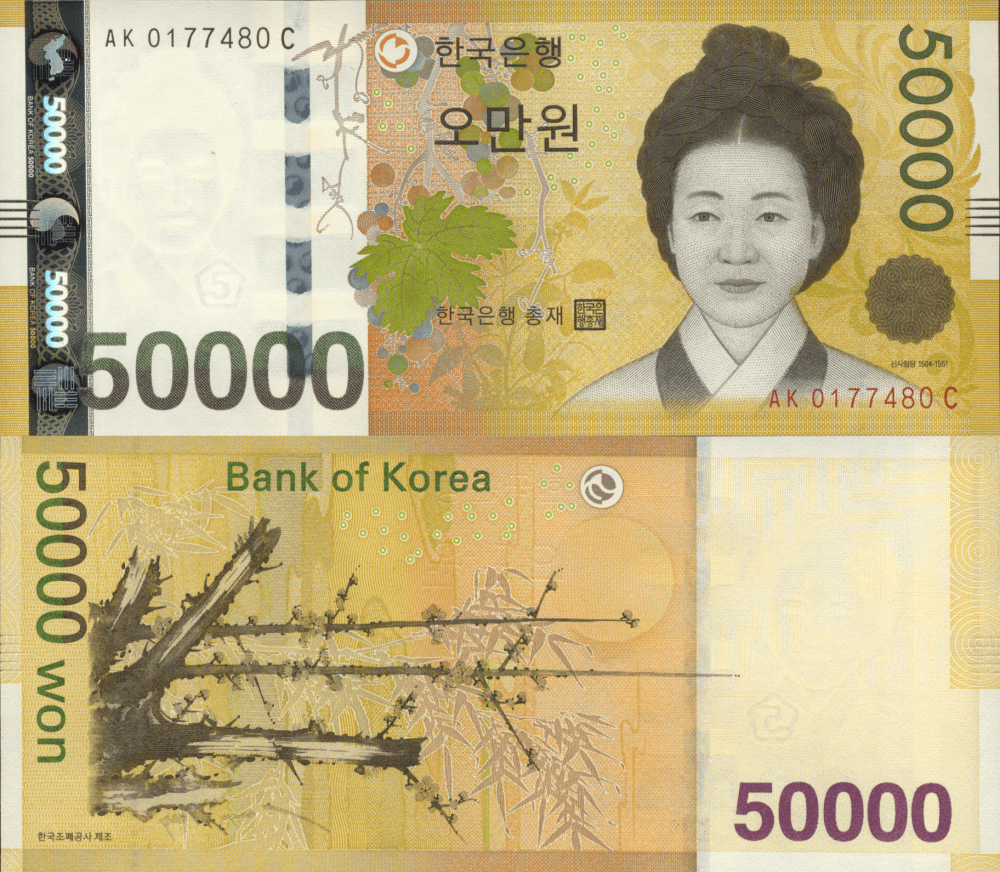
50000 won bill
Top: front of the bill
Bottom: back of the bill
Continuing on the theme of movies, me and my partner watched the popular Korean movie 아저씨 (The Man from Nowhere) which released in 2010. The movie was very popular in Korea as it was the highest grossing movie in the country in 2010. The movie starred 김도진 (AKA 원빈/Wonbin) a very popular actor in Korea despite starring in only 5 films.
The film follows Cha Tae-sik, a very isolated and quiet pawnshop owner with a mysterious past, who forms an unlikely bond with his neighbor So-mi, a very young girl. When So-mi's mother steals drugs from a ruthless drug trafficking organization/gang, they become targets. So-mi is then kidnapped while her mother is brutally killed, prompting Cha Tae-sik to unleash his deadly skills as a former covert operative to rescue her. As he delves deeper into the criminal underworld, he uncovers shocking truths about his own past and the extent of the corruption around him. The film is a gripping tale of redemption, revenge, and the power of human connection in the face of adversity. With intense action sequences, compelling characters, and emotional depth it’s very similar to a John Wick movie but with a much more sinister tone and larger character development.
Despite being “just an action movie”, the movie actually highlights an issue in Korea that is not very well recognized as it’s very dark and covered by many other daily issues. This issue is organ trafficking. When the gang killed So-mi’s mother they took out her organs for illegal selling since selling them can generate a huge sum of money. They also kidnapped So-mi in order to use her and other kids like her (“unwanted” orphans) to make and deliver their drugs. As kids, no one, including themselves, would suspect that they would be doing such things under the guise of an innocent delivery person.
Very briefly, organ trafficking in South Korea is actually increasing annually since the demand for organs is so high. Organ donations are significantly lower compared to other developed countries in the Western world. In 2011, there were 20,000 patients waiting for organs but only 2500 were made throughout the year. This attracts gangs like the one depicted in the movie to exploit this and harvest organs illegally and sell them to hospitals and other organizations while they’re disguised as innocent donations.
Despite being a wonderful country, the movie overall just shows the darker side of what is going underneath. It highlights some major issues that many people do not know about and sheds light on their severity. But it also shows that these can be overcome through consistent willpower and determination.
Ancient Korea is probably not a very well known to many people compared to Ancient Greece, Rome, China, Egypt, etc. But I assure you that if anything it’s just as interesting or dare I say even more so. One of the better understood periods of time in Ancient Korea is the 삼국시대 (Three Kingdom period, 57 BC – 668 AD). The period was made up of the 3 kingdoms: Gogoryeo, Baekje, and Silla. This period saw significant political rivalries, military conflicts, and cultural developments between the 3 states. Goguryeo, in the north, emerged as a powerful kingdom known for its military prowess. Baekje, in the southwest, prospered through maritime trade and cultural exchange. Silla, in the southeast, eventually unified the peninsula later under its rule after forming alliances and defeating its rivals. This period marked the beginning of true (kind of modern) Korean history as it’s where most of present day Korea’s cultural and social influences originated.
The weaker of the 3 nations was no doubt Baekje, but it still had very interesting developments. One of which were the tombs, specifically the Tomb of 무령왕 (King Muryeong) the 25th King of Baeke. The tomb is one of the most studied archaeological finds in Korea because of how preserved it is, and therefore is a major contributor to studying the Baekje kingdom.
The tomb was actually found when nearby tombs were being drained, and the tomb itself was also untouched by anyone since the king and queen were buried there nearly 1500 years before. The tomb also has a lot of Chinese influences, such as the placement of the king and queen in the east and west parts respectively. However, the tomb was placed in the south which was different from Chinese practices of placing them in the north. This indicates a divergence from Chinese influences which was what much of the 3 kingdoms were influenced by. The tomb itself of course contains a lot of jewelry and possessions of the king and queen. Most famously, it contains the two crowns/diadems for the king and queen (금제관식). The crowns were the first crowns found for the Baekje kingdom, making them extensively studied.
As mentioned before, the tomb was the first tomb found to be untouched by any robbers since the burial of their respective royalties. This makes the tomb very valuable in studying the Baekje kingdom to understand its cultural and political landscape so far in the past. Furthermore, the artifacts and jewelry found within the tomb also follow traditions and designs found in ancient China and Buddhism. Much of thee ancient Korean states were actually Buddhist, showing that the Buddhist origin can be traced as far back as the 3 Kingdoms period and ultimately China.
![Royal Tomb of King Muryeong [UNESCO] | This Is Korea Tours](https://thisiskoreatours.com/wp-content/uploads/2017/03/Royal-Tomb-of-King-Muryeong.jpg) Tomb Exterior
Tomb Exterior
![The Tomb of King Muryeong (6th century) of Baekje, an ancient kingdom in Southwest Korea in the Three Kingdom period [736x730] : r/ArtefactPorn](https://i.redd.it/huzuysw7y5l91.png) Tomb Interior
Tomb Interior
 Royal Diadems
South Korea is a very prosperous country. In the past couple decades, the country has experienced rapid growth and development economically, socially, and politically. We see its influence in technology in the form of Samsung, Hyundai, Kia, semiconductors, etc. We see influences in the social world with Kpop, food, Kdramas, and movies. This is because in the modern world, the government backs these developments greatly. But Korea has also faced a great deal of struggles throughout its history other than the war.
To learn more about this, me and my language partner chose to continue on the path of movies and watch the newly released movie 서울의 봄 (dir trans: Seoul’s Spring, known as: 12.12 The Day). This movie is based on the true events of the coup d’etat by 전두환 (Chun doo hwan) to become the 5th “President” of Korea. The movie essentially goes through the events that happened that led to Chun doo-hwan’s eventual rise in power.
The previous “president” (Park Chung-hee, also a dictator), was assassinated and Chun was placed in charge of the investigations to find the ones responsible for his death thus giving him access to much of the country’s secrets and military. On top of that, he also formed 하나회 (Hanahoe: The Group of One) which was essentially a secret organization/club within the military comprising of military leaders that followed in Chun doo-hwan’s beliefs. Together, they stormed Seoul, the capital of South Korea, with little to no opposition because of Hanahoe’s influence and staged a coup on December 12, 1979. The movie portrays one military leader, the capital garrison’s commander Jang Tae-wan (Lee tae-shin in the movie) who opposed Chun doo-hwan’s mutiny but to no avail. Famously, he ends his resistance describing himself as a “criminal who failed to uphold his duties as the commander of the Capital Garrison Command.”
The movie was a fantastic portrayal of how weak Korea’s political structure was. Everyone thought that after Park Jung-hee’s assassination a new beginning for the country would begin. A spring for the country that endured so much hardship, hence: 서울의 봄. But unfortunately, only a new period of darkness began as the 4th president barely lasted a year. Furthermore, the country to this day still faces support for Dictator Chun by extremist groups, which is partly why the movie had to use pseudonyms for all the characters to avoid any lawsuit from these figures, many of which are still alive and living fantastic, prosperous lives without any punishment.
In Korea alone, the film performed exceptionally well becoming the biggest movie in the country in 2023. In fact there was a popular challenge in Korea where people would watch the movie and record their heartbeat and blood pressure throughout to show others the amount of stress and anger the film generated. The film also released internationally and also did relatively well. The film deals with themes of patriotism and democracy, something that I think many Americans would enjoy.
Overall, the movie was fun but it also showed me the side of Korea that many people do not know or choose to reject and deny. The history behind a country is extremely important as it shows how it developed to become the successful nation it is today, and it at the cost of many lives and struggles of the innocent, and this movie showed exactly that.
When most people think of traditional Korean foods, they probably think of Bulgogi, Galbi, Kimchi, and Korean fried chicken. But behind these popular dishes, there lies an entire world of food items and ingredients that are used very often in Korean foods. One of these is Insam (인삼) or more commonly known as ginseng (진생).
Let’s start with a brief history lesson. Insam's usage in Korea can be traced back over 2,000 years. The first written records of Insam cultivation and consumption in Korea date back to the early 1st century AD, during the Three Kingdoms period. Initially, it was revered for its rarity and perceived health benefits, leading to its use in traditional medicine. The name was given because the beginning syllable (인, In-), which refers to a human, denotes the humanoid shape the root has. As a medicine, Insam is believed to possess numerous health benefits, ranging from boosting energy and improving cognitive function to enhancing the immune system and reducing stress. Korean traditional medicine often incorporates Insam into herbal remedies and tonics to promote overall well-being. It can also be used in creating alcohols which must be left to ferment over years and years before it’s ready to be consumed, making it a very rare and expensive product.
In fact, there is a specific word for Insam that grows naturally in the wild: Sansam. It’s very rare and is found in the mountains of Korea. Sansam is prized for its rarity and perceived potency, believed to be higher due to its natural growth and unique environmental conditions. Insam is often associated with vitality and prosperity, while Sansam holds a special significance as a symbol of purity and connection to nature. It embodies a connection to nature and the mountains, symbolizing purity, resilience, and vitality in Korean culture. Korea's climate and soil are well-suited for Insam cultivation, particularly in the mountainous regions of the Korean peninsula. Cultivating Insam is a labor-intensive process that requires specific environmental conditions and careful cultivation techniques. The best-quality Insam typically grows in shady, forested areas with well-drained soil. Harvesting Insam requires patience, as it can take several years for the roots to reach maturity.
Over the years, Insam has become a sort of symbol of the country. It has been a valuable export product, loved by neighboring countries like China and Japan. Korean Insam's reputation for superior quality and potency has made it highly sought after in international markets, contributing significantly to Korea's trade and commerce. In the modern world, it’s now found and exported across the world in countries such as America. Insam continues to hold a special place in Korean culture and society. It is widely consumed in various forms, including teas, supplements, and health tonics. The demand for Korean Insam remains high both domestically and internationally, with the Korean government implementing strict regulations to protect its quality and authenticity.
Insam or ginseng is not merely an herb in Korean culture; it is a symbol of tradition, health, and prosperity deeply ingrained in the nation's history and identity. From its origins in ancient times to its modern-day significance, Insam remains a cherished and revered part of Korean heritage, embodying the country's rich cultural and medicinal legacy.

For this month, me and my language partner decided that we would watch some popular Korean movies together. Because my skills in Korean are sufficiently fluent, we watched movies that would be somewhat difficult for a beginner to watch without subtitles. The movies we watched were 외계+인 1부 (Alienoid 2022) and the much more popular 기생충 (Parasite 2019). Watching movies to learn Korean not only made learning entertaining, but it also exposed me to some of the culture, history, and atmosphere in South Korea.
For starters, Alienoid had a fairly confusing plot that required me to pay attention very closely. The movie took place over 2 different time periods: The 고려시대 (Goryeo Dynasty, 1380 AD) and “modern” Korea (2012 AD). At first, the movie revolves around two aliens from a far away planet that capture “demonic” aliens from there that possess human bodies. As they complete a mission in the Goryeo Dynasty, they capture one but the host gives them her infant girl, asking them to take care of her. Reluctantly, they take her in back to the modern world and raise her with the given name 이안 (Yi-an). However, soon things go south as the 2 aliens learn about the Controller (the top-dog demon alien) and his plans to take over the Earth so that his race of aliens can live there. While fighting the Controller, they go back in time where the rest of the movie takes place. Explaining the rest of the plot would take a while so if you want to know I would recommend watching it :) .
On the complete opposite spectrum is the movie Parasite. This movie revolves around the Kim family, who, through deception, infiltrate the wealthy Park family's household, each securing a job there. The narrative takes unexpected twists as class tensions, social commentary, and dark humor unfold, ultimately leading to a dramatic and impactful conclusion. Once again, if you want to know the plot I HIGHLY recommend watching this one in particular. This movie received widespread acclaim, winning several awards, including the Palme d'Or at the 2019 Cannes Film Festival and Best Picture at the 92nd Academy Awards.
Alienoid provided a strong look into life during the Goryeo dynasty. The movie had a lot of fantasy elements, mainly magic, which of course is fake. But it provided an overview of the things the people during the Goryeo dynasty believed in. The supernatural, objects of magical powers, spirits, etc. It also showed how society was structured; for example a key part for some of the movie revolved around a 사또 (magistrate) who was sort of like a sheriff/mayor of a small area of the kingdom. Conversely, Parasite was a satirical portrayal of the social class disparities in Korean society. The film explores the extreme contrast between the wealthy and the poor, illustrating the challenges and complexities of social mobility. Both films provide a good insight to how Korean society flowed and continue to flow and the differences and evolution between the two.
When people talk about popular Korean figures, most people think of the BTS members or Bong Joon-ho or even Yoo Jae-suk. But very few non-Korean people will know about Korea’s greatest military mind. 이순신 (Yi sun-sin), or Admiral Yi, was arguably the greatest military mind that the Korean peninsula had ever seen. He lived during the Joseon dynasty and his naval campaigns mostly took place during the 임진왜란 (Imjin War) where he saw significant victories against the Japanese despite being out-resourced and outnumbered.
His most famous victory came in the 명량대첩 (Battle of Myeongnyang) where he was outnumbered 13 ships to the Japanese 333. Giving up the Myeongnyang strait to the Japanese would’ve meant that the Japanese empire would have free access to supply resources directly into Joseon for a mainland invasion. Nevertheless, Admiral Yi was able to use the natural environment of the Myeongnyang Strait to his advantage to turn the Japanese fleet around and turn the tide in their favor. In the battle, he lost 0 ships while the Japanese lost 31. This battle is still considered one of the greatest naval achievements in history. In fact, there was a movie made from it, 명량, which at the time of its release was the highest grossing Korean film of all time. Around a fifth of Korea’s population had also viewed the film.
During his campaign, he created a seven year record of all the battles and strategies inside the 난중일기 (Nanjung Journal) which is now listed as a part of UNESCO’s memory of the world. He also has several memorials, monuments, awards, and towns named after him. What helped him the most in his battles however was his innovative mind not only in using the battlefield to his advantage, but also in creation:
The 거북선 (turtle ship) was a large playmaker in the success of Yi Sun-sin’s campaign. The turtle ship was an early version of the ironclad with iron spikes and plates, resembling the shell of a turtle. This design not only provided protection from enemy attacks but also made the ship difficult to board. It also made it very strong for ramming against the enemy ships. Although not official, the turtle ship can be viewed as a Korean national treasure as it is displayed in various museums. A full complete replica is still yet to be built however as its design is still up to debate and being studied constantly.
Over the past month, I decided that i would take my Korean learning journey into literature. But since formal literature and books were too advanced (or costly), I chose to read some Webtoons, specifically exploring popular titles like "Itaewon Class" and "Sweet Home." This venture not only expanded my Korean language skills but also provided me with a fresh and insightful perspective on Korean culture and society. Webtoons, or online comics, have become a cultural phenomenon in Korea, and they offer a unique view into the daily lives, societal norms, and emotional landscapes of the Korean people. As a language learner, delving into the narrative-rich world of Webtoons proved to be an engaging and dynamic way to enhance my understanding of colloquial expressions, informal language usage, and the nuances of everyday communication.
One of the Webtoons that left a profound impact on my learning journey was "Itaewon Class." The series, which has also been adapted into a popular Kdrama, follows the journey of a resilient entrepreneur navigating the complexities of the business world. Through the dialogues and interactions between characters, I found myself not only picking up on new vocabulary but also gaining insights into the cultural dynamics of Korean workplace etiquette and the pursuit of success in a very, very competitive society.
In addition to the language aspect, "Sweet Home" offered a different lens through which to explore Korean society. This gripping Webtoon, centered around a monstrous apocalypse, delves into the psychological struggles and interpersonal relationships of its characters. As I navigated through the suspenseful plot, I encountered a range of emotions expressed in Korean, from fear and despair to camaraderie and hope. This emotional depth added layers to my language learning experience, allowing me to absorb and internalize expressions that extend beyond everyday conversations.
Moreover, the Webtoons provided a large array of Korean culture. From the bustling streets of Seoul depicted in "Itaewon Class" to the dynamic portrayal of Korean urban life in "Sweet Home," these visual elements complemented my linguistic learning by offering cultural context and expanding my understanding of the settings in which the stories unfolded.
As the month progressed, I found myself not only improving my Korean language skills but also gaining a more profound appreciation for the diverse factors of Korean society and storytelling. Webtoons, with their vivid narratives and cultural insights, have become not just a tool for language acquisition but a gateway to a deeper understanding of the vibrant and changing world of Korean culture. This immersive journey has not only expanded my language proficiency but has also opened my eyes to the vast array of tradition and culture of life in Korea. Without a doubt, I’ll continue to keep reading other Webtoons to expand my understanding in both of these topics.
One of the most popular things to have come out of Korea is 태권도 (Taekwondo). The martial art is one of the most popular things to have come out of the country (besides the music of course). It’s become a global phenomenon and even made its mark in the Olympics. Let’s start with the historical roots. Taekwondo started a long time ago in Korea, during a time called the Three Kingdoms Period (around 57 BCE to 668 CE). It borrowed some moves from an old Korean martial art called Taekkyeon. But it wasn't until the 1900s that Taekwondo got its name and became an official martial art. People wanted a martial art that was uniquely Korean, especially after Korea experienced some tough times, like the Japanese occupation.
Taekwondo is more than just kicking and punching. It's like a moral lesson. It takes bits of ideas from Confucianism (a Chinese philosophy), Buddhism, and old Korean values. Practicing Taekwondo teaches people to be respectful, honest, never give up, control themselves, and have a strong spirit. These ideas go beyond the gym and become part of a person's character, adding to the charm of Korean culture. Imagine Taekwondo as a dance with kicks and punches. The moves aren't just random; they have special meanings. The forms, called poomsae, are like a dance routine that shows the beauty, control, and power of Korean culture. It's like telling a story through movements, making Taekwondo a unique way of expressing Korea's history and traditions.
As mentioned before, although Taekwondo is and will always be Korean at heart, it has become famous everywhere. It's been an official Olympic sport since the year 2000. This means people from all over the world get to see Taekwondo at the biggest sports event. Taekwondo isn't just a Korean thing; it's like a global friend that helps different countries understand and connect with each other. Although Korea is evolving constantly and becoming, Taekwondo is an example of how certain traditions and cultures can last forever. It helps link the past and the future, making sure the wisdom from long ago isn't forgotten.
Taekwondo isn't just a sport, it's a balanced mix of history, lessons, and cultural stories. As Korea's way of saying hello to the world, Taekwondo teaches not only kicks and punches but also the values that make people better. So, next time you see those high-flying kicks or hear about Taekwondo in the Olympics, remember, it's more than a sport – it's Korea's resilience in history and tradition making way across the globe and introducing deeper aspects of Korea over the commonly seen Kpop and Kdramas.
Throughout the semester, I learned that basically if I learn a language that I genuinely want to learn, then I will put much more effort into it compared to something that I’m forced to learn. This may sound very obvious but I think if I had just known the scale to which it would affect my learning, then I would’ve without a doubt learned Korean much sooner. Having almost daily conversations in Korean helped me expand greatly, rather than just sitting down and going through lecture about probably Korean grammar and whatnot. Having a language partner does make the experience much more enjoyable as they help me learn the content in a fun way. Learning the language through videos about history and culture as well as of course the music, will be something that I continue to do without a doubt. What I found most difficult however was trying to learn the writing in Korean. Although the alphabet, forming words, and reading are possibly one of the easiest out of any language, the grammar itself I feel is one of the hardest. Sometimes “conjugating” words did not follow any rule depending on the root word making it extremely difficult to follow along. Learning about the language families helped me with my final project (and coming up with my final project topic). After learning that Korean, Japanese, and Chinese were all very similar I wanted to know how similar they really were and if they changed over time at all. Overall, this experience was nothing to forget as it helped me learn so much about Korean culture and language in such a short timeframe. I don’t think I’ve ever learned this much about a language/culture before on any scale and if given the chance, I’d definitely do it again.
If I were given the opportunity to study the Korean language and culture, first I would start with the establishment of the actual territory. Perhaps the origins of the people of the first Korean resemblance of a country can explain the influences of external factors, such as Hanja, throughout the history of Korea. From the origin, the evolution and change of the culture and language can then be studied. The Korean spoken language has existed for a long time while the use of Hanja (Chinese characters) were used for writing. How the spoken language came to be could also be an interesting topic. Then of course, is the creation of the Korean written language (Hangul). Over time, the written and spoken language have changed greatly over time. Looking at how the speech of those from the Joseon dynasty versus people right now have changed would be interesting to see. Especially, after the colonization of Korea by the Japanese. A lot of words in Korean are very similar, if not identical, to the Japanese counterpart. Furthermore, is the use of English words in Korean. The large influence of English on Korean is no secret, especially since almost half of the words that modern Koreans use are basically direct English translations. Why this happened can also be looked into more deeply to see the underlying causes. Then there are also words taken from other languages, such as Portuguse for bread and German for part-time job. What could’ve caused these incorporations into the Korean language, and why are words from these foreign languages used over the actual pure Korean language.
Since my final research topic concerns the evolution of the Korean language over time, me and my language partner decided that it would also be good if I learned some Korean history as well. So over the last month or so, I would watch brief videos on the history of Korea and the important events that happened within. But since watching pure historical videos could be boring or even just hard to understand with the Korean I know, I was shown historical videos that had a bit of a comedic aspect to them. These include, once again, episodes from 무한도전 (Infinite Challenge in English) and brief history lessons on Youtube.
Despite being history lessons though, learning through these were very fun and interesting since they didn’t feel like actual lectures. Rather, as mentioned before, they had a bit or even a lot of comedy incorporated into them. But the most helpful thing was that they used casual language to teach these historical events. That made understanding the videos much easier, even though there were, of course, specific words that I didn’t really know. We chose to focus on events that would change the entire nation and its future. This includes the creation of Hangul, Japanese occupation, World War II, Korea’s independence from Japan, and finally the Cold and Korean War. Some of the words I learned are; 독립 (independence), 6.25 전쟁 (Korean War), 친일파 (pro-Japan faction), 일제강점기 (Japanese occupation), etc. Although a lot of these words aren’t useful in everyday conversation, it helps me understand the history of Korea better. But by learning all these historical events throughout Korean history, I was able to make connections on how the language itself changed greatly across.
For example, before the creation of Hangul the main written language was Hanja; a language strongly based on Chinese. And because of this, many of the words in the spoken language are also based on Hanja rather than Hangul even to this day. But of course after the creation of Hangul, there are many pure Korean words that are used instead. During 일제강점, one of the main goals of Japan was to eliminate all Korean culture and replace it with their own This led to many words from Japanese being incorporated into the Korean language to erase the usage of Korean. Even in the modern world, a lot of Japanese equivalent words are used instead of the actual Korean words, showing the lasting impact of the terrible event.
Lastly, is the huge impact of the independence of Korea and the Cold & Korean War. To keep things simple, the division of Korea was due to the conflicting views between the Soviet Union and USA. This led to North Korea being freed by the USSR under communist views and South Korea being freed under democratic views. This led to a strong influence of the US essentially covering South Korea. The US had military, police, and government officials taking charge in South Korea during the Cold War and post-Korean War. A lot of this influence caused the US to be an influential figure for South Korea, leading to many English words being directly incorporated into the Korean language. The lasting effects of this can be seen in the modern world where nearly more than 50% of the words used in the Korean language are just direct translations of the English equivalents.
Languages go extinct simply when people do not speak, write, or use it enough for it to be passed on to the next generation. Eventually, the language then dies out and becomes a distant memory of th past. The sad part of the language becoming extinct, isn’t the fact that the language itself is gone, but a part of culture or tradition is now gone as well. Of course relics of the past can be studied, but without the actual language to study it can be difficult to understand the true meaning of their cultures and traditions. Especially, when it comes to small tribes that aren’t studied as extensively as say Latin. Speaking of Latin, that brings the issue of whether a language is truly dead or can even be brought back. People always talk about how Latin is a “dead language”, but truth be told, personally I don’t think it’s a dead language. It’s considered the official language of the Vatican, and mass in the Vatican are Latin. People study Latin all over the world and therefore know how to read, write, and speak it. A true extinct language is one that is unknown to the entire world. One that no one speaks or studies. But even if a language does go extinct, I believe it can be brought back. Take the Siletz language for example. Once considered extinct, it now has 4900 members in the tribes of the Siletz Indians and is being taught at the public charter school in Siletz. All the language was once considered dead, efforts to teach it and expand it helped bring it back to life. If the language is still known, even the smallest amount, I believe that it can be brought back to a wider scale if enough effort to revive it is put into place.
Countries often have traditional clothing that can be traced back throughout the entire country’s history. In Japan is the kimono, Scotland has the kilt, and Korea has the 한복 (Hanbok). But what is the significance of the Korean Hanbok? Well, it bears immense significance all throughout Korean history. Its roots stretch back to ancient times, the Hanbok encapsulates the very core of Korean heritage; evolving over centuries while maintaining its cultural roots.
The origins of the Hanbok can be traced back to the Three Kingdoms Period (57 BCE - 668 CE), where its design first began to take shape. Originally, the Hanbok was worn by everyone throughout the peninsula. Whether poor or rich, it served as an everyday attire for everyone. But over time, as Korea experienced changes in rulings and cultural shifts, the Hanbok became not only an article of clothing, but a way to express social status, cultural values, and aesthetic sensibilities.
During the Joseon Dynasty, the Hanbok began to represent the Confucian ideals during the time period. It started to reflect the values of modesty and social hierarchy. Different colors, fabric choices, and accessories conveyed specific information about an individual's age, gender, and social status. The Hanbok thus started to become more of a traditional clothing, rather than just an everyday article of clothing. Later, under Imperial Japan, the Japanese empire attempted to erase the Hanbok from the country itself. It was prohibited from being worn on special occasions, but of course they were not able to do this as it still exists today.
Because of this, in the modern world the Hanbok is generally only worn on special occasions such as Lunar New Year’s, a wedding, Chuseok (Korean harvest festival), birthdays, etc. The younger generation, in particular, has embraced the Hanbok as a symbol of cultural pride, showing it off and wearing it in various forms such as fashion shows and social media platforms. This changing world has brought the Hanbok to adapt a more modern feel/look as well. The design has adapted a more contemporary feeling to keep it relevant in the modern world. The traditional version still exists of course and is still mostly worn over the contemporary versions.
The Hanbok stands as more than just a piece of clothing; it is a living testament to Korea's enduring cultural legacy. Woven into its fabric are centuries of history, cultural values, and artistic expression. Its significance and values have persisted throughout centuries even through the hardest times. The Hanbok's significance persists in its ability to bridge the past and the present, fostering a sense of pride and connection among the Korean people and captivating the admiration of the world.
I am able to write in Korean… kinda well. According to the people all around me who I text to in Korean, the meaning or message of whatever I’m trying to communicate gets across. However, there are still many spelling mistakes. Most of these are because of characters that sound the same, such as ㅐ vs ㅔ (both sound like ae). Also typing to Korean is hard, especially on a keyboard since I basically don’t know any of the character positions on the QWERTY keyboard. Writing is much easier since I can actually create the words myself. Although, it hasn’t been an issue yet, the sentence structure in Korean differs from English. Of course, the subject, object, and verb of the sentence remains but the ordering of them is different. In English, the basic sentence structure goes subject-verb-object. For example, it would be “I like swimming.” But in Korean, the order goes subject-object-verb. So if the sentence was “나는 수영을 좋아해" (same meaning), the direct translation would be “I swimming like.” But like mentioned above, this hasn’t created any issues for me (yet) in conveying my message or anything of that sort. I’m sure if sentences get more and more complicated though, there may arise an issue of that sort.
