Faith Pinckney's Posts (6)

Sort by

Reflection Paper #2

I’ve mentioned briefly before, my inspiration for learning ASL was due to my interactions with individuals and families at Chick-fil-A who were deaf. After trying to self-learn sign for a few weeks, I asked around at UR about ASL classes to see if there were any offered or if the tuition exchange could possibly be used to help students who would want to take ASL at other local schools. Thankfully, I had heard from Mrs. Creamer within the Registrar's Office and she informed me out about SPCS’s ASL 1 and ASL 2 group course.

I started training with Reba two years ago in her group ASL course, and it was phenomenal. However, it was even more of a pleasure learning from her 1:1 this semester! I think getting the chance to communicate with her for a longer period of time and through one-on-one sessions improved my ASL dramatically. I also took a new approach by actively researching videos made by deaf/HoH individuals who use ASL. It has been amazing seeing the increased interest for learning sign language in recent years. I have found myself incorporating sign into my conversations unintentionally. I catch myself signing some words when others cannot hear me or if I have to repeat simple words like "yes" or "no". I also have started using the ASL sign for three whenever I say that number. Whereas, prior to my lessons, I just used the "typical" 3 that looks like a W or 6 in ASL. I remember how, in the beginning, I would mistakenly sign 6 instead of 3 when I was practicing numbers by signing to Reba my phone number. This mistake of mine would cause her to write down the wrong phone number. Now, I tend to only use the ASL 3 instead of how I used to. 
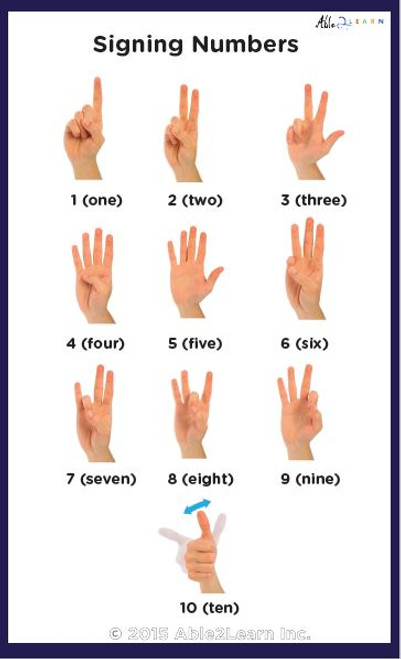
Sign Language 1-10 Poster - Able2learn Inc.

Some things that I found difficult were trying to learn more about particular dialects of ASL (such as Philadelphia ASL and BASL). Additionally, I found that, in relation to BASL and Philadelphia ASL, some of the books and videos regarding the research projects were no longer accessible. I would find many websites that had “broken links”. Moreover, if there were not closed captioning on the video and it was sign language that I did not understand yet, I wouldn’t be able to gather what the research was a presenting. I hope that there continues to be more accessibility to these dialects and that they are able to be preserved.

Going forth, I want to try to continue learning more history regarding ASL. I got to discover a bit of this in my cultural presentation, but I would still like to expand upon this. I would also like to gain more comfortability on how sign words and their placements have changed over time. I think this would only improve as I practice with more natives rather than only reading books.  I also want to eventually progress to watching videos in ASL without captioning (kind of like an "immersive" approach). I found out about deafvideo.tv during the last weeks of the semester, and I think this may be the way to go!

Sometime after college (and once it is safe to do so), I am hoping to do a trip to Gallaudet University. I would love to have a meeting with Dr. McCaskill and others who are fighting for recognition of BASL. 

Read more…

Cultural Presentation - BASL

Hi, everyone! Here is the link to my presentation on BASL (because there are gifs towards the end, I am just pasting the  link).

Here are also some of the resources I used in my project and one of the diagrams I found useful.

w-BlackASL%20b.jpg?t=20191113b&profile=RESIZE_710x

Read more…

Discussion Post #3

This semester, I am learning ASL. A "basic" ASL sentence can have a sentence structure of time-subject-predicate, but it can also have a sentence structure of subject-verb-object. Like some other languages, the sentence structure changes depending on the type of sentence. When rhetorical questions are asked or imperative and emphasis words are used, these words are signed at the end of a sentence. A noun is signed before an adjective. For example, to ask “Where do you live?” I would sign, “You live, where?”. I am still a bit confused on when it is appropriate to use S-V-O structure and it not count as Signed Exact English, I am hoping to speak with my instructor for clarification. The structure that makes the most sense to me is “topic + comment”. If I wanted to talk about a party being on Saturday, I would sign the topic “Party” and comment “Saturday”.

That being said, based on what I know now, I do not think there is one disciplinary approach that is preferenced over another in ASL. I can see how all of the branches of linguistics can play an important role in teaching and communicating in ASL. In particular, computational linguistics reminds me of the newer devices that can translate signed words into written text and vice versa. However, I have particularly been interested in learning the anthropological linguistics of American Sign Language. My knowledge that there is usage of sentence structure that is different than it would be in English has been causing me to really think about sentence structure formation as I continue to expand my vocabulary. I appreciate how Reba instantly corrects me when I sign a sentence in the incorrect format. In becoming more informed on the ASL sentence structure rules, I think it will help lessen the amount of hesitancy I have when I try to formulate sentences that I haven’t already learned the phrase from elsewhere.

df50889f6f5d38ca4acf05cf18e01f22.jpg?profile=RESIZE_710x

Read more…

Discussion Post #2

In Figuring Foreigners Out, the author addresses key differences between cultures that can impact cross-cultural relationships and understanding. The author focuses on 5 main cultural differences: individualist vs collectivist understandings of personal identity, nonverbal communication, monochromic vs polychromic concepts of time, internal vs external views of an individual’s locus of control, and direct vs indirect communication. Likewise, in Dr. Hofstede’s Dimensions of Culture study, it is revealed how significantly different the values of some countries are in comparison to others. However, Dr. Hofstede has slightly different analysis categories: Power Distance Index, Individualism, Masculinity, Uncertainty Avoidance Index, and Long-Term Orientation. In learning how these categories can impact a culture and through completing the exercises, it became more apparent to me how the culture that I was raised in significantly influences my choices and my own thought process. This caused me to reflect on statements that I’ve heard about particular cultures being more direct or harsh. In reality, to that particular culture, it is normal and not “harsh” at all.
I think the most blatant instance where I came across the concept that people from different cultures might have differences in how they perceive the world and in how they interact with others was when a student participating in my high school’s exchange program shared a meme that was inappropriate. To (most) people from my area/culture, it would be considered “common sense” to not make such a statement or think of it as a joke. However, when I had explained to them how the joke wasn’t funny at all and was a serious matter, as they revealed to me how they didn’t understand the meaning behind such and that “where [they are] from, people make jokes like this all the time”, I realized that they may be experiencing a bit of a culture shock. I felt as though the reading touched upon this, especially when it is stated that, “The problem in cultural circumstances is that people from different cultures sometimes assign different meanings to the same behavior” (116). In this context, the author is specifically focusing on nonverbal communications, but I think it also applied to verbal communication.
Prior to these readings, I didn’t really take the time to consider the terms “individualism” and “collectivism” and the ways in which they impact our culture. I also found myself questioning certain aspects of it (Would “Employee of the Month” be individualist since doing their own position well ultimately benefits the group, or is it collectivist since that person being highlighted is ultimately part of a group?). I think that I do mostly agree with that was said in the Figuring Foreigners Out reading, and I wish I had a better understanding of such back when I was in an environment where I regularly interacted with people from different countries.
The only part of the reading that I didn’t quite understand the necessity of the quote on page 68. Not only was it sexist towards the end, but it also seemed to criticize a culture within a chapter that was, from my understanding, embracing the differences in cultures. Assuming the statement regarding Americans’ belief in the future  is correct, would it be wrong for Americans to think this way if that is their culture? Then again, perhaps me perceiving the quote as harsh could be due to a difference in communication between my culture in comparison to the author’s culture.

Read more…

Learning Plan

Over the years, I have learned how I am very much a visual and an auditory learner. I've also learned that I study most effectively through making notecards, watching lectures on materials, and allowing enough time for repetition. I was inspired to learn about ASL through interacting with a guest at my job at Chick-fil-A. It was soon after then that I learned about how there is a significant deaf community in Richmond, and I wanted to be able to communicate with them.

Due to this, I've organized my self-directed learning plan to mostly consist of videos, gifs, and much interaction with either other people learning ASL or directly trying to communicate with individuals who sign ASL and are deaf/hard of hearing. In addition to common resources many people refer to when learning ASL (LifePrint, SignSchool) I've found YouTubers such as SignDuo and Our Signed World to be incredibly helpful as they are the channels made from individuals who are deaf. Another resource that I recently learned about is Deaf Family Matters on Instagram. This page has not only allowed me to learn more about deaf culture, but has taught me about some ableism and discriminations that deaf citizens face. It has also has exposed me to new terms that I would most likely not cover in a "traditional" ASL class.

Pinckney%20ASL%20Learning%20Plan.docx

Read more…

Reflection #1

When I was around 9 years old, I would try to learn languages through Rosetta Stone. My first inspiration for trying to learn a new language was because a close family friend of mine was Italian, and I wanted to learn how to speak with them in Italian. Another language that I tried to self-teach through Rosetta Stone was Spanish. It was amazing, to me, seeing how similar certain words were between the two languages. Though I enjoyed going through the modules on Rosetta Stone and learning new vocabulary, I regrettably didn’t practice speaking the language outside of the program and didn’t take the initiative to watch shows or read books in the languages that I was attempting to learn.

In high school, I took three years of Spanish classes to complete my language requirement. Throughout those three years, I was able to really learn what methods of teaching a language that I benefited from best. When I first began Spanish, I took it in a CP course. I enjoyed the model that my teacher utilized in that we learned Spanish through making up stories. The teacher would often include the names of students and make references to popular culture of the time. Periodically, we would view parodies of current trending songs that were made in Spanish.  We were encouraged to practice speaking to one another in simple sentences using the terminology that we were exposed to. This professor practiced mostly immersion and spoke in Spanish throughout the majority of the class. The following year, I enrolled in Honors Spanish with a different teacher, and the style was different than I had encountered in the previous year. This class focused more on grammar and sentence structure, which I soon found that I struggled with. However, one difference in this teaching style that I particularly enjoyed was how we were exposed to Latin American culture through the literature we reviewed in class.

After taking my Spanish courses, during my senior year, I decided to enroll in a German class online. I was inspired to learn German due to how my school had a foreign exchange student program, and many of my closest peers were from Germany. This was my first experience trying to take an online language course that was mostly self-paced. Each week, we had a session in which we would gain live instruction from the teacher over materials we had learned in the past week. This live session also granted participants the chance to practice speaking the language. I’ve found that I really benefit from repetition and hearing others speak in the language that I am attempting to learn.

If I had the chance to go back to when I first started exploring other languages, I wish that I had taken more of an effort to learn more about the cultures of the languages that I was learning. As someone who is very much a visual and an auditory learner, I would have greatly benefitted from reading books or watching television series that communicated in the language that I was seeking to learn. This realization of how I best learn languages is what makes me excited as I study American Sign Language more this semester. I plan to be intentional with communicating with members of the Deaf community, as well as spend time watching deaf or HOH YouTubers to continue learning more about their culture. I think that engaging with members of the community is especially important, as I’ve learned while self-teaching how some resources online are truly teaching SEE or PSE, rather than ASL.

Read more…