
David Kim
Spring 2024 SDLC112 - Cultural Presentation "태극기 Taeguekgi"
David Kim
Spring 2024 SDLC112 - Cultural Presentation "태극기 Taeguekgi"
David Kim
Spring 2024 SDLC112 - Podcast by David & Rachel
Spring 2024 SDLC112
Cultural Post #4
태극기 "Taegeukgi"
David Kim
30262888
david.kim123@richmond.edu
태극기 Taegeukgi is the national flag of South Korea. It has a unique design that reflects several key aspects of Korean culture and philosophy. The Taegeukgi was first officially adopted as the national flag of Korea on March 6, 1883, during the reign of King Gojong of the Joseon dynasty. During the Japanese occupation of Korea(1910-1945), the Taeguekgi was banned, and the Japanese flag was imposed as the official flag. However, the Taeguekgi continued to be used by Korean independence activists as a symbol of resistance. After Japan’s defeat in World War II, Korea regained its independence, and the Taeguekgi was reinstated as the national flag. In 1948, the Taekguekgi was designated as its national flag when South Korea was officially established as a separate country. During the Korean War, the Taegukgi became a symbol of South Korean resistance against North Korean invasion, as well as a symbol of hope and unity. Today, the Taegeukgi is a symbol of Korean identity and is displayed proudly on various occasions, such as national holidays, sporting events, and official ceremonies.
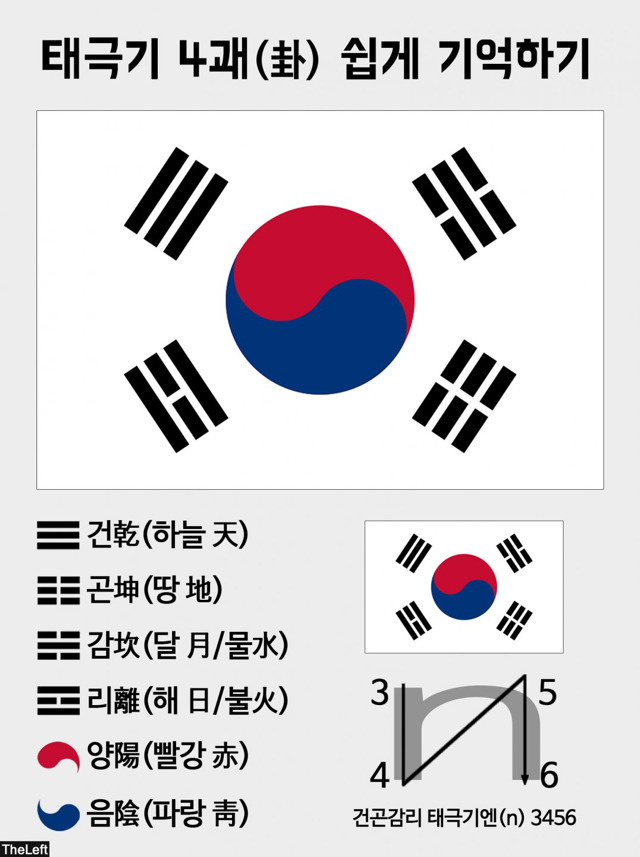
The Taeguekgi has a red and blue Taeguek circle in the center and four black trigrams surrounding the circle on a white background. The white background of the flag represents purity, peace, and homogeneity, which is highly valued by the Korean people and culture. At the center of the flag is the 태극 Taegeuk, which is a red and blue symbol representing the concept of yin and yang, the duality of the universe in Korean philosophy. The red section represents positive cosmic forces, and the blue section represents the negative forces. Together, they symbolize balance and harmony. It also represents the truth of nature that all things are created and evolve through the interaction of yin and yang.
Surrounding the Taegeuk are four sets of black trigrams collectively called 건곤감리 geongongamri or 4괘 kwe, each in the corners of the flag. These trigrams are derived from the Chinese I Ching (Book of Changes) and represent the four classical elements, directions, virtues, and natural phenomena. They are also associated with the four guardian spirits that protect the country and its people. The left top one is called 건 geon, which symbolizes the sky. The right bottom one is called 곤 gon, which symbolizes earth. The right top one is called gam, which symbolizes the moon or water. The left bottom one is called 리 ri, which symbolizes the sun or fire. You would read or write in the order just like when you write the alphabet n, from left top to right bottom. Then you will have 3,4,5, and 6 strokes in a consecutive order.
The Taegeukgi has a specific set of proportions. The width of the flag is twice its height, and the diameter of the Taegeuk circle is half the width of the flag. These proportions are meant to create a harmonious and balanced appearance. The Taegeukgi flag represents the values of the Korean people who respect nature and harmonization.

Korean Source
https://encykorea.aks.ac.kr/Article/E0058892 ;
https://www.mois.go.kr/chd/sub/a05/birth/screen.do
English Source
Spring 2024 SDLC112
Cultural Post #3
한옥 “Hanok”
David Kim
30262888
david.kim123@richmond.edu
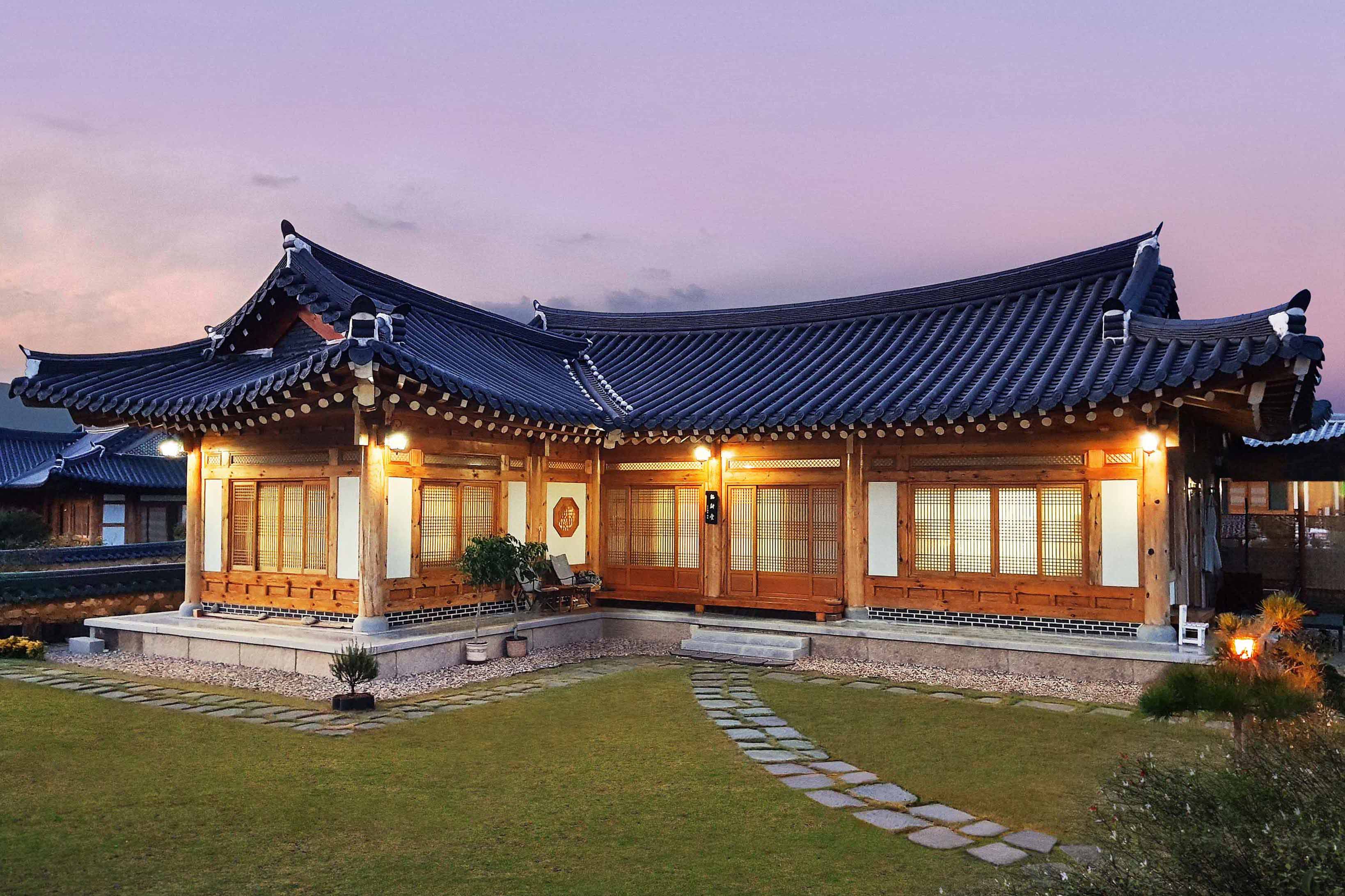
한옥 “Hanok” refers to traditional Korean houses, known for their unique architectural style and cultural significance. These houses have been a staple of Korean architecture for centuries, embodying the principles of harmony with nature, functional efficiency, and social hierarchy.
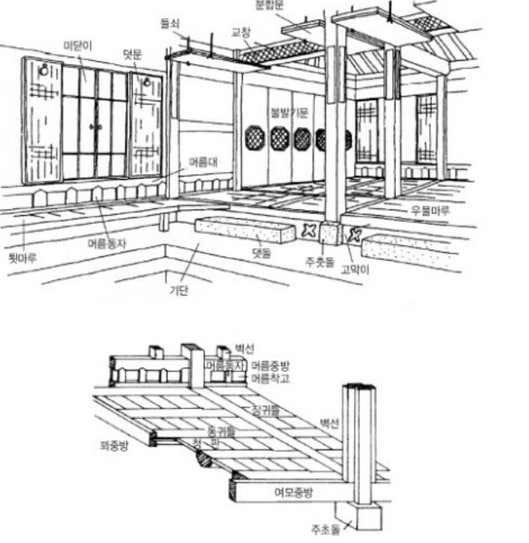
Hanok houses are typically single-story structures with a floor plan that follows the natural contours of the land. They are often L-shaped or square, with rooms arranged around a central courtyard called a madang. The layout is designed to maximize natural light and ventilation while providing privacy and security. 마루 “Maru” is an architectural element of Hanok that was developed to adapt to the heat. Maru is a space on the floor made of wood that allows a pleasant summer by allowing the air to pass through without the moisture from the floor. In addition, the floor is used as a place to connect multiple rooms or store things.
The roof of a Hanok determines the impression of a Hanok, whose beauty comes from its sleek curves. The
naturally raised curves of Hanoks preserve their classical beauty compared to the straight roof shapes found in traditional Chinese and Japanese architecture. Gently curved Hanok roofs are made of traditional materials such as 한지 hanji (Korean paper) or clay tiles. The eaves of the roof extend outward to provide shade and protection from the elements, creating a distinctive silhouette.
One important feature of Hanok houses is the 온돌 ondol, a traditional Korean underfloor heating system. Heated by a wood-burning stove, the ondol system circulates hot air through channels under the floor, providing warmth during the cold Korean winters. The ondol system is still used even today in apartments. It was a very efficient and effective system because it could solve heating and cooking at the same time. Traditional ondol was changed to boiling water with the boilers.
Hanok houses reflect traditional Korean beliefs and values. For example, the layout of the house often reflects Confucian ideals of social hierarchy, with the most important rooms located closer to the main entrance. Also, people believed that harmony with nature was important. Hanok houses are typically constructed using wood and earth materials such as clay, straw, and stone from the surrounding environment. These natural materials help regulate indoor temperature and humidity, contributing to a comfortable living environment.
While traditional Hanok houses have been preserved in some parts of Korea, many have been adapted to modern living standards. The main problems with Hanok houses were uncomfortable facilities, challenging maintenance, and high costs for building. Modern Hanok houses may incorporate contemporary amenities such as electricity, plumbing, and insulation while preserving the traditional architectural elements and aesthetics. Recently, Hanok houses are used for different purposes rather than to live. Main purposes are using them as places for restaurants, cafes, museums, and more. There are also hotels and accommodations that offer the concept of Hanok. If you have a chance to visit Korea, I recommend you to visit Hanok Village in Bukchon, Seoul or Gyeongju.
Hanok houses are not just architectural structures but living representations of Korean culture and history. They continue to be cherished and preserved as valuable cultural heritage sites, providing a glimpse into Korea's traditional way of life.
Korean Sources
https://hanok.seoul.go.kr/front/kor/info/infoHanok.do?tab=1
English Sources
Spring 2024 SDLC112
Monthly Learning Journal #3
David Kim
30262888
david.kim123@richmond.edu
My language partners and I continued watching the Korean drama A Killer Paradox on Netflix. The third episode starts with Yeo-ok, the blind woman’s story. When she was young, she was hanging out with the wrong friends. They were not properly functioning at a place with coal gas. Someone lit up a lighter to smoke, and there was a big fire. Yeo-ok got herself burned around her left eye. She also signed up for eight different insurances for her aunt and uncle who raised her. Then she killed them by herself. She did it not because of money, but because of her nature and vanity.
Detective Jang Nan-gam meets Yeo-ok’s cousin, who wrote the story of Yeo-ok on the internet. She told him that Yeo-ok poured boiling water on her face with a smiley face. Detective Jang Nan-gam heads to Jaejun’s funeral, but gets facked in the face by Jaejun’s mother because he was asking questions. Detective Jang Nan-gam already knew that Jaejun was a perpetrator before becoming a victim. Years ago Jaejun and his other friend raped Kang Yeon-seo, a middle school girl. A month later, she suicide by jumping off on sixth floor. Detective Jang Nan-gam says that there is no perpetrator or victim because every human being is the same. He goes back to the convenience store and figures out that Lee Tang was not showing up after he got payment in advance and interacted with Yeo-ok. While Lee Tang was at home, he got a petition through a registered mail by his former boss.
Another detective visits Kang Yeon-seo’s father Kang Sang-muk’s house. Kang Sang-muk says that he killed the high school students to get revenge for his daughter. He said that they deserve to die. He gets arrested and investigated at the police station. However, detective Jang Nan-gam figures out that his statement and the evidence do not match. Kang Sang-muk gets hit by a car while leaving the police station.
Lee Tang eventually decides to turn himself in. He packs the money and all of the evidence in his bag. However, thieves steal his bag, take the money, and throw away the bag and evidence into a river. At the hospital, Kang Sang-muk recognizes Lee Tang because Kang Sang-muk was planning to kill the high school students with the help from unknown figure, OnlyForHEROES on telegram. It is the same one who left a note for Lee Tang in the last episode. Detective Jang Nan-gam feels something suspicious, but Kang Sang-muk suicides by overusing sleeping pills. Lee Tang ran away to find the unknown figure. His mother and sister visits his place, but there was only a lifeless house and a note by Lee Tang that he was quietly leaving.
During the three episodes, Lee Tang killed several people, but they all eventually deserved getting killed from different people’s perspectives. I’m looking forward to how Lee Tang will react to his actions after knowing all of them deserved getting killed from different people’s perspectives.
Spring 2024 SDLC112
Cultural Post #2
서예 "Seoye"
David Kim
30262888
david.kim123@richmond.edu
서예 “Seoye" is the Korean term for traditional Korean calligraphy. It is an art form that involves writing characters, often using 한자 “hanja” (Chinese characters) or 한글 “hangul” the Korean alphabet, in a visually expressive and aesthetically pleasing manner. It is valued not only for its aesthetic beauty but also for its ability to convey meaning and emotion through the written word. Seoye is deeply rooted in Korean culture and has been practiced for centuries. Since hanja was introduced to Korea during the Go-joseon dynasty, it is estimated that Seoye has a history of over 2,000 years.
Seoye is not just about writing words or characters; it is also about conveying the emotions, thoughts, and personality of the calligrapher through the strokes and style of the writing. Calligraphers often use different brushes, ink, and paper to create various effects and styles. The beauty of Seoye lies in its simplicity, elegance, and ability to capture the essence of the written words.
Calligraphers use special tools, including different types of brushes, ink, inkstone, and paper. They use brushes or pens made of animal hair or synthetic fibers. 먹 “mok,” the ink is usually made from charcoal or pine soot. Inkstone is used to grind the ink stick and mix it with water. Seoye paper is often made from mulberry tree fibers.
There are several styles of Seoye, each with its own characteristics and rules. For Korean, there are 판본체 panbonche, 판본 필서체 panbon pealseoche, and 궁서체 gungsuhche. 판본체 has thick lines with relatively more space between each characters. 판본 필서체 has thick lines but with sharp edges. 궁서체 has relatively thin lines with sharp edges, looking more relaxed. These styles are determined by the emphasis on the brushwork. Calligraphers use various pressure and speed to create different effects. The brushstrokes are often bold and expressive, conveying the emotions of the calligrapher.
Seoye follows aesthetic principles such as balance, harmony, and rhythm. Calligraphers strive to achieve a harmonious composition of characters, with each stroke contributing to the overall beauty of the piece. Seoye often incorporates meaningful phrases, poems, or proverbs, reflecting Korean cultural values and beliefs. The choice of words and the way they are written can convey deeper meanings and emotions.
Seoye has been an important part of Korean culture for centuries, used in various contexts such as official documents, religious texts, and artistic expression. It is considered a form of meditation and self-cultivation, with calligraphers often practicing for years to master the art. This is why parents often make their children learn Seoye if they need to develop their patience and concentration.
Overall, seoye is a beautiful and intricate art form that reflects the rich cultural heritage of Korea. Seoye has been used in various ways, including as a form of communication, as a means of preserving and transmitting cultural heritage, and as a way to cultivate one's mind and spirit. Today, seoye is still practiced and appreciated in Korea, both as a traditional art form and as a means of artistic expression.
![한글서예 다양한 서체로 쓰는 법 설명 + 판본체 정자체 흘림체 서예고체 궁체정자 궁체흘림 캘리그라피 Korean calligraphy 서예 붓글씨 악필교정 [초로쌤의 서예교실] - YouTube](https://i.ytimg.com/vi/5tMM-r6T4gY/maxresdefault.jpg)
Korean Sources
https://m.cafe.daum.net/callipia/JsS/2593?listURI=%2Fcallipia%2FJsS
https://encykorea.aks.ac.kr/Article/E0027937
English Sources
https://thekrazemag.com/latest-updates/2022/1/2/korean-calligraphy-seoye-the-art-of-writing-hangul
Spring 2024 SDLC112
Monthly Learning Journal #2
David Kim
30262888
david.kim123@richmond.edu
My language partners and I continued watching the Korean drama A Killer Paradox on Netflix. The second episode starts with the surrounding situations and people around the main characters murder college student Lee Tang and detective Jang Nan-gam. Detective Jang Nan-gam visits his father who is ill and laying down at a hospital. By looking at him having arguments with his mother, it seems like he does not have the best relationship with his parents. Meanwhile, Lee Tang goes to church with his mother. She kept nagging him about school and Working Holiday. As soon as other church members approached her, she started to brag about her daughter getting married and her son going on a Working Holiday.
When Lee Tang was working at the convenience store, the blind woman entered the store and told Lee Tang to give him a pack of cigarettes and 2 million won (around $1,518.66). Lee Tang was confused and acted like he did not know her. However, it turned out that only one of her eyes was blind and she could still see. Lee Tang did not even have one-tenth of the amount she asked. He gathers money from every bank and he even receives his part-time job payment in advance. He is so busy and pressured, so he does not take his midterms. Lee Tang gets invited to the women’s house. She suggests a deal of keeping Lee Tang’s crime as a secret and giving back the hammer if Lee Tang gives her 2 million won every month. Lee Tang says it is unfair and tries to get away with the hammer, but she threatens him with his personal information about his family and own dreams. Lee Tang acts like he was listening to her, but eventually kills her with the same hammer.
After a while, a milkman reports to the police that she was murdered. The police investigate her house and look for clues, but everything was erased because of the guide dog’s saliva. Instead, they found two full bodies of skeletons buried in her backyard.
Lee Tang felt very guilty after killing the man in the first episode and the woman a few days ago. He almost tried to kill himself, but his friend Kyung-hwan visited Lee Tang. However, Lee Tang ended up fighting with his friend who even forgave his mistake.
The highschool students who got nagged by the police in the first episode were drunk and realized one officer was taking the guide dog for a walk. One of the highschool students, Jae-jun, stabs the police officer with a broken alcohol bottle. While they were running away, they met Lee Tang and tried to steal cigarettes from him. However, they ended up getting killed by Lee Tang. The episode ends with Lee Tang receiving a note written ‘text me if you need help.’
I was not expecting the story to progress this fast, but it keeps the audience interested. One Korean term I learned is 가불 (ga-bul), which means receiving payment in advance. Lee Tang uses this to gather money. I wonder if Lee Tang will eventually get caught after several murders.
Spring 2024 SDLC112
Cultural Post #1
태권도 "Taekwondo"
David Kim
30262888
david.kim123@richmond.edu
Korean martial art 태권도 "Taekwondo" literally means the "art of hand and foot fighting." The name “Taekwondo” is derived from three Korean words. 태 “Tae” means foot or to hit with the foot. 권 “Kwon” means fist or to attack with hand. 도 “Do” means the way or the art. Taekwondo is characterized by its emphasis on kicking techniques, which are often fast, dynamic, and powerful. It also incorporates hand techniques such as punches and blocks, as well as open-handed strikes and throws.
According to a Korean Martial Arts website Sunbae, the origin of Taekwondo is obscured by many thousands of years of Korean history. The first organized development of Taekwondo martial arts training is thought to be around over 2000 years ago when the Three Kingdoms (Silla, Goguryeo and Baekje) ruled. However, it is estimated that Taekwondo was practiced in a martial art style as far back as 5000 years ago. There were no other options for self defense than bare hands and the body for a weapon, so we assume that bare-hand fighting martial arts originated.
Taekwondo is practiced as a sport, self defense, and as a form of self-improvement. In a typical Taekwondo class, you will learn 품새 “poomsae” (forms or patterns of movements), 겨루기 “kyorugi” (sparring), self-defense techniques, and more.
Taekwondo is known for its various forms or patterns of movements called “poomsae,” which practitioners learn and perform as part of their training. There are 8 series of the first type of “poomsae,” which is Taegeuk 1 to 8. There are 9 series of the second type of “poomsae,” which are Goryeo, Geumgang, Taebaek, Pyongwon, Tenjin, Jitae, Cheonkwon, Hansu, and Ilyeo. There are 17 types of Taekwondo poomsae that are actually practiced.
Taekwondo practitioners also engage in 겨루기 “kyorugi,” which is a type of sparring. It is a controlled competitive practice where practitioners test their skills against an opponent. With appropriate protection and headgear, practitioners aim to score points by landing kicks and punches on their opponent. This is an example of rules for “kyorugi.” Practitioners earn a point if they aim for the opponent’s body and more points if they aim for the opponent's head. If the opponent gets down, they also earn an extra point. If the scores are tied, whoever gets an extra point in the extra time wins.
Taekwondo is not just a simple physical discipline. The philosophy of Taekwondo emphasizes the importance of respect, humility, perseverance, and self-control. It's not just about physical abilities but also about developing a strong and disciplined mind. Taekwondo is a good way to practice techniques, develop coordination, and improve concentration. This is why a lot of parents in South Korea encourage their children to learn Taekwondo at a young age.
Korea’s martial arts Taekwondo has finally made its debut as an official sport in the Olympics. Taekwondo, which was an exhibition sport at the 1988 Seoul Olympics and 1992 Barcelona Olympics, was adopted as an official sport on September 4, 1994
Overall, Taekwondo is a well-rounded martial art that offers both physical and mental benefits, making it popular worldwide for people of all ages. Taekwondo helps people to develop them not only as martial artists but also as individuals.
태권도 Taekwondo
품새 Poomsae

겨루기 Kyorugi

Korean Sources
https://www.koreataekwondo.co.kr/d002
https://www.koreataekwondo.co.kr/d004
English Sources
https://www.usatkd.org/v2-getting-started-in-taekwondo/what-is-taekwondo
Spring 2024 SDLC112
Monthly Learning Journal #1
David Kim
30262888
david.kim123@richmond.edu
For Spring 2024, I decided to watch the Korean drama A Killer Paradox on Netflix with my language partners. The show is based on a Korean comic on Naver Webtoon with the same title. I was disappointed because the English translation does not possess the full meaning of the Korean title. The original Korean title is 살인자ㅇ난감. You can read it in two different ways, which is 살인자 난감(The killer is panic) or 살인 장난감 (Killing Toy). 장난감(Jang Nan-gam), which means toy, is also the detective’s name in the show. I guess it is a difficult title to translate, but the show gives something else from the title itself.
A Killer Paradox’s main character is Lee Tang. He is an average college student who finished his military service in South Korea. He works part-time at a convenience store and dreams of a Working Holiday in Canada. After his working shift, he meets the drunk people who went to the convenience store again. One man with bad manners was sleeping on the street. Lee Tang tried to wake him up but he was not getting up. Lee Tang meets the other man with good manners and tells him about the other man but he suddenly commits physical violence toward Lee Tang. It reminded Lee Tang of his high school years when he was bullied. Lee Tang accidentally pulled out a hammer that he borrowed from the convenience store to hang a painting at his place and hit the man on his head. Lee Tang used to be shy, calm, and quiet. He realized what he just did and started to panic. There were no surveillance cameras, but a woman who seemed blind with a guide dog passed right by. Lee Tang immediately ran away after she walked away.
When Lee Tang went back to his place, he felt guilty but still made an alibi using his friend. Detective Jang Nan-gam visits the convenience store and asks several questions to Lee Tang. However, there were no surveillance cameras near the crime scene and a fly covered the convenience store’s surveillance camera when Lee Tang borrowed a hammer. The police arrived to a conclusion that the drunk men killed each other. It seemed like Lee Tang was getting off the suspect line. However, detective Jang Nan-gam was the only one who was still suspecting Lee Tang.
After a while, it turned out that the man Lee Tang killed was the culprit of the serial murder case in Gangwon-do. Lee Tang and detective Jang Nan-gam were both surprised by this fact. It bothered Lee Tang that he had left a hammer at the scene. The hammer was at the woman’s house, the blind person who passed by the crime scene.
Even though there were only a few scenes, I could see what a South Korean college student’s life was like. The final outcome might be exaggerated compared to reality, but you can still rarely see drunk people on the subway or on deserted streets. I am looking forward to what will happen during the rest of the show.
Spring 2024 SDLC112
My Learning Plan
David Kim
30262888
david.kim123@richmond.edu
My%20Learning%20Plan%20-%20David%20Kim%20%28Spring%202024%29.docx
https://drive.google.com/file/d/1RbSA8bkJMkfS2PpRC-ZVEbJ5IBhfF_og/view?usp=sharing
David Kim
30262888
david.kim123@richmond.edu
David Kim
30262888
david.kim123@irhcmond.edu
Fall 2023 SDLC 111
Cultural Post #4
다례 Darye
David Kim
30262888
david.kim123@richmond.edu
The Korean tea ceremony, known as 다례 Darye, is a traditional practice that emphasizes the preparation, serving, and drinking of tea. Darye places importance on simplicity, harmony, and respect. It's a meditative practice that seeks to bring people together in a serene environment. Darye is often conducted in a tranquil setting, such as a traditional tea house or a calm garden, enhancing the overall experience.
While it is challenging to find the exact time of origin, tea culture in Korea can be traced back over a millennium. Tea was introduced to Korea from China during the 삼국 시대 Three Kingdoms period (57 BCE - 668 CE). During the 고려 시대 Goryeo Dynasty (918-1392), Buddhist monks played a significant role in popularizing tea as they incorporated it into their daily rituals and practices. The 조선 시대 Joseon Dynasty (1392-1897) further solidified the importance of tea in Korean culture.
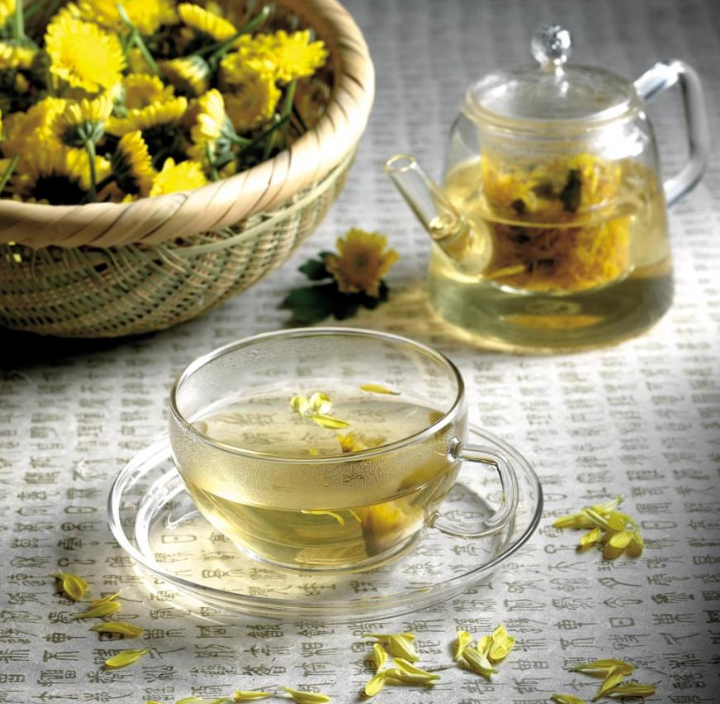
Various types of tea are used in Darye. Each type has its own unique preparation and serving methods. 녹차 Green tea is one of the most popular types of tea used in the Korean tea ceremony. Green tea leaves are minimally processed, preserving their natural flavors and aromas. 보리차 Barley tea, made from roasted barley, has a toasty flavor and is often enjoyed for its mild and refreshing taste. 옥수수차 Corn tea is made by roasting corn kernels. It has a slightly sweet and nutty flavor, making it a comforting choice. 국화차 Wild chrysanthemum tea is made from 국화 wild chrysanthemum flowers and is known for its light and floral notes. 대추차 Jujube tea is made from 대추 the Chinese fruit jujube. It has a naturally sweet taste and is often consumed for its perceived health benefits. 오미자차 Omija tea is a unique Korean tea made from Omija, also known as the five-flavor berry. It is known for its complex flavor profile, combining sweetness, sourness, bitterness, saltiness, and spiciness.
Darye follows a precise sequence of steps. The host begins by carefully choosing and cleaning the tea utensils, including the tea bowl 다완 (Dawan), tea whisk, tea scoop, and tea caddy. The host heats water to the appropriate temperature for the specific type of tea being served. The water is then poured into the tea bowl. The tea bowl and other utensils also may be warmed by pouring a small amount of hot water over them. This helps create an ideal environment for brewing the tea. The host measures the appropriate amount of tea leaves and places them in the tea bowl. The hot water is poured over the tea leaves, and the host uses the tea whisk to gently stir and mix the tea, allowing it to steep. The tea is carefully poured into individual tea cups and presented to the guests. The host may serve each guest individually or arrange the cups on a tray. Guests are encouraged to appreciate the aroma, color, and taste of the tea. There may be moments of quiet reflection as everyone enjoys the tea together. After the tea is consumed, the host cleans and dries the utensils. This step is performed with precision and care, maintaining respect for the tools and the ceremony itself.
Darye is not just about drinking tea. It represents the aspects of Korean culture, including Confucian principles, spirituality, and the appreciation of nature. Darye provides a platform for social interaction, fostering connections and conversations among participants.
https://encykorea.aks.ac.kr/Article/E0055116
http://contents.history.go.kr/mobile/km/view.do?levelId=km_010_0070_0030_0020
http://www.myungwon.org/sub3_2
https://teabybirdy.com.au/blogs/news/south-korean-darye
다례 Darye
녹차(Nok-Cha) Green Tea

보리차(Bori-Cha) Barley Tea
![질마재] 순수한 유기농 보리차 - 고창마켓](https://noblegochang.com/web/product/big/GC00153.jpg)
옥수수차(Oksusu-Cha) Corn Tea
![띵굴마켓 : [코스트코] 광동 옥수수 수염차 340ml × 24팩](https://thingool123.godohosting.com/gd5replace/thingotr4652/data/editor/goods/210603/ef56d6e3223d556923f8b6c68a652eff_182814.jpg)
국화차(Gukhaw-Cha) Wild chrysanthemum Tea
대추차(DaeChu-Cha) Jujube tea
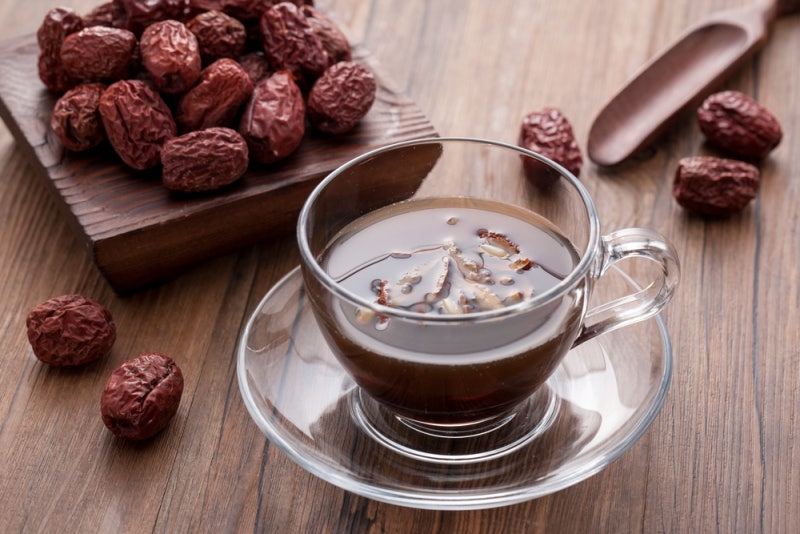
오미자차(Omija-Cha) Omija Tea

Fall 2023 SDLC111
Monthly Language Learning Journal #4
David Kim
30262888
david.kim123@richmond.edu
For November, my language partner and I watched episodes six and seven of the Korean drama show “Mask Girl” on Netflix. Episode six “Kim Mo-mi” is about Kim Mo-mi’s life after she gets imprisoned. The episode starts with black and white. She is dressed in a prison uniform with the number 1047. She is famous due to the Mask Girl case and does plastic surgery consulting for people inside prison. She meets An Eun-suk, another prisoner who is the strongest figure inside the place. She has connections with politicians and made the rule that people who are imprisoned by adultery can not have any food for three days. This scene shows that An Eun-suk is more powerful than the officers. She regularly gets coffee with the manager of the prison. However, Kim Mo-mi doesn’t care and shares her food with the person who was caught for adultery. Even though Kim Mo-mi fought with An Eun-suk’s people, she was the only one getting a penalty. She did not give up and kept fighting with An Eun-suk to the point that An Eun-suk told her people to not mess with her. It becomes 2023 and the episode brings in the colors. One day, Kim Mo-mi receives a letter: "You should also feel what it is like your child is getting destroyed.” She tries to escape but fails and gets a penalty of one month to stay alone in a small room only with a bible. Now Kim Mo-mi gives a testimony and promises An Eun-suk to donate a kidney for her daughter. During a bible study inside the prison, Kim Mo-mi and Kim Kyung-ja meet again. Kim Kyung-ja was one of the volunteers for the bible study. She escaped the car back in 2010. She got plastic surgery, made a fake ID, and bought a new house. She was the old woman who sold tteokbokki and spread the rumor that Kim Mi-mo was the daughter of Mask Girl. Episode six reminded me of the previous episodes. First, the threatening mail sent by Kim Jyung-ja reminded me of the threatening email sent by Ju Oh-nam in the beginning. I was surprised that they were son and mother. Also, the rumor appeared in the show again. I realized how a rumor can ruin someone’s life without any effort or money. It is dangerous because no one is responsible for it and it is difficult to stop it.
Episode seven “Mo-mi and Mi-mo” is about the last story between all the characters. Kim Mo-mi is taken to a hospital for kidney donation. She escaped the hospital and ran away with a car. Meanwhile, Ye-chun finds out that the rumor about Kim Mi-mo was started by the tteokbokki grandma. Kim Mi-mo’s grandma, Ye-chun, and Kim Mo-mi are all heading to Kim Kyung-ja’s house. Kim Kyung-ja already had Kim Mi-mo at her place and tied Kim Mi-mo up with a camera recording her. Kim Mi-mo’s grandma was killed by Kim Kyung-ja. Kim Mi-mo was able to defeat Kim Kyung-ja and save her daughter. However, Kim Kyung-ja was still alive with her gun. The police shot her but Kim Kyung-ja’s last bullet was shot toward Kim Mi-mo, and the mother saved her daughter with her own body. Ye-chun’s parents became Kim Mi-mo’s guardians and the drama ends with Kim Mi-mo watching her mother’s kindergarten tape.
When I first finished the whole drama, I thought it was very violent and dark. I could only see the dark sides that they tried to capture. However, I can now see the unseen relationship that only families can have. Even though Kim Mi-mo, Kim Mo-mi, and Kim Mi-mo’s grandmother had bad relationships, they all cared for each other deeply. They were even willing to sacrifice their own lives to save each other. When the drama Mask Girl did a good job capturing the dark reality of South Korea, it also did a wonderful job capturing the strong connection between family members.
Fall 2023 SDLC111
Cultural Post #3
국악 Gugak
David Kim
30262888
david.kim123@richmond.edu
Korean traditional music 국악 Gugak is a diverse and dynamic form of music that has its roots deeply embedded in Korea's cultural history. It encompasses a wide range of vocal and instrumental music, dance, and rituals.
During the Goryeo Dynasty, Gugak was divided into three categories. First, 아악 Aak, which originates from the Song Dynasty, was mainly used for rituals. Second, 당학 Dangak, which was already used, was commonly used for meetings with the king. Lastly, 향악 Hyangak, which was already used, was mainly used to learn Korean in informal settings.
Gugak utilizes a variety of traditional instruments. 가야금 Gayageum is a traditional Korean zither with 12 strings. It can be plucked with fingers or with a small bamboo stick. 거문고 Geomungo is another type of zither, but it is larger and has six strings. It is played by plucking the strings with a bamboo stick, making deep and resonant sounds. 대금 Daegum is a large bamboo flute with a buzzing membrane that produces a unique sound. 해금 Haegum is a two-stringed fiddle played with a bow. It is well known for its thin and high sound. 아쟁 Ajaeng is a bowed string instrument with strings made of twisted silk, known for its distinctive resonant sound. 피리 Piri is a double-reed instrument that is similar to an oboe. It has a cylindrical bore and a metal mouthpiece. 장구 Janggu is a traditional double-headed drum shaped like a hourglass. It has a wooden body and two different-sized heads, producing both high and low sounds. 북 Buk is also a traditional Korean drum, usually played with a stick by one hand. It has a wooden frame and a leather head.
Gugak often features distinct rhythms and scales that set it apart from other music. 장단 Jangdan refers to rhythmic patterns in Korean traditional music. These patterns are the rhythmic framework upon which the music is built. There are various jangdan patterns with their own unique feel and purpose. Some examples are 자진모리 장단 Jajinmori Jangdan, 굿거리장단 Gutgeori Jangdan, and 휘모리장단 Hwimori Jangdan. 악삭 Aksak is a type of irregular rhythm that is often found in gugak. It deviates from the regular meter found in many Western musical traditions. The use of aksak rhythms adds complexity and a sense of unpredictability to the music. 산조 Sanjo is a form of Korean traditional instrumental music characterized by solo performances. It often features complex rhythmic patterns that allow the performer to showcase their improvisational skills within a specific rhythmic framework. 평조 Pyeongjo is a traditional Korean mode or scale. It is similar to the Western major scale but has distinct intervals. The pyeongjo scale contributes to the bright and uplifting character. 향조 Hyangjo is another traditional mode that is similar to the Western minor scale but with unique intervals. It imparts a more contemplative and introspective quality to the music. 당악 음계 Dangak scales features complicated scales to contribute to the formal and ceremonial nature of formal music. 풍류 Pungnyu is a mode associated with folk music. It has a distinct and lively character, reflecting the celebratory and communal aspects of traditional Korean festivals and gatherings.
Institutions and musicians work to ensure that traditional music continues to thrive. Additionally, some contemporary artists incorporate elements of gugak into modern genres, creating a fusion of traditional and contemporary sounds.
https://encykorea.aks.ac.kr/Article/E0006374
http://www.sctoday.co.kr/news/articleView.html?idxno=4832
https://www.koreatravelpost.com/gugak-music/
가야금 Gayageum
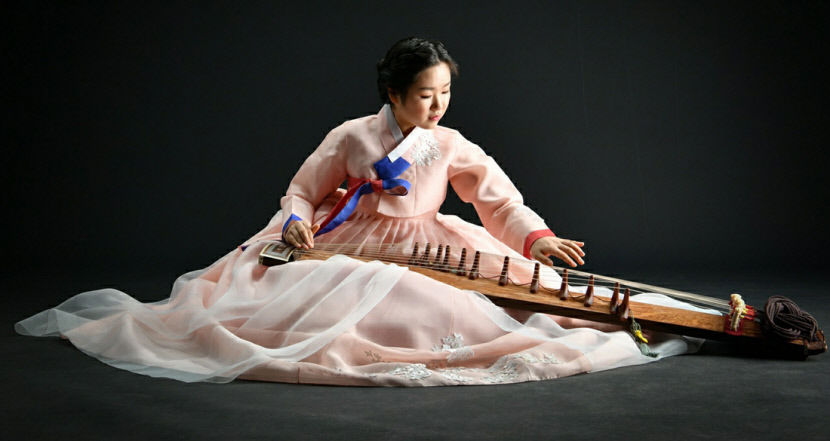
거문고 Geomungo
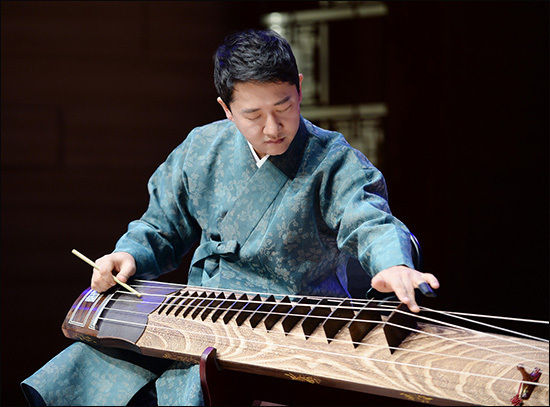
대금 Daegum
해금 Haegum
아쟁 Ajaeng
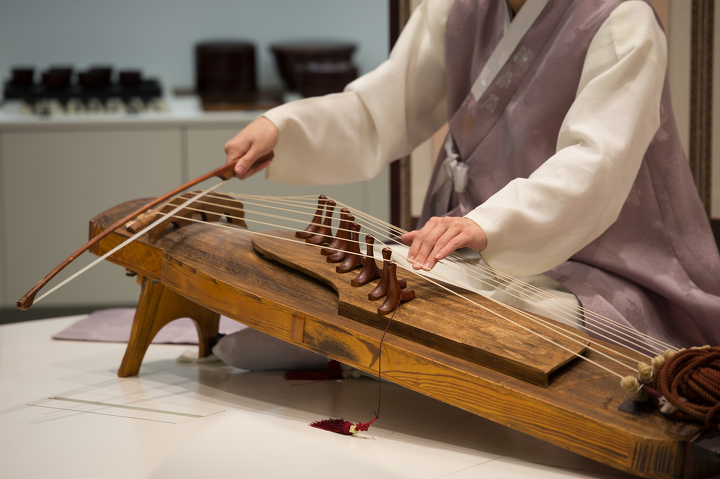
피리 Piri
![말랑말랑 국악 이야기] 부는 악기는 왜 모두 '피리'일까?](https://kid.chosun.com/site/data/img_dir/2014/03/13/2014031302661_1.jpg)
장구 Janggu
![문인이 만난 우리 시대의 명인] ⑩ 무형문화재 기능보유자 송진호 :: 경남신문](https://www.knnews.co.kr/edb/nimages/2022/07/2022070708044072559.jpg)
북 Buk

Gugak performances:
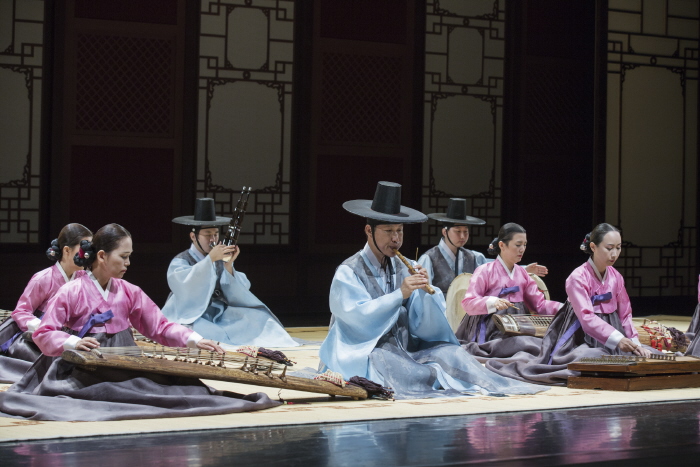
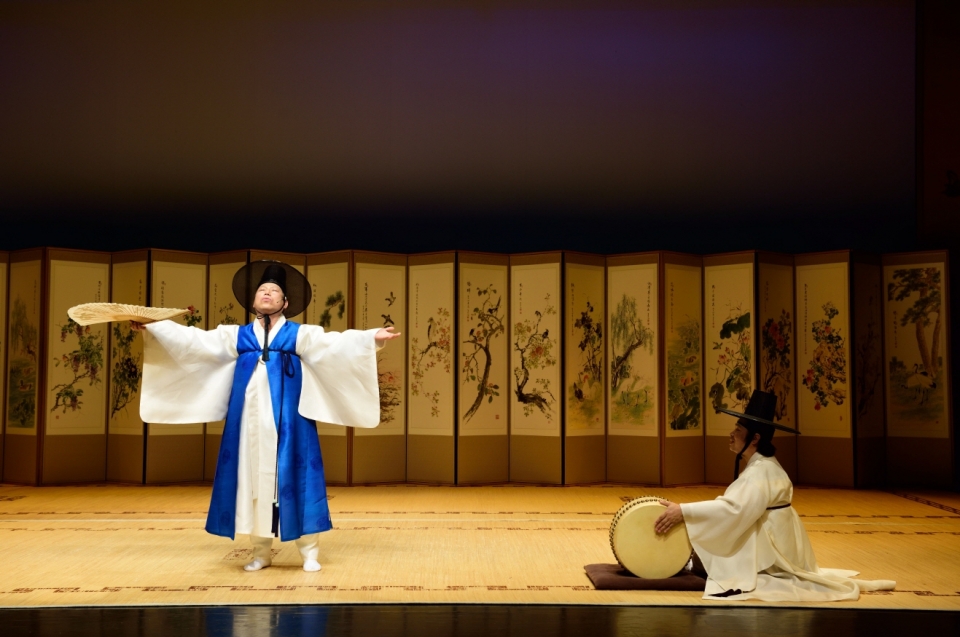
1 hour video of Gugak performance
Fall 2023 SDLC111
Monthly Language Learning Journal #3
David Kim
30262888
david.kim123@richmond.edu
For November, my language partner and I watched episode four and five of the Korean drama show “Mask Girl” on Netflix. Episode four “Kim Chun-ae” starts with Kim Chun-ae telling her story to Kim Kyung-ja. During high school, Kim Chun-ae’s first love was Buyong, a K-pop idol trainee. Buyong kept borrowing money from Kim Chun-ae, but did not give back any of the money. After Buyong debuted, Kim Chun-ae secretly heard that Buyong thought of her as his personal ATM. Kim Chun-ae got mad of her and uploaded his high school pictures of smoking, drinking, and inappropriately hanging out with his friends. This scene reminded me of episode three, when Ju Oh-nam sent a threatening email to Kim Mo-mi because he couldn’t hold his anger. I think these connections captures another important dark side of South Korea’s internet culture, 악플(Ak-peul) hate or mean comments. Some immature people leave hate comments even though the news is not yet true or proved wrong. There are also some young people who killed themselves because of hate comments. After getting plastic surgery, Kim Chun-ae bumps into Buyong, who has no job and is living a meaningless life. To support him, Kim Chun-ae works at a bar at night and becomes the most popular worker dancing and singing. She meets Kim Mo-mi there and gets close with her just like sisters. They both lived a lonely life and wanted to get prettier. To protect her, Kim Chun-ae lies to Kim Kyung-ja that she will try to find Kim Mo-mi. Kim Chun-ae was living with Kim Mo-mi and tells her to leave far away immediately. Kim Chun-ae tries to get her stuff at her house without getting caught by Buyong, but Buyong finds out that she was the one who ruined his life. Kim Chun-ae and Kim Mo-mi kill Buyong by suffocation and get away in a car with his dead body in the trunk. Kim Mo-mi reveals that she is pregnant. Even though it is Ju Oh-nam’s baby, she is going to raise her with love, telling her she is beautiful. Kim Kyung-ja caught up with them and killed Kim Chun-ae with her gun. Kim Kyung-ja gets stoned by Kim Chun-ae. Kim Mo-mi put the bodies all together in the car and dumped the car into the river. Mask Girl turned herself in. Episode four captured the dark reality in South Korea about unfair love relationships, working at night, telling bad things about a different person, and hate. I was impressed that it also showed how you can still find someone who will be on your side no matter what just like Kim Chun-ae.
Episode five “Kim Mi-mo” is the story of Kim Mi-mo, the daughter of Kim Mo-mi and Ju Oh-nam. Mask Girl is sentenced to life imprisonment. Kim Mi-mo was raised by her grandmother, Kim Mo-mi’s mother. However, she realized that she was the daughter of Mask Girl. Wherever she moved, the rumor kept following her and she became antisocial and rebellious. She only had a good relationship with the old woman who sold tteokbokki. She finally made a friend at a new school. Her name was Ye-chun, but she lied to Kim Mi-mo to be close with her. She was raised in a peaceful family of parents and younger siblings, but told Kim Mi-mo that her father was alcoholic and was violent toward her mother and herself. The rumor about Mask Girl’s daughter also became a hot topic in Kim Mi-mo’s new school. Kim Mi-mo found out that Ye-chun was lying about her family. Episode five reminded me of episode one because of the rumors. Rumors influenced Kim Mi-mo in a bad way, even though she did nothing wrong. I think there is a connection between hate comments and rumors because internet rumors could affect a person’s life in a bad way through hate comments. I look forward to the next episodes about Kim Mi-mo and her relationships with her grandma, tteokbokki grandma, and her friend Ye-chun.
Fall 2023 SDLC111
Cultural Post #2
탈 Tal
David Kim
30262888
david.kim123@richmond.edu
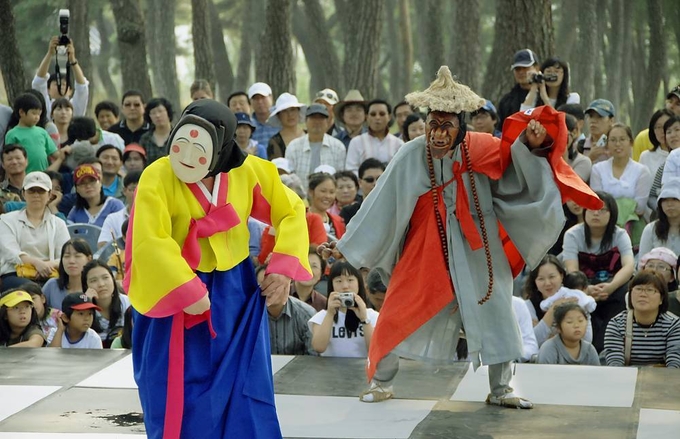
Korean masks 탈 Tal are traditional masks with deep cultural and historical significance. These masks have been used for various purposes in Korean culture, including shamanistic rituals and theatrical performances. They come in a variety of styles and designs, each serving a specific purpose.
In traditional Korean shamanism, masks represent the connection with the spirit world. The masks were believed to serve as a conduit between the human and spirit worlds. Shamans, known as 무당 mudang or 무교 mugyo, would wear masks during ceremonies to embody the spirits they were invoking. The movements and dances performed while wearing the mask were considered a form of spiritual expression. They also believed to have the power to ward off evil spirits, bring blessings, and facilitate communication with ancestors or divine entities. Different masks were used for different purposes, depending on the nature of the ritual. The masks used in these rituals were not just decorative. They held significant spiritual meaning and symbolic significance. For example, masks might represent specific animals, mythical creatures, or deities. The choice of a particular mask would be based on the spiritual intent of the ritual. Overall, the ceremonial use of Korean masks reflects the multifaceted nature of Korean culture and its rituals and beliefs.
Tal were not limited to spiritual rituals. They were also used in festivals and celebrations. Certain festivals involved masked dances and processions, bringing communities together in a joyful manner. Tal masks are often integral to traditional Korean mask dances 탈춤 Tal-chum (Tal Dance) and plays 탈놀이 Tal-nori (Tal Play) that depict stories from folklore, mythology, and historical events. These performances serve as a means of storytelling, preserving cultural narratives, and passing down traditions from generation to generation. Tal performances often have an educational aspect, especially when they are used to retell historical events or convey moral lessons. Through the use of masks, performers can engage audiences in a visually captivating way, making the stories more accessible and memorable. Tal performances play a crucial role in preserving and promoting Korean cultural identity. By showcasing traditional art forms, including mask dances and plays, these performances contribute to the continuity of cultural practices and help maintain a sense of identity in a rapidly changing world. Tal combines entertainment, cultural preservation, education, and a celebration of identity, offering audiences a look into Korean traditions and artistic expression.
Tal are crafted using materials like wood, paper, and gesso (a type of plaster). Skilled artisans create intricate designs, and the masks are often painted in vibrant colors. There are various types of Korean masks, including 하회탈 Hahoe masks and 양주탈 Yangju masks. Hahoe masks, from the Hahoe village, are known for their realistic and expressive features. Artisans carefully carve and paint Tal, making each one as a unique work of art. Yangju masks, from the Yangju region, are commonly used with traditional mask dances and performances that have been passed down through generations.
If you have the chance to visit Korea, I hope you experience making your own Tal, wear different types of Tal, and watch a dance or a play using Tal. Tal is a unique cultural artifact that combines spiritual, cultural, and artistic aspects of Korea.
https://encykorea.aks.ac.kr/Article/E0058798
https://www.antiquealive.com/Blogs/Korean_Mask.html
탈 Tal (Korean Masks)
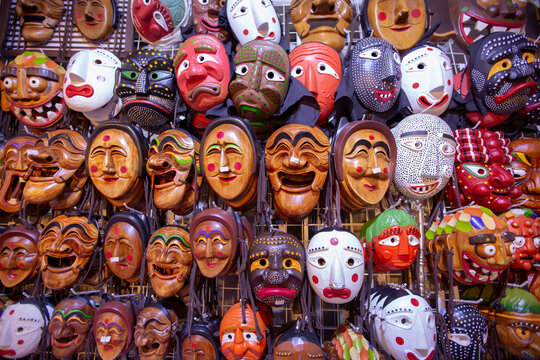
하회탈 Hahoe masks

양주탈 Yangju masks

탈춤 Tal-chum (Tal Dance)
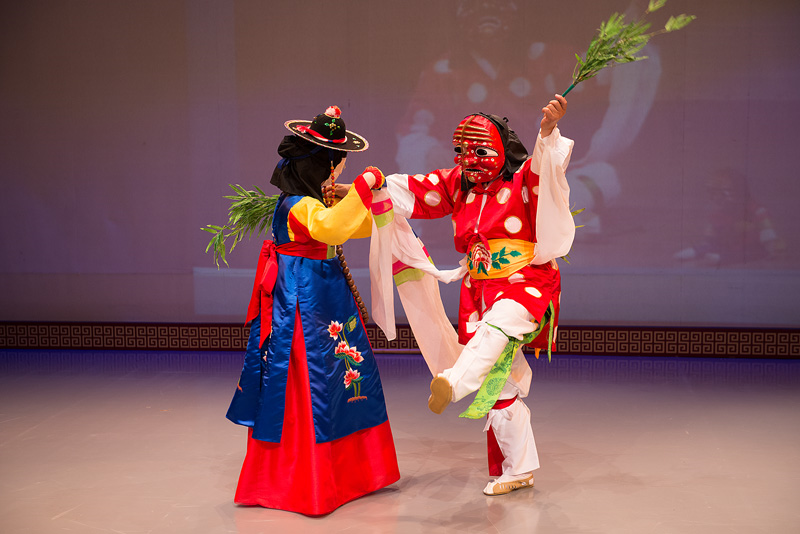
탈놀이 Tal-nori (Tal Play)
Fall 2023 SDLC111
Monthly Language Learning Journal #2
David Kim
30262888
david.kim123@richmond.edu
For October, my language partner and I watched episode three of the Korean drama show “Mask Girl” on Netflix. Episode three “Kim Kyung-ja” continues on with the story of Ju Oh-nam. Ju Oh-nam is in love with Kim Mo-mi, but already knows that Kim Mo-mi is in love with her boss. Ju Oh-nam watches Kim Mo-mi following her boss into the company building after work. Even though Ju Oh-nam watches Kim Mo-mi’s boss, who is married, is having an affair, he was just happy that she was not Kim Mo-mi. This part scared me because I felt that he is a person who puts his feelings first regardless of whatever is happening right or wrong. This scene has nothing related with South Korean culture because it is purely an individual emotion and reaction depending on the person.
When Ju Oh-nam saw Kim Mo-mi going into a motel with her drunk boss, he could not hold his feelings and wrote a threatening email to Kim Mo-mi. The letter said “I know who you are Mask Girl.” When she received that letter, she was surprised in the office and quietly cried in the toilet by herself. Even though Kim Mo-mi got that email, she went out on a date with another streamer. He said he graduated college in America and complimented Kim Mo-mi’s appearance. However, he posted “She is ugly but I am still going to spend the night with her” on his social media. Kim Mo-mi wanted to refuse, but the guy would not let her go outside a motel room. The guy dies by an accident after a physical fight. Ju Oh-nam, who followed them by seeing the social media post, completely kills him and takes care of the dead body.
When Kim Mo-mi got back home and took a shower, I was shocked again by the scene production of her face melting down and fluttering. It felt like it was expressing her complexness and hate about her appearance. Ju Oh-nam came to her house and started talking to each other. Kim Mo-mi found out that Ju Oh-nam was the person who sent that email and said that she wants to erase it all. Ju Oh-nam tries to have sex with her but she does not strongly resist. He takes off her mask but she already rapped her head and face around due to plastic surgery. Without having a lot of time to be sad, Ju Oh-nam gets killed by Kim Mo-mi with a sharp object next to them.
The episode shifts to Kim Kyung-ja, the mother of Ju Oh-nam. Kim Kyung-ja raised Ju Oh-nam by herself. She called the police because Ju Oh-nam disappeared, but dead body parts in the refrigerator was the only thing they could find at his house. It was the body parts that he took care of for Kim Mo-mi. Kim Kyung-ja found out that the case was related to Mask Girl and tried to find her by herself. She gets prepared with a real gun and a stun gun. She finds a woman who had the same necklace as Mask Girl and kidnaps her. However, the woman says she is Kim Chun-ae, not Mask Girl.
Episode three captured the dark reality in South Korea about loneliness, bullying, adult live streams, rape, murder, and kidnapping. Even though it was exaggerated, Mask Girl is a good drama to learn about those topics. I am looking forward to the next episode.
Fall 2023 SDLC111
Cultural Post #1
추석 Chuseok
David Kim
30262888
david.kim123@richmond.edu
When I checked my calendar for September, 29th was marked with Chuseok and 28th and 30th were marked with consecutive holidays of Chuseok. Since I am living in the United States during this time period for university, I am jealous of other Koreans who have long weekends with holidays.
Chuseok is a national holiday celebrating Fall and harvest on August 15th of the lunar calendar. It is a three-day holiday, also known as the Korean Thanksgiving Day. It is one of the biggest traditional holidays in South Korea with New Year’s Day. In addition to the meaning of appreciating Fall and harvest, it adds the meaning of celebrating the victory of 신라(Silla) over 발해(Balhae). It is not known exactly when Chuseok began, but it is assumed that it began before the Three Kingdoms Period, given that it already existed in Silla. "Han" means big and "Gawi" means center. "Gawi" also means 가배(gabae), which is a tool that women used to weave yarn during the Silla Dynasty. There are many hypotheses about the origins of Chuseok, including the story from the 적마경기(Jeokma Gyeonggi) held during the reign of Yuri Lee Sa-geum, the third king of Silla.
During Chuseok, various events are held and games are held. People enjoy playing games such as 널뛰기(Neolttwigi), 제기차기(Jegichagi), 강강술래(Ganggangsullae), 윷놀이(Yutnori), and 씨름(Ssireum). They enjoy Nongak, divide sides among villagers, or play tug-of-war with other villages. A wrestling match takes place on the lawn or sand, and the winner receives calves, rice, and mineral trees. In the west coast of Jeollanam-do, women gathered in an open field at the sunrise of Chuseok and played Ganggangsullae, and it is said that they also enjoyed 닭싸움(chicken fights) and 소싸움(cow fights). Making a wish on the full moon is a tradition that has been passed down since a long time.
On Chuseok, people wear hanboks, prepare songpyeon made of new rice, and various foods such as fresh fruits and taro soup to appreciate the harvest. Also, they have a good day sharing delicious food with my neighbors. No matter how poor and difficult people lived, they enjoyed sharing food together. It is the season of fruits in which all kinds of grains are ripe, and contains the brightest moon chestnut, and a grave is offered in gratitude for the grace of the ancestors. In addition, it is usual for Korean office workers to be paid bonuses in the name of Chuseok bonuses. Young children will also get some money from elders.
Chuseok is Korea's largest holiday to celebrate a good harvest in the harvest season, hold a rite to honor the benevolence of the ancestors, and share a warm heart with neighbors. As the saying goes, "No more or less, always like Hangawi," new grains and fresh fruits come out during the good season of Cheongo-mabi, and everything is abundant.
Since it is difficult to experience Chuseok and its culture, food, and traditional games in the United States, I hope to spend a good time in South Korea for Chuseok in the future.
https://www.90daykorean.com/chuseok-in-korea/
https://encykorea.aks.ac.kr/Article/E0057862
http://contents.history.go.kr/mobile/km/view.do?levelId=km_036_0040_0020_0030_0040
Fall 2023 SDLC111
Monthly Language Learning Journal #1
David Kim
30262888
david.kim123@richmond.edu
For Fall 2023 SDLC 111, my Korean language partner Rachel and I decided to watch a new Korean drama “Mask Girl” on Netflix. Mask Girl is a Korean black comedy and thriller drama about a girl living two lives based on her appearance. Kim Mo-mi is a female worker who is daydreaming about her male boss during the daytime. At night, she puts on a face mask and livestreams content for adults as her internet personality Mask Girl.
During the first twenty minutes, there was a shocking scene to me. Kim Mo-mi is love in with her boss, who is married. She thinks he is nice, attractive, and smart. When she thinks he is focusing on his work, he is actually drawing abdominal muscles in his photo. This could be a funny scene, which I also agree it is, but I think it is a great scene that represents perfectionism and the deadly beauty standard of South Korea. Even though someone else thinks he is perfect, he is eager to be ‘more’ perfect and look even nicer. I could make connections from this scene to young girls and female K-pop artists. When young girls admire female K-pop artists, they want to follow everything about them, including their appearance. They think being skinny is beautiful and try to become as skinny as possible by eating almost nothing. Their obsession with beauty leads to danger to their health, more beauty products, and also plastic surgery.
There was one scene that portrayed the 소문(So-moon)(rumor) culture of South Korea. Kim Mo-mi accidentally saw her boss whom she was in love and another female worker having an inappropriate meeting in the office at night time. During lunch with other co-workers, she told the story of what happened. Then, she could hear other people that she didn’t know talking about that story with exaggerated scenarios. They said rumors that the female worker got pregnant, and already given birth, and the boss is 두집 살림(Do-jip-sal-lim)(living in two houses). I think this scene did a good job of capturing the atmosphere of the pressure and rumor culture of Korean companies. Koreans usually have the pressure of worrying about what other people are thinking about them. That is why beauty products and plastic surgery are well-developed in South Korea. Even though everyone has the same worries and concerns, people do not mind talking negatively and gossiping about someone else. I have not experienced the rumor culture in South Korea, but you can easily find this cliché in many Korean movies, dramas, and other media.
During September, Rachel and I completed the first two episodes of Mask Girl. The second episode introduces a new male character, Joo Oh-nam. Joo Oh-nam works at the same place as Kim Mo-Mi. He was bullied since he was young because of his appearance. He likes to be by himself and watch live-stream content for adults. As Joo Oh-nam gets to know that Mask Girl is Kim Mo-Mi, the episode ends. I am planning to keep watching it and discuss the cultural aspects of South Korea.


