My updated Korean language learning plan: BeckyChen_LearningPlan_REVISED
My 'I can' statements: BeckyChen_I_Can_Statements
My updated Korean language learning plan: BeckyChen_LearningPlan_REVISED
My 'I can' statements: BeckyChen_I_Can_Statements
I think my work throughout this semester has been reasonable. Although I wasn’t able to follow my learning plan completely, I’ve gotten through about two-thirds of it and then started the Eggbun app because I wanted to work outside of my textbook and try something new. The Eggbun app is basically a Korean language learning application that covers the following topics: Hangeul, names of the Korean letters in Hangeul, borrowed words from other languages, the different number systems, pronunciation, classroom expressions, greeting expressions, self-introduction expressions, and topic and subject markers. As I mentioned in a previous post, Vivian had recommended Eggbun in her presentation, and I downloaded it as soon as it was available for iPhones. So far, I like it because it’s interactive whereas learning from the textbook can get a little dreary sometimes.
In addition to the Eggbun lessons, this semester I’ve studied the following topics: saying hello and farewell, using like/dislike and want (to)/don’t want (to) in sentences, creating simple sentences, verbs, telling time, and relationships. If I have time during finals week, I hope I can also learn the last bits of my lesson plans, which includes negative sentences, the past tense, and informal Korean.
Now, I can somewhat confidently do the following in Korean:
NOTE: the following tasks are all spoken
Since my goals were relatively reasonable, I don’t think I encountered too much difficultly as I studied Korean this past semester. Maybe time management was a bit tricky, but when I’m studying I usually catch on pretty quickly. But now that I think about it, Korean pronunciation can be a bit hard sometimes. It’s hard for me to distinguish between the pronunciation of hard consonants and double consonants. I also still have to work on memorizing the sound changes in Hangeul. I think the best thing I can do to improve my pronunciation is just to look up tutorials specialized in Hangeul teaching and practice saying those types of words a lot or maybe ask a Korean friend about the differences, which brings up another point. I didn’t really consult any of my Korean friends about my work this semester and I wasn't assigned a language partner, so I ended up working independently on pretty much everything. Part of the reason was because I didn’t run into problems that I couldn’t solve myself, but even when I do run into them, I like to try to solve them myself first before consulting someone else because it helps me learn. But, in the future, I’d like to be more open with my language study and regularly consult native speakers, because I think the immediate feedback would be an efficient way to practice conversational skills and pronunciation since being able to speak Korean fluently is one of my long-term goals.
Ordering food at a Korean restaurant:
Transcript:
A: 안녕하세요. 주문하시겠습니까?
B: 뭐가 맛있어요?
A: 불고기나 갈비가 바베큐로 좋습니다.
B: 채식메뉴 있어요? 전 채식주의자에요.
A: 그리고 순두부찌개도 추천드립니다.
B: 순두부찌개 주세요. 안맵게 해주세요.
A: 네.
A: 어떠신가요?
B: 맛있어요. 물 더 주세요.
A: 네, 여기 있습니다. 디저트로 무엇을 드시겠습니까?
B: 어떤 게 있나요?
A: 아이스크림과 차가 있습니다.
B: 아이스크림 주세요. 어떤 맛이 있나요?
A: 녹차와 바닐라가 있습니다.
B: 녹차 아이스크림 주세요.
A: 여기 있습니다.
B: 감사합니다.
B: 여기요! 계산해 주세요.
A: 여기 있습니다. 감사합니다.
B: 네, 안녕히 계세요.
Rough translation:
A: Good evening. What would you like to order?
B: What's delicious?
A: Bulgogi (beef) and galbi (ribs) is good for barbecue.
B: Are there vegetarian dishes? I'm vegetarian.
A: I also recommend the soondubu (soft tofu stew).
B: Please give me soondubu. Please don't make it spicy.
A: Yes.
A: How is everything?
B: It's delicious. Please give me more water.
A: Yes, here it is. Would you like some dessert?
B: What do you have?
A: Ice cream and tea.
B: I'll have ice cream. What flavors do you have?
A: Green tea and vanilla.
B: Please give me green tea ice cream.
A: Here it is.
B: Thank you.
A: Waiter! Check, please.
B: Here it is. Thank you.
A: Yes, goodbye.
Answering questions about identity:
**NOTE: I accidentally switched the tasks between Artifacts 2 and 3. See 'My Second Artifact' if you want to hear me introducing myself and my family.
Rough translation: (polite form)
A: Hello.
B: Hello.
A: I'm Chul-Soo Lee. What is your name?
B: I'm Becky Chen.
A: I'm French. What nationality are you?
B: I'm American.
A: Where are you from?
B: I'm from China.
A: I'm 34 years old. How old are you?
B: I'm 21 years old.
A: I'm a designer. What do you do?
B: I'm a student.
This is my first time learning a language entirely from scratch by myself. In the past, my language learning experiences were usually in the classroom with a teacher. I have always enjoyed studying languages but I quickly found out that my learning plan for Korean was a bit too ambitious from the beginning, especially when I was also balancing my school schedule at the same time. And so, because it was hard to complete everything on my lesson plans, I began to improvise the tasks for each week as I went along. For example, two weeks ago, I started using the iPhone app “Eggbun” that Vivian recommended in one of her presentations, and I really like it! The iOS app is not as developed as the Android one, but it’s still pretty cool. Eggbun is particularly useful if you just want a quick and efficient way to learn the basics of the Korean language (Hangeul, greetings, self-introduction expressions, number system, etc.), which is something that would take my book several chapters to explain because it incorporates the phrases into scenarios and explains the grammatical structure in detail. I know that I had originally said that I would focus on using just my textbook, and that’s because I thought that it would be nice to learn the material from the same source for a consistent teaching style. I also thought that it would save me time from compiling materials from various sources that would also have different teaching methods. But now that I think about it, I think that finding material from various sources would actually force me to make connections between different sentence structures and learn multiple ways of saying the same thing, which would help make my sentences more fluid and flexible. I’ve also discovered that my book doesn’t always teach practical scenarios and phrases, which I realized after my friends asked me to say relatively simple phrases in Korean and I didn’t know how. As for the cultural aspect, I definitely learned a lot about Korean culture from both my own projects and my classmates’ presentations. What particularly intrigued me were the Korean drinking culture and the resourcefulness behind the creation of hanok, or Korean traditional homes.
Overall, I think that I can improve as a language learner by being more consistent with my learning plan. They say that one seeking to acquire a new language should study that language everyday, but daily language study was challenging in my situation. Throughout the semester, my learning sessions were less systematic and took place mostly during the weekends and holidays. However, now that summer vacation is approaching and I’m at the end of my college career, I think I’ll continue with my Korean Made Simple book at a slower pace. I think I enjoyed learning Hangeul, the Korean alphabet, the most. It was something that I felt I knew the most thoroughly about. It always excited me whenever I could pronounce unfamiliar Korean words because I knew the sounds of Hangeul.
I particularly enjoyed the readings about the survival of languages and bilingualism. Actually, I enjoy learning topics about applied language rather than linguistics and technicalities of languages. This is mostly because my primary reason for learning any language is so that I can use it. If I can get by without knowing the technical details, then I’ll probably skip it and go with the most practical route. Learning activities that I constantly do are ones that involve quiz and recall. Basically, if I learn new vocabulary, I would test myself by writing as many of the new vocabulary words on a blank sheet of paper from recall. No notes. Other times, I would play Quizlet games that use the same quiz and recall principle.
If there was more time, I’d like to learn more about how language structure changes on a microscale, in other words how do ‘slang’ and ‘vernacular’ emerge. I can understand how an official language can stay in country borders because it’s standardized and taught in schools. However, I’ve always wondered how regional dialects manage to stay within regional boundaries when there’s no one regulating the flow of speakers and non-speakers from the region. I also know that most of the East Asian languages have similar grammatical structure, and I think making these connections would help speed up the language learning process. I honestly don’t know if learning about a language’s history and origins will help me much as a practical language learner; perhaps, I would get a better context for when to use certain phrases in the language. But it’s still interesting to study how languages emerged, because I think creating a language is one of the most admirable things that human beings have done. It’s hard to believe that so many people are able to agree on a specific way of communicating and how we are able to ensure uniform language learning for so many years. Without a formal education system, I wonder if language learning would persist as it does today.
The cultural projects that my classmates presented so far were all very interesting. I was particularly interested in the Israeli holidays and Korean drinking culture topics. My knowledge about Judaism and Israeli culture is very limited: In fact, I recall once in third grade, the librarian was getting ready to read a story about Moses to us and then asked the class if anyone was Jewish. There was a long silence and then I raised my hand, not sure what she meant but felt like maybe “being Jewish” would be something cool to tack onto my identity. Of course, as I got older, I met new people and among them my first Jewish friend. She devoutly observes the Jewish holidays, and it seemed like she was always either fasting or eating only certain foods during certain times of the year. Thus, I grew curious about why there are so many holidays in Judaism. Since many Jewish holidays seemed to involve unique food, like matzos and latkes, I figured that they were all related to stories in their holy book. But, it never occurred to me that the Israeli holidays have a deeper purpose: that is, they allow the Israeli and Jewish people to celebrate surviving another year, because their people had been persecuted many times in history.
As for the Korean drinking culture, I personally don’t drink but have always wondered why soju seemed to be at the center of many Korean lives in TV dramas. I thought it might be the taste, so I tried it once legally (just a sip) but it tasted like cough medicine to me. Or, maybe I just have no taste for alcohol. And so, since it didn't seem to be the taste, I suspected that it might be for social reasons. Maybe the drinking culture in Korea is so popular today because it helps bring people together. It turns out that's precisely it. There are even understood rules about what’s rude and what’s not when drinking. Of course, the hierarchy that’s so prominent in other elements of Korean culture is also present here. For example, the younger person always pours a drink for the older person, and they must also cover their glass and look away when drinking to show respect. Drinking alone is generally looked down upon in Korea, probably because it’s mostly a social act. There's often a routine to drinking, where after some bottles of soju the group may head over to a karaoke place or a nightclub. It’s also not uncommon to see businesspeople chatting away over barbecue and soju. Anyways, seeing that I missed the point of soju when I took that one sip, maybe I should give soju another chance and drink it with a group of friends next time.
For my cultural project, I researched on Korean traditional houses, or hanok (한옥). I found these houses interesting, mainly for their scientific design and practicality. Some unique features of the house include an underfloor heating system (온돌), the use of open wooden floors (마루) to foster community among the inhabitants, and the special paper (한지) windows for ventilation. The main concept of hanoks is to welcome nature into the home and to incorporate it into the occupants’ lives: that is, the Korean people believe that human and nature should willingly coexist. This idea is different from most Western style homes, where there’s usually a fine line between home and the outside world.
Nowadays, traditional hanoks are less common due to the industrialization of South Korea after the 1960s. Although many hanoks have been demolished and replaced with apartment complexes, there has been a recent renewed interest in environmentalism and Korean history in South Korea, so modern hanoks have emerged. Impressed with the functionality and efficiency of hanoks, some Western architects have even incorporated elements of the hanok design, such as the ondol system, into their own projects.
I chose this topic for my cultural project, because I was curious about the way that Korean people think. And, I thought "what better way to find out than to look at how they live ?" And so, I decided to study Korean homes. After completing this project, I learned that the Korean people, as a collective whole and perhaps more so the past generations, are very resourceful and incredibly knowledgeable about human well-being to come up with such clever designs. I mostly appreciated their use of the floor and value of empty space, because it’s humbling and suggests that people don’t need materialistic goods to spend good quality time together. For soju, though, that’s another story.
My Hanok presentation (descriptions in notes section of each slide):
https://drive.google.com/file/d/0B4C94ZXjSLU7bUY3WFVVSGJWXzg/view?usp=sharing
Sources:
Content
Images
I love reading and writing in Hangeul! Actually, in my earlier posts, I mentioned that I thought I’d focus on speaking the most for the sake of time, but then I realized that learning Hangeul was essential for my pronunciation too. And so, I learned to read and write in Hangeul and enjoyed it because it made my lessons a lot more holistic. After learning Hangeul, I was able to pronounce unfamiliar Korean words, and I got excited because that was one of my learning goals! The sound change rules are still a bit tricky though when I try to write the characters just based on pronunciation, so I think I’ll just have to memorize the characters that involve sound changes. If you haven’t noticed already from my older posts, I really advocate holistic learning so I appreciate that my KMS book includes audio with its lessons. Overall, I really like writing and reading in Hangeul because I think it helps me learn the word pronunciation more accurately. I guess I could just romanize the words if I were only learning to speak, but I feel like that would open too much room for pronunciation error that would accumulate overtime, which wouldn’t be productive. So, I decided to start from square one.
It took a surprisingly short amount of time, maybe a couple hours, to learn the Hangeul alphabet. The KMS book was designed so that I had to learn Hangeul before doing the lessons (because they were all written in Hangeul with no romanization), so I had no choice if I were going to follow the book. But now I’m thankful for knowing Hangeul, because it has definitely helped with my language study throughout.
In response to the “Why bilinguals are smarter” and “Are bilinguals really smarter?” readings:
This isn’t the first time I’ve heard about this “bilinguals are smarter” idea. Of course, the media always tends to twist the wording in their titles a bit to draw people’s attention, but essentially the idea is that learning an additional language helps the brain improve and acquire certain executive functions, and the ability to exercise these functions is considered a “smart skill.” But, intelligence has always been subjective. Most people might see learning multiple languages as a good thing, but I can see some possible drawbacks, such as lack of depth in any one particular language. For example, bilinguals generally know more vocabulary overall, but for each individual language they may know fewer words than average. It’s the same idea as doing many things mediocrely or doing a few things excellently. Of course, it’s possible to be fluent at many languages, but it’ll take time and the learner has to decide whether or not they are willing to input the time to learning the new language and what they are willing to sacrifice. Time spent learning a new language is time not spent reviewing your old language. It may also be best if he does not take up additional languages besides that one language, so that he doesn’t increase the ‘distraction’ while trying to master that one foreign language. But, this then begs the question ‘is it practical to learn any single language in depth?’ Personally, I’m a very practical person so sometimes I feel that as long as I can communicate and get my message across, it’s good enough. But then there’s something called the human ego that drives our desire to be proficient in everything we do. Learning the language in depth also shows your appreciation for the language’s culture. But, there are definitely some advantages to being monolingual too, so it’s not really a matter of who’s smarter than whom. In the end, it really depends on the individual, what their goals are in life, and whether language acquisition is a priority for them.
I don’t know the exact number, but I think I’ve learned at least 1000 Korean words though I haven’t quite memorized them all yet. In retrospect, I think I should have targeted my lessons to practical scenarios rather than just blindly following the book. I realized this when one of my fellow Korean learners asked me how to say ‘bathroom’ and I didn’t know how. Therefore, in these next few weeks I’d like to aim for practicality in my lessons. I think it will help if I make a dialogue for common scenarios and list the relevant vocab words I can use in that particular scenario, so that I can group the words and phrases together and memorize them more efficiently.
I learned the vocabulary words through Quizlet. I made vocab lists and practice with the Quizlet flashcards and games every now and then. I used to hand-write my vocab lists but I decided to switch over since it seemed faster on the computer. Plus, I got to practice my Korean typing which was fun. And, I basically learn the new terms by practicing over and over again. Fortunately, a lot of the terms sound like the corresponding term in Mandarin and my Chinese dialect, which made it easier to memorize. To reinforce the words into my memory though, I sometimes might come up with mini skits where I would improvise and make a scenario based on the sentence structures and vocab words I’ve learned so far. The goal is to correctly use as much vocab words as possible. Personally, I think this quiz-and-recall method is super-effective for memorizing new words quickly and holistically. By the end of the semester, my goal is to be able to use the Korean grammar and vocab I've learned in at least five different scenarios.
For Week 12, I will learn how to talk about the weather and how to speak with negation. I’ll achieve this by reading Chapters 11 (Colors) and 14 (Negative Sentences) of my KMS book and doing the corresponding exercises. I’ll also watch sweetandtastyTV’s “Korean Phrases 5: Describing the Weather.” By the end of this week, I want to be able to talk about the weather with a Korean friend. I'm also going to search for a Korean newspaper online and see if I can read the weather forecast.
At this point, I'm accumulating a good amount of vocabulary, but I need an efficient way to memorize them all. I think I'll start giving myself vocab quizzes and maybe start using Quizlet to compile my Korean vocabulary lists. However, the Quizlet might take a little longer since I haven't gotten used to the Korean keyboard yet, so I think I'll stick to regular written vocab lists for now.
For Week 13, I will learn how to use Korean markers and about family relationships. I’ll achieve this by reading Chapters 15 (Korean Markers), 18 (Relationships), 19 (Informal Korean), and 20 (Past Tense) of my KMS book and the corresponding drills. I know this seems a bit ambitious so I'll probably do Chapters 19 and 20 next week. I will have finished the first KMS book by Chapter 20 which is exciting!
If there's time, I'll also try to watch some of the following YouTube videos: "2. Introducing family, Grand Father, Grand Mother..." by seemile.com, "Learn Korean Ep. 15: Past Tense" by Billy Go, "How 반말 Works - Casual/Informal Language in Korean" by TalkToMeInKorean, "Learn Korean Ep. 9: Topic and Subject Markers" by Billy Go, "Learn Korean Ep. 56: Object Marker" by Billy Go, "Learn Korean Ep. 43: Possessive Marker" by Billy Go.
For Week 11, I will expand my Korean vocabulary by studying more adjectives. I’ll accomplish this by reading Chapters 9 (Adjectives) and 10 (More adjectives) of my KMS book and doing the corresponding drills. I’m also going to watch Billy Go’s video “Episode 70: Adjectives” and “Basic Korean Classic 03 - Adjectives.” I’m working on elaborating my sentences, so hopefully these tasks will help me build a stronger vocabulary to convey my thoughts better. I also want to spend some of this week reviewing the previous lessons if there's time.
Family seems to be a central part of Korean society. Based on the research I’ve done on filial piety and what I’ve observed at my Korean friends’ houses and in Korean family dramas (i.e. All About My Mom), I can tell you that Korean children were raised to show respect towards their elders and parents regardless of their mood, personality, and circumstances. They may show their respect in subtle ways such as bowing and using formal speech.
South Korea is a country highly influenced by Confucian principles, which emphasizes filial piety and hierarchical structure in families. Although I’m not entirely sure about Korean-American families, I think they uphold a similar structure. South Korea is still very much a patriarchal society, so the father is the head of the household and is responsible for providing food, shelter, clothing for the family and arranging marriages for his children. The eldest son also has quite a bit of responsibility and therefore receives a lot of respect as well. If the father is no longer present, the eldest son takes over as the head of the family. This is why in the past Korean families typically preferred having a son. However, to combat the male-preference problem, the government revised family-related laws to establish equality between sons and daughters in terms of inheritance. The wife of the household is expected to take care of her husband’s aging parents. Traditionally, men were the sole breadwinners and decision makers in the family, but in modern day South Korea there has become a lot more flexibility.
Traditional Korean households were also fairly large. In fact, it was not uncommon for three or four generations to live together under one roof. During the Korean War, there was a period of famine and the infant mortality rate was high, so children were seen as a blessing. Later on, industrialization would further complicate the family structure in South Korea. Nowadays, many young married couples live away from their parents and extended families. Most South Korean households are now couple-centered nuclear families.
After reading the New York Times article “Tribe Revives Language on Verge of Extinction,” I’ve become more aware of the importance of languages to one’s identity. As one of my classmates mentioned, language is part of your culture, and since you are exposed to a certain culture growing up you naturally develop an attachment to it. Thus, losing a part of your culture can be painful because it’s essentially like carving out a piece of your identity. That is probably why the five remaining Siletz Dee-ni speakers feel that they have a duty to preserve what’s left of their culture: their language.
I’m pleasantly surprised that outsiders of the Siletz Dee-ni language are helping with the Siletz Dee-ni dictionary project. Most people usually learn languages for practical reasons and for fun, so learning the language for the sake of keeping it alive is admirable to me. But, if we think of language as something we use solely to communicate out of necessity, the task can seem burdensome at the same time. There are only five speakers and the odds that learners will be able to study and use the language accurately and regularly is very slim. Once those five speakers aren’t around anymore, the learners won’t be able to progress in their study of the language anymore (unless they construct a comprehensive dictionary by then, but even so without native speakers it is quite possible that the language will become diluted overtime) and the interest in the language might decrease in future generations. I guess one way to keep it alive in the meantime is to create a community of Siletz Dee-ni speakers and meet regularly to speak in the language. I cannot predict whether or not future generations would continue the practice, but I guess preserving the language for the short term will help support the remaining Siletz Dee-ni speakers and that’s what’s really important.
A language’s history can help me learn the language, because I will have context for why certain words are used more often than others or why some words don’t exist in the language. For example, I know that Koreans follow Confucianist principles heavily in their daily lives, which explains the existence of honorifics and formal speech that Koreans use to show respect for elders, strangers, and family members. If I didn’t know how important filial piety was in Korea, I could probably still train myself to say honorifics and formal speech in the right situation. But, it’ll be a thousand times easier if I knew the history, because then I would probably understand cultural mannerisms and infer the right things to say. And, I'd much rather prefer improvising my conversations than remembering a fixed dialogue from a textbook.
Learning about the history of Hangeul allowed me to discern when to use hanja and Hangeul. I now have a greater appreciation of Hangeul, because I learned that it’s an alphabet that persevered through times of power and class struggles. The fact that nearly 100% of Koreans are literate now amazes me because that’s a wonderful status for any country. So, in that case, I think learning about the history helps motivate me to learn the language as well. In the end, you can’t separate language from the culture. You have to learn them both to be a truly proficient language learner.
For the most part, I think Korea is mostly a polychronic country. Although they acknowledge the importance of time, Koreans also don’t let it confine them. Of course, this may not apply to the corporate realm, where businesspeople in any country are expected to be timely and efficient. But, I’m talking about the greater masses. The Korean people's’ attitudes towards life is probably not unanimous, but in general I think Koreans are flexible with time.
But, I also don’t think it’s totally black and white. I see a bit of monochronic behavior in Korea depending on the situation. For example, trains have to follow a strict schedule. Most people with jobs understand to be timely. People with appointments are expected to show up on time. I feel like this is the basic necessity for being a respectable member of society. The Westernized Korean society is showing increased awareness for time which is apparent in institutions such as schools, companies, factories, hotels, and stores. So, in this case, punctuality and diligence is a basic criteria for being a respected member of a specific community.
It's a different case for traditional Korean society, however. Back then, there were no such modern institutions so punctuality and diligence were mainly things that women, servants, and manual workers had to worry about. High-class men, or yangban, were not expected to show diligence because they did not do much (or any) physical labor. The servants and women were given those jobs, which included preparing food, sewing, cleaning, and washing.
In general, Koreans like spending time together especially with the family, which further supports my claim about their sense of polychronism. It’s more obvious if I compare Korea to America, which is a country that highly values punctuality. Korea appreciates leisure time and it shows in their sense of community and collectivist mindset.
For my culture project, I’d like to research on traditional Korean houses, or hanok. I became curious about hanok when I first saw them in dramas. They appear very cleverly built from natural materials and they’re aesthetically pleasing too. I also like being resourceful and lead the green effort in my own home, so I'd love to learn about the architectural design that makes it such an efficient home. Anyways, I’ll talk more about hanok in my presentation. My learning goals for the project include the following: 1) learn about the history of hanok houses up to present-day, 2) use at least 20 relevant Korean phrases/terms in my presentation, 3) extract some cultural insight from the history of hanok and share it with the class.
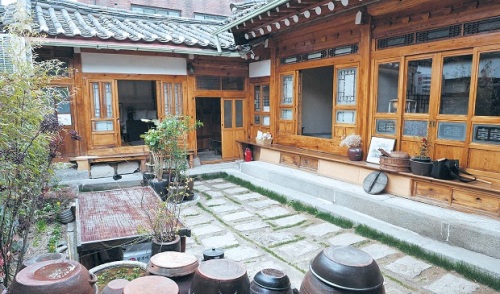
A home in Bukchon hanok village
For Week 9, I’ll be learning how to ask questions and how to use some shopping terms in Korean. I’ll achieve this by doing Chapters 7 (Asking Questions), 8 (More Questions), and 17 (Shopping) and the corresponding exercises in my KMS book. I’m not sure when I’ll need to speak Korean when shopping, but I’m going to do the chapter anyways. Who knows? Maybe I’ll get to go to Korea someday and visit one of the fish markets (FYI, fresh fish is my favorite food)! That’s shopping for food though. Whatever, I’m sure that most of the same phrases are used when shopping for clothes. Anyways, it’s on my bucketlist.
As usual, I’ll supplement my book work with YouTube videos. I found two that seemed particularly interesting: “Korean Phrases for Shopping (As a Customer)” and “Korean Phrases for Shopping (As a Salesperson)” both by TalkToMeInKorean. That way I’ll get both sides of the scenario. Hmm, this has some potential in becoming a skit.
For Week 10, I will learn how to talk about food and how to use the two Korean number systems when counting and talking about time, dates, and age. I’ll achieve this by doing Chapters 12 (Numbers) and 13 (More Numbers) in my KMS book and their corresponding exercises. I’ll also watch YouTube tutorials on ordering food at a Korean restaurant (e.g. “Korean Phrases for Ordering at a Restaurant” by sweetandtastyTV). I also happened to snag an extra menu from a Korean restaurant I ate at this weekend, and I was so excited that I could actually read the dishes in Hangul! The menu includes many popular traditional Korean dishes, so it’s a good start for learning the names of various Korean dishes.
I’ll also be making my third artifact, which is actually my second artifact since I accidentally switched the tasks for the two (please see ‘My Second Artifact’ post for the full explanation). Therefore, for my Third Artifact, I’ll be completing the task for the Second Artifact; that is, asking and answering questions about identity. Below is a rough outline of the dialogue:
Rough translation: (polite form)
A: Hello.
B: Hello.
A: I'm Chul-Soo Lee. What is your name?
B: I'm Becky Chen.
A: I'm French. What nationality are you?
B: I'm American.
A: Where are you from?
B: I'm from China.
A: I'm 34 years old. How old are you?
B: I'm 21 years old.
A: I'm a designer. What do you do?
B: I'm a student.
Yeah, so that’s the gist the conversation. FYI, I’ll be both Speakers A and B, but I’ll probably use GarageBand to change my voice for Speaker A just to prevent confusion. We’ll see how it goes.