cien zhang's Posts (37)

Sort by

SDLC110-Self-assessment

First of all, as I wrote in my final assessment for 105, taking this course and learning Korean on my own were the right decisions I have made. I have gained abilities including observe culture, connect culture with language, manage time and tasks and also stay motivated and be responsible for my own study all the time. Regarding to the tasks and goals I have set up at the beginning, I think I have achieved most of them. For example, I have tasks of learning how to say Welcome and Hello in Korean, how to ask about others' identities, and how to express emotions in Korean etc. I have used a lot of resources online including Korean learning cards which I ofter attached them in my journals and Korean learning videos to learn those topics. My four artifacts will be great reflections on what I have achieved in pronunciations . Moreover, my journals also reflect how I learned Korean in daily basic.

One part of my plan to study Korean is through watching Korean drama. At the beginning, I thought it was a relax and comfortable way to learn Korean because I enjoy watching drama so much. However, later I found that nothing was learned if I just watched it for one time and paid all attention to the story. Then I had to change my way of watching K-drama. I used to watch one whole drama one episode after another, then take a break. Now I started watching dramas that were currently airing at least one episode every day. I have watched nearly three 15 episodes drama so far for study. And when I was watching them, I began to pick up words and phrases that kept popping up. I wrote them down in notebook and kept re-read them everyday. Since I needed to stop the episode and replayed the sentence again and again, sometimes it is so annoying that I just want to give up and forget about the study assignment. However, every time I would persuade myself to be patient and insist on studying. Now after keeping doing this for a period, I was able to recognize the sounds and meaning of some words in K-drama without looking up online. Thanks to this learning process, I realized I have developed a better willpower and self-discipline.

In general, I think I have put many efforts on learning this course and Korean.Even though this semester has come to the end, I will not stop learning Korean and take it as a part of my study life.
Read more…

SDLC110 Learning Journal #5

My first artifact was done in VOKI. I have never heard about this tool before. After using it for doing my first artifact, I think it is so useful. It is very convenient and I can add more interesting parts when presenting. For the first artifact, I shared my study in greeting words in Korean. I have practiced many times before recording. I think it is good in general. However, when comparing my pronunciation to the official Korean pronunciation, I did realize there was accent difference. So I may need to listen more official pronunciation and try to correct my accent and wrong pronunciation. There are many differences in pronunciations among Korean, Chinese and English. Doing this artifact gave me a chance to listen how well my pronunciation in Korean. I will use this VOKI tool more often and add it into my learning plan too. 

Moreover, regarding to my task on last week about learning how to express feelings in Korean, I think I have been able to remember the pronunciations of most of them. When I practiced with my roommate who is also studying Korean, I will be able to say my feeling without going back to the learning card again and again. Once time when I watched a Korean drama and the female character said "I am hungry", I understood it!

Read more…

SDLC110 Learning Journal #14

It is hard to believe that the semester is close to end and I have learned Korean independently for three months. For me, learning Korean is not my first time of learning a foreign language. However, it is my first time to learn a new language by myself instead of teaching by professionals. After this process, in addition to my knowledge in Korean, I have evolved as an self-directed language learner.

I have met many difficulties in this process due to self-study. For example,  At the beginning, I thought it was a relax and comfortable way to learn Korean because I enjoy watching drama so much. However, later I found that nothing was learned if I just watched it for one time and paid all attention to the story. Then I had to change my way of watching K-drama. I used to watch one whole drama one episode after another, then take a break. Now I started watching dramas that were currently airing at least one episode every day. And when I was watching them, I began to pick up words and phrases that kept popping up. I wrote them down in notebook and kept re-read them everyday. Now after keeping doing this for a period, I was able to recognize the sounds and meaning of some words in K-drama without looking up online. Thanks to this learning process, I realized I have developed a better willpower and self-discipline.

I think learning Korean not only increases my knowledge, but also helps me improve my willpower and become a self-directed learner. Furthermore, this learning process also enhances my ability on staying motivated and time management skill.In general, taking this course and learning Korean on my own were the right decisions I have made. I have gained abilities including observe culture, connect culture with language, manage time and tasks and also stay motivated and be responsible for my own study all the time. Even though this semester has come to the end, I will not stop learning Korean and take it as a part of my study life. 

Read more…

SDLC110 Learning Journal #13

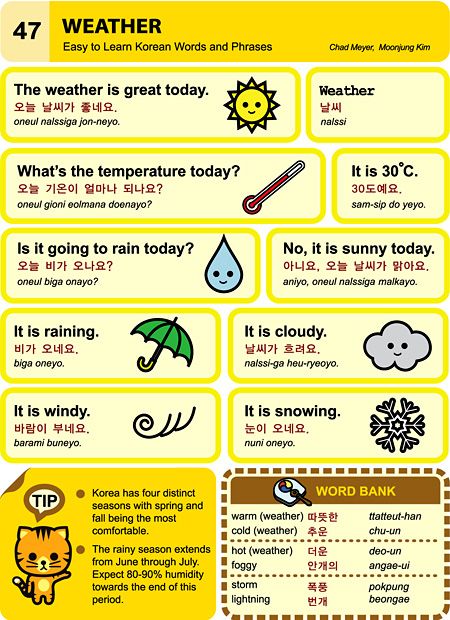
This week I learned some words about weather. As we all know, the easiest fall-back conversation topic when we have nothing to talk about is weather. Everybody loves talking about the weather, especially when it is bad. Therefore, I searched online and found the words in Korean to describe weather. 

Below is a list of vocabulary I think will be useful when talking about the weather in Korean.

Vocabulary

Nouns
날씨 = weather
기온 = temperature
공기 = air
비 = rain
눈 = snow
바람 = wind
이슬비 = drizzle
눈바람 = blizzard

The are all not very hard to speak but not easy to remember the shapes of words. Therefore, I still wrote them down in my notebook in case I forgot. 

47.jpg

Read more…

SDLC110 Learning Journal #12

This week I had learned the way for Asking for things. 

here Are / There is

The Korean verb which means either "there are" and "there is" is issoyo ( 있 어요 )
They are dependent on the context in which you use them, and on what you are talking about. The stem of the verb is iss- with the inclusion of o and the polite particle -yo, thus forming the ending -oyo. However in the case where the verb stem ends in vowel, we use -a or -o, such as -ayo.
Vowel stem - yo
Consonant stem - ayo if the last vowel ends with -a or -o
Consonant Stem - oyo

I think these words are commonly used in daily life. Therefore, I had marked them down in my notebook and practice them often. 

There is also a website which explains this issoyo well: http://www.learn-korean.net/learn-korean-classes-viewarticle-11.html

Read more…

SDLC110 Learning Journal #11

As we all know, there is polite and formal way of speaking in Korean. This week I planned to learn how to make requests more polite. The polite honorific -seyo can be used to make requests more polite, -seyo is used when the verb stem ends in in a vowel, and -useyo is used when the verb stem ends in a consonant. For example:


mashi- becomes mashiseyo
ha- becomes haseyo
kidari- becomes kidariseyo
iss- becomes issuseyo
anj- becomes anjusey

If I want to request someone to wait for me, I would say kidariseyo, which means "please wait".
The use of -seyo means that I have a special respect for the person, for example if I say hansongsaengnim-i hakkyo-e kaseyo , I am saying Mr Guo is going to school. ( But you are also showing special respect for him ).

It is very interesting to learn the use of -seyo. I will try to add this word into the sentences I learned past in order to make them more polite. 

Read more…

SDLC110 Learning Journal #10

This week I was going to learn the number counting in Korean. There is two number counting systems in Korean. The first set are known as pure Korean numbers, and the other are Sino-korean which is based on the chinese numerals.

The use of these numbers depends on the context in which it is used, for example the pure korean numbers are used when counting hours, and the sino korean when used to count minutes.

kong 0
il 1 shibil 11 ishibil 21
i 2 shibi 12 ishibi 22
sam 3 shipsam 13 ishipsam 23
sa 4 shipsa 14 ishipsa 24
o 5 shibo 15
yuk 6 shimnyuk 16
ch'il 7 shipch'il 17
p'al 8 shipp'al 18
ku 9 shibku 19 ishipku 29
ship 10 iship 20 samship 30

saship 40
kuship 90
paek 100
ch'on 1000
man 10,000

It was not easy to remember all the number counting. But I tried to match up each words to the number respectively. I hope that I can at least know what number it represents when I see the word. 

Read more…

SDLC110 Learning Journal #9

This week I started to learn basic pronunciation in Korean. Korean pronunciation is entirely different in structure compared to English pronunciation. In English, whenever a word ends in a consonant, we always make a little sound after saying that last letter. But in Korean, there is no final ‘breath’ sound. For example, 

In English: ship
In Korean: 십 (meaning ‘ten’)

In English = dock
In Korean: 독 (meaning ‘poison’)

It was quite hard for me to remember the sound of each word. Even though I can rephrase the word after listening to the pronunciation, the next day I would forgot how to say it. Therefore I still need to spend more time on practicing the pronunciation. 

I have looked up many website and this is the best one: http://www.howtostudykorean.com/unit0/197-2/

Read more…

SDLC110 Learning Journal #8

The goal for this week was learning how to order food in Korean. There are four parts needed to learn in order to be successful ordering, 

1. Hangul (in order to read the menus) 
2. The names of different foods (to pick what you want)
3. Your address (tell them where to come)
4. The basic questions you will be asked on the phone (to respond accordingly) 

Among these the 2 and 3 are the most important things to know. Therefore, I looked online and found many resources.
I also learned the sentence of getting check after eating.

계산서 주세요.
Gyesansuh juseyo.
Please give me/us the bill.

tumblr_m94vjuP8bo1r5mnsc.jpg

Read more…

SDLC105 First Presentation PPT

Here is the PPT:

Korean%20culture%20presentation-Cien.pptx

For my first presentation, I talked about Korean Lunar New Year. 8 February 2016 is Seollal (설날 – the Lunar New Year’s Day), which is one of the important festivals in South Korea. Seollal falls on the 1st day of the 1st month of the lunar calendar and family members and relatives get together to celebrate. So, how do the Koreans celebrate

Seollal? There are many interesting rituals and I will talk about some of them and the reasons behind in.

Read more…

SDLC110&105 Cultural Project Presentation

K-pop%20and%20fans%20culture.pptx

My topic for cultural project is about K-pop music and its fans culture. K-pop music is one of the popular part of Korea culture. K-Pop is an abbreviation from the word Korean Pop. It originated from South Korea but has a steady increase of followers from all over the world. Unlike the name, K-Pop music genre is more than just pop. The K-Pop that we know today emerges around the 1990s during the Hallyu Wave. This is the period when people starts to pay attention and interested in Korean production like the Korean drama sand music industry and K-Pop starts to spread their wings to the other region.
"Fans" is an abbreviation for fanatics of a given subject.And then, "K-pop fans" are people interested in K-pop and its related subjects. K-pop has emerged as a strong global phenomenon, and their fans are found all over the world, both inside and outside of Korea. Most of the fans will be teenagers. As a part of youth subculture, K-Pop has a big influence to the teenagers and youth not only in their music taste, but as well as their sense of style and fashion.

Read more…

SDLC105 Learning Journal #10

The first time when I was going to write the Korean language, it was so difficult to remember the shape of characters. The all looked similar in my eyes and I had no idea how to memorize them. Later, I found the online resources and knew there are Korean word structure and basic letters. 

The following are the first set of Korean consonants that you need to get into your brain. There is no easy way to explain them, you just need to memorize them:
ㄱ= k
ㄴ= n
ㄷ= d
ㄹ=r/l*
ㅁ= m
ㅂ= b
ㅅ= s
ㅈ= j
ㅎ= h

Later I learned that there is no perfect way to represent Korean characters using English letters (or sounds). The English letters presented above are the letters that we will commonly find being used to represent their respective Korean letters. While it is helpful (at first) to memorize the general sound of a Korean letter by using the English letter. 

Read more…