Parisa Mershon's Posts (12)

Sort by

SDLC105, F22 | Reflection Paper #2

Reflection Paper #2

What insights have you gained about yourself as a language learner and cultural explorer? What did you find difficult? What have you enjoyed?

I learned that I progress much faster in my target language when I am able to meet for shorter sessions more frequently rather than longer sessions less frequently. I have mentioned this in many posts throughout the semester, but the Mahsa Amini protests that are currently ongoing in Iran have halted my and my language partner's ability to meet as frequently. Because my language partner lives in Iran, the consequent internet shutdown made it sort of a game of hot potato trying to find which communication service worked the best for that given day.

I know the idea that more frequent shorter lessons align with the topics in class and might be rather obvious, but I realized this semester exactly how crucial this aspect of language learning is for me. This is not to say I am not able to function in the latter form of learning, I think just making a little bit of Farsi part of a daily routine is easier for me to plan around and manage time for. 

I also have to give myself a little bit of credit, as I think I ended up being much more adaptable than I previously suspected in my language learning. Even though the internet shutdown proved a challenge, my language partner and I still made it possible to meet, and I was able to compensate for the lost time in meetings with increased linguistic and cultural study.

Other major difficulties were just dealing with the increased complexity in the Intermediate lessons on PLO. As stated in other posts, the jump from Elementary lessons (#21-40) to Intermediate lessons (#41-60) is significant. The topics become more abstract, such as culture, lifestyle, and economics, and in order to accommodate this jump, the grammar and vocabulary spike in difficulty as well. I think this combined with the less frequent lessons hit me pretty hard, as it is already more of a challenge to remember the vocabulary. 

All in all, I have still had great enjoyment this semester. With the more complicated lessons brings more opportunities for cultural learning. I am excited about what is yet to come.

How will you continue your learning?

Right now, I still plan on using PLO. It has been a great resource, and now that I have completed SDLC/SDLAP 105, I will be more equipped to tackle the grammar. I think I might take more advantage of iTalki next semester, both as an opportunity to speak to someone new and as a backup considering Iran's volatile politics and internet. Everything else will remain relatively the same. As soon as the internet ban loosens up, I hope to meet with my language partner more frequently again. We already practice me reading a passage and translating, my language partner reading a passage and me translating, me rephrasing a passage with different grammar/vocabulary, my language partner asking comprehension questions and conversing about the passage with me, and practicing conversational/cumulative speaking. 

I might delve more into presentational speech and writing, but that is not a goal for me right now. 

Which readings and learning activities did you find most useful? What would you like to learn more about?

Though I need to practice it more, I think IPA/articulatory phonetics as a whole will prove to be quite useful. I remember reading papers in the past that used terminology I did not know then -- but now do. Now I will be able to understand more precise instructions on accent/pronunciation. I want to delve more into morphology and syntax, as it got a little cut off at the end of the semester, and Farsi is much different than English in both areas. I especially want to learn more about case. 

Read more…

خوش نویسی (khoshnevisi)

Last cultural post of the semester! If you have by chance read my Monthly Language Learning Journals, specifically the August post, you may skip this section as I will just be providing some brief context on PLO. For my Farsi studies, I am -- at the time this artifact is being posted -- using the website Persian Language Online to study (abbreviated as PLO from here on out. While reading PLO lesson 42 (in the "Intermediate" level), I came across a new term, خوش نویسی (kkoshnevisi). My language partner explained this as an ancient art form, the best translation being Persian calligraphy. I tried to find a rather short video (posted below), though feel free to play it at two times speed or skip around.

Etymology. خوش نویسی (khoshnevisi) stands for the actual art form of calligraphy, while خوش نویس (khoshnevis) -- without the suffix -ی (-i) -- is a calligrapher or the actual artist who is painting/writing the calligraphy. خوش نویس (khoshnevis) comes from خط نوشتن (khat neveshtan) meaning 'to write a script,' where خط (khat) literally means 'line,' and نوشتن (neveshtan) means 'to write.'

History. Much of the modern-day Iranian/Persian script is due to the 7th-century Arab Conquest of Persian (also called the Islamic Conquest of Persian). The major players were the Sasanian Empire ('the Persians') and the Rashidun Caliphate ('the Arabs'). Due to a laundry list of prior events that weakened the Sasanian Empire -- namely a civil war, the Rashidun Caliphate was able to annex the Sasanian Empire, leading to its eventual downfall.

In brief, this conquest changed many things about ancient Iranian culture, including but not limited to the -- rather forced -- transition from Zoroastrianism to Islam, increasing Arabic influence on legal code and culture, and (most importantly for this post) a change of script. The change of script was mainly due to the introduction of Islam, as with it came the Arabic alphabet. Over time, Persians adopted the alphabet and morphed it into their own, which is now known as the Persian alphabet or Perso-Arabic script. 

Nasta'liqAround three hundred years later, Abū ibn Muqla Bayzavi Shirāzi would develop six different styles of Persian calligraphy, "Mohaqiq", "Reyhan", "Sols", "Naskh", "Toqi" and "Reqa." Historically, these are also known as the "six pens." of Nasta'liq, the most predominant style today, originates from another artist combining the styles "Naksh" and "Reqah." Khoshnevisi is the name for Persian calligraphy in general. 

dscf0625.jpg?profile=RESIZE_710x

Technique. Though I ventured a little bit into the different styles, there are many more that I neglected to mention. For brevity's sake, I will be focusing on Nasta'liq. Pens are generally made of reed, with an end cut to an edge. See the image to the right. The material is somewhat softer than a traditionally Western metal calligraphy pen, but unlike many metal tips, the width is not so much determined by the weight or pressure put on the pen when writing. Nasta'liq involves rotating the pen at various angles to achieve different thicknesses in strokes. These angle changes must be fluid, or else the appearance becomes choppy and does not look like one single fluid stroke. 

References

González E S, "The Art of Writing Beautifully," Getty. 26 May 2022. https://www.getty.edu/news/the-art-of-writing-beautifully-persian-calligraphy/

"Persian calligraphy wins UNESCO protected status," Tehran Times. 17 December 2021. https://www.tehrantimes.com/news/468158/Persian-calligraphy-wins-UNESCO-protected-status

Yūsofī Ḡ-H, "CALLIGRAPHY (continued)," ENCYCLOPÆDIA IRANICA. 1 January 2000. https://www.iranicaonline.org/articles/calligraphy-2

Read more…

SDLC 110, F22 | Journal #4 (November)

November

Preface

Last learning journal for the semester! Unfortunately, the internet shutdown in Iran is still a looming issue (see the September & October posts for more resources on the Mahsa Amini protests). As I mentioned in a previous learning journal, I think it might be beneficial to seek out a secondary language partner on iTalk over winter break for the coming semester. That being said, however, it seems that Microsoft Teams might turn out to be a more viable option than WhatsApp, Viber, or Signal (considering the current circumstances in Iran). This past month, my language partner and I have been switching between communication platforms in an effort to resume using video chat during our language learning sessions. Before the shutdown, video chat was a given, but now it is a coin toss on whether or not the call will drop if we use it. Though we have only been using Teams for a week, we have not yet had a call drop (fingers crossed!). 

PLO Lessons & Progress

If needed, please see the August post for further explanation of PLO & difficult levels; E# = Elementary Lesson #, I-# = Intermediate Lesson #). On my last journal, I had just finished E38, and I had two more lessons to go until finishing the Elementary level and continuing on to Intermediate (I-41 -- I-60). As predicted, now that I have started the Intermediate lessons, my progress has slowed down significantly. The jump from the Elementary level to Intermediate is steep, as the lessons are now much longer and more complicated. I am going through about one lesson a week, so 2-3 sessions per lesson. Currently, I just started I-43. 

Now that we have covered almost all the material for SDLC 105, I am feeling more prepared to tackle more of the complex grammar in Farsi. At this point, I am growing much more accustomed to the Subject-Object-Verb syntax in Farsi.

Now, I think the two things I am currently working on are the definitive article را () and مورد (mowred). Out of the two, I understand  much better. It is a definitive article, often used after a transitive verb. The closest English equivalent would be "the," but they are not quite the same, as  only used when a verb is affecting a noun, e.g. "taking the book", not just "the book is red." Mowred, I have to admit, is giving me some trouble. It seems to be a sort of placeholder. In isolation, it is a noun, but what confuses me is when it is used in tandem with other modifiers. For example, mowred-e alāghe, which means favorite. 

Other than that, the main thing I am struggling with is just remembering more abstract grammar, which I assume will just come with time and repeated review. 

Read more…

SDLC105, F22 | Discussion Posts

SDLC F22 Discussion Posts

Post #10

1) Read: ScienceLine, “Are Bilinguals Really Smarter?” 2) Read: NYT: “Why Bilinguals are Smarter”

Imagine that you have received a research grant to conduct a linguistic study of your target language and culture. How would you get started, and what would you investigate? How would different structural components presented in class appear in your work?

I would want to investigate modern slang in Iran, especially around the government and censorship, and also how the modern-day population views Islam. I would first try to talk to the family and/or contacts I have in the U.S., as it might be much harder to discuss such topics in Iran. I would also try to reach out to any known researchers in the field. I know from limited experience that a large number of (particularly younger) Iranians do not practice Islam, and a more-or-less common form of protest is improperly wearing the state-officiated hijab. I recall one of my cousins saying you could tell what people in Iran were actual Muslims based on how they wore the hijab, as many women still show their hair (but not enough to get detected by the morality police). Eventually, after my Farsi was proficient enough and I knew enough nuances about the culture -- especially as it concerns politics, I would go to Iran and try to discretely gather opinions on the topic. This endeavor is rather fantastical, as many people might be too afraid to talk so openly about the government. Communicating with technology would be out of the question, as the Iranian government monitors internet interactions. 

Post #9

How have you started writing in the target language? Do you prefer to type or write freehand? Have you started to see patterns emerge in the structures between words, clauses, and sentences? What is the relationship between simple and complex sentences? How does your knowledge of parts of speech, government, and agreement affect your ability to communicate in written contexts? Provide a sample of several short meaningful writing exercises from your target language. 

I have dabbled in writing in Farsi (my target language), mostly out of curiosity. The script is written and read from right to left, and the main strokes are completed first within one 'word' (a little complicated how that is divided up), then additional strokes are added (dots and slashes. Many verbs are compound, meaning they can be formed by taking a noun or a verb and another verb and making a new verb. Here are some examples of this:

  • دیدن کردن (didan kardan) to visit
    • دیدن (didan), to see
    • کردن (kardan), to do
  • حرف زدن (harf zadan), to talk/speak
    • حرف (harf), letter/speech
    • زدن (zadan) to hit, to touch

There are no gendered articles in Farsi, in fact, there is no word for the pronouns he or she, only it (though there are varying degrees of politeness). The pronoun "it" is actually hardly used, it is much more common to refer to someone by their name or relation, or just leave it out of the sentence and only conjugate the verbs in the third person. 

Post #8

1) NYT “Tribe Revives Language on Verge of Extinction”  2) Watch the 2007 Interview with David Harrison, “When Languages Die.”

How do languages go extinct?

Increasing globalization and rising global communication have, almost ironically, caused a severe degradation in the diversity of language. Globalization, more often than not, leads to homogenization, as cultural intermingling leads to cross-cultural change. Hegemonic cultures (such as Western/European cultures) often lead this homogenization, as various forms of media signal the hegemonic culture as a model one. This cultural phenomenon parallels what happens to the languages within the respective cultures. 

Respond to the readings, and reflect on what happens when a language dies. How can linguists help preserve a language? Can a ‘dead’ language ever be brought back to life? What efforts are currently underway to document linguistic diversity?

One crucial aspect of reviving a language is creating an immersive environment so that language can be quickly absorbed by new learners. Though learners can study a language for a long period of time, they might never reach the same level that they would in an immersive environment (often in a shorter period of time). This inherently answers the next question, as linguists can help foster these immersive environments, as the more easily accessible they are, the more motivated learners will be to pursue them. 

The question of whether or not 'dead' languages can be revived depends heavily on how one defines a 'dead' language. If there are no surviving records of the language, be it speakers or scripts, this would make reviving it extremely difficult, as there might be no way to tell if its revival is accurate to the original (i.e. it is possible a new language could be made with the same name as the old, but we would have no way to tell). 

Post #7

No Readings

Go back and watch the recording of your presentation of your learning plan on the class PanOpto collection on Blackboard. Comment briefly on how things are going. What has changed? How have you incorporated materials and insights from class into your efforts? Have discussions regarding language structures and learning strategies helped you to understand the target language and culture? If so, how? Reflect on your language learning so far. How would you describe the relationship between language and culture? What do you need to do to improve your communicative competence? Based on the readings by H.D. Brown, what kinds of competence are emphasized in your plan?

A lot has changed politically in Iran. It has been much harder to talk about current events because my language partner fears the Iranian government is monitoring our calls. In terms of materials, it has been much slower than I had anticipated. The intermediate lessons on the website that I use, PLO (Persian Language Online), use much more intricate grammatical structures that are not as intuitive to me. The vocabulary is more abstract, so it makes it more difficult to remember/recall fluidly. I have incorporated more lessons from class. Our current unit on phonology has made it easier for me to understand the articulation points I should be striving for. 

I do not think I am quite at the level yet where I can connect the language structure to culture; that being said, however, the influence of Arabic on Farsi (Arabic loanwords, script, etc.) portrays the intermixing of the two cultures and the integration of Islam in modern-day Iran.

Through my learning of Farsi, my understanding of the linkage between language and culture deepens. Especially considering the political circumstances in the country, the movements in the language (such as attempting to reduce Arabic loanwords, despite Arabic being the dedicated language of the Quran) are tied with current political movements (reduction of Arabic can, in a way, show how some members of society -- especially women -- are moving towards a more secular state). 

Post #6

Readings: 1) “What is a Language Family” by Kevin Morehouse 2) “Family Tree of Language Has Roots in Anatolia, Biologists Say” by Nicholas Wade 

Reflect on the history of your target language. To what language family does it belong? What sounds, words, and structures exemplify periods of contact with other cultures?

Farsi specifically belongs to the Western Iranian group of the Iranian languages, which is in the Indo-European language branch. One influence can be seen in the very name of the language. Arabic has had a large cultural (and thus linguistic) influence on Iranian culture. An aspect of Arabic is that there is no [p]. This is not the case in Farsi, the original name being "Parsi," but was changed because [f] does exist in Arabic. Another Arabic influence can be seen in the Farsi writing system. Though the alphabets are not identical, there are some letters in the alphabet (س ص ث =  [s], or ز ذ ظ = [z] to name a few) that all represent the same phone/sound; however, in Arabic, these letters represent different sounds/phones, which do not exist in Farsi.

Read Post #5 for more information on the Arabic invasions and Farsi.

How do these considerations enhance your understanding of the target language and culture in terms of their associated historical origin, development, and contemporary realization? and pragmatic questions of usage? 

As I've encountered in my learning, occasionally we (my Language Partner & I) will run into Arabic words, and consequently, small grammar points associated with those words (mainly plurals or pronunciation). I will make more of a point to keep track of these Arabic loanwords, and possibly research some of the relevant grammar associated with them. 

How do languages change over time? How do linguists track, predict, and extrapolate these changes?

Language mainly changes the following ways: change in phoneme pronunciation, borrowing words or features from other languages, and analogical change (e.g. "inflammable" changing to "flammable"). In historical linguistics, linguists can examine an older/dead language by tracing the phonetic changes in modern, related languages backwards, allowing them to recreate how the original language may have sounded.

Post #5

Readings: 1) “Communicative Competence,” pp. 218-243 from Principles of Language Learning and Teaching by H.D. Brown

Do some preliminary research on what interests you about the target culture and describe how this topic relates to language. Do you need any special vocabulary or linguistic knowledge to engage this topic? If so, have you included objectives in your learning plan to engage this topic?

I am mainly interested in learning more about the Shahnameh, or Book of Kings, by Iranian poet Abolqasem Ferdowsi --specifically its cultural and linguistic significance. The Shahnameh arguably saved and preserved the modern (written) form of my target language, Farsi. 

In the 7th century, the Sassanian Empire in Iran fell to an Arab invasion. For the next two centuries, Iranians were persecuted for their faith (Zoroastrianism, one of the first monotheistic organized religions, was the main religion in Iran before Islam), libraries burned, and the use of Farsi (written and spoken) was all but silenced. In Iran, this period is known as the 'two centuries of silence.' Farsi, Zoroastrianism, and any other Iranian culture were at risk of extinction from the Arabic language, government, and Islam. 

Ferdowsi finished and rewrote the Shahnameh, which comprised almost all pre-Islamic traditions, legends, and history, in a relatively pure form of Farsi without the use of Arabic or other loanwords. Ferdowsi and his accomplishments are revered in Iranian culture, and the Shahnameh is seen to many Iranians as the savior of modern-day Farsi and Iranian culture.

Post #4

Readings: 1) G. Hudson, “Phonetics” in Essential Introductory Linguistics, pp. 20-42.

What is the difference between sound and spelling?

Spelling refers to a specific language's method of representing written communication; this can include representations of sound, but these rules often have exceptions and can be a static representation of sound.

Sound refers to the specific phones and pitch in a language, "speech" being defined as "a sequence of phones" (20). 

Why is this distinction significant for your language-learning efforts?

It is important to understand that we must be cautious when reading so as to not use our target language's writing system as a guide to pronunciation. Writing can be deceiving and omits important factors, such as meter or what syllables are stressed. 

Describe the phonetic inventory of your target language. Are there sounds in your language that don’t exist in American English? If so, provide several words and their phonetic transcriptions of words as examples to support your argument.

  • the fricative [ʁ]
    • example: " داغ " \ˈd̪̊ɑʁ̥\ = "hot" (like a desert)
  • plosive uvular stop [q]
    • example: " قلب " \ˈɢ̊alb̊\ = "heart"
  • post-alveolar stop [d͡ʒ]
    • example: " به ویژه " \b̊eh̬ v̊iˈʒe\ = "especially"

Farsi also has "r" trills and taps, which almost every "r" adhers to. 

What do you need to know about the sound system of your target language?

I have already practiced the phonetics of my language extensively, though I can always get better. Funnily enough, I seem to struggle the most with American-English /r/'s; I've always found it easier to tap or even trill. 

How will you acquire the ability to discriminate differentiated segments in your listening, and to produce these sounds in your speech? 

Because I have been listening to Farsi for many years, I am already decent in my ability to discriminate between the different sounds in Farsi.

Post #3

Readings: R1) D. Crystal, How to Investigate Language Structure, R2) J. Aitchison, Aitchison's Linguistics 

12746896270?profile=original

Refer to the diagram on page 9 in Aitchison’s linguistics (see figure to the right). How do you combine different disciplinary perspectives to formulate a more holistic understanding of your target language? Do you give preference to one disciplinary approach over the others?

As of right now, I am mainly concerned with "Languages"/"Applied Linguistics," mainly due to the fact that I am still a beginner in my target language; thus, I am most focused on building a strong foundation in the core of Aitchison's circle, phonetics, phonology, syntax, and beginning to develop semantics and pragmatics. 

I could argue I study my target language through a stylistics/literature lens (albeit simple literature). This helps provide a more holistic approach to my target language, Farsi, because the language is divided in formal/written language -- the "Literature" portion (which I am exposed to through reading my lessons -- "Literature"), and the "Languages" portion -- when I read dialogues using more casual/colloquial Farsi, or I practice conversational speaking with my Language Partner. 

How will your knowledge of language structures and disciplinary methodologies inform the trajectory of your learning plan?

Again, as of right now, I am mainly focusing on the first 3-4 rings in Aitchison's figure. Because of my heritage, the pure phonetics of my target language perhaps comes easier than if I were studying a completely foreign language/culture. Nonetheless, I am struggling much more with syntax, as Farsi operates in a mainly Subject + Object + Verb (SOV) sentence structure, while English almost exclusively uses SVO (or OVS in the past tense). This and the extensive verb conjugations mean I am dedicating much more time to syntax. 

Post #2

Summarize some of the main ideas behind Figuring Foreigners Out and the Hofstede Dimensions of Culture (source 1) (source 2) (source 3).

Gert Hofstede developed a model (a series of choropleth maps) delineating how various cultures (and their values) affect their respective workplace values. 

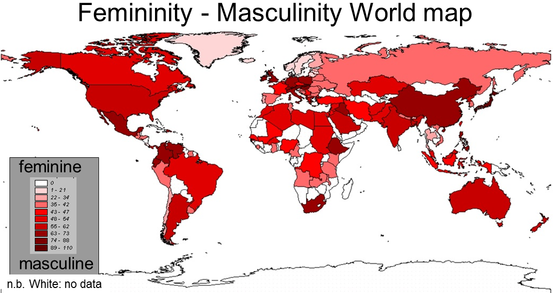
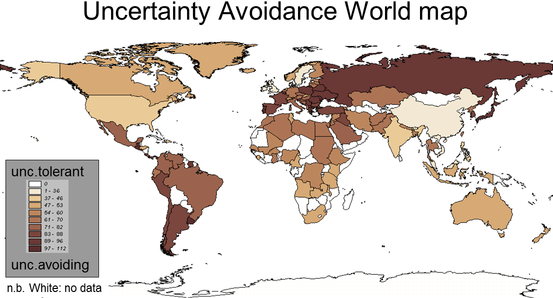
In his research, he initially developed four choropleth maps: Power Distance Index (PDI), Individualism (IDV), Masculinity (MAS), and Uncertainty Avoidance Index (UAI). 

PDI-world-map-50.png?profile=RESIZE_710x

PDI (image above) "focuses on the degree of equality, or inequality, between people" (source 1). A large distance (dark green) represents little upward mobility and clear class division, and a small distance (light green) represents high upward mobility and fluid class division.

IDV-world-map-50.png?profile=RESIZE_710x

IVD (image above) "focuses on the degree the society reinforces individual or collective, achievement and interpersonal relationships" (source 1). High individualism (dark purple) represents an emphasis on individual rights and less-family-oriented (looser) relationships. Low individualism (light purple/white) represents an emphasis on collectivism and strong, family-oriented relationships. 

MAS-world-map-50.png?profile=RESIZE_710xMAS (image above) "focuses on the degree the society reinforces, or does not reinforce, the traditional masculine work role model of male achievement, control, and power" (source 1). High masculinity represents a high degree of gender differentiation, with males being the dominant force of power. Low masculinity/femininity represents a low degree of gender differentiation, with females sharing equal status with males. 
UAI-world-map-50.png?profile=RESIZE_710xUAI (image above) "focuses on the level of tolerance for uncertainty and ambiguity within the society - i.e. unstructured situations" (source 1). A high UAI indicates a low tolerance for ambiguity, and a low UAI indicates leniency for a variety of opinions. 

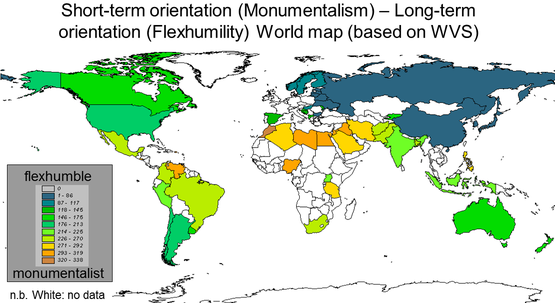
The last two were developed later in his research. 

MON-world-map-50.png?profile=RESIZE_710xLTO (Long-Term-Orientation) (image above) "focuses on the degree the society embraces, or does not embrace, long-term devotion to traditional, forward thinking values" (source 1). High LTO shows a reluctance to cultural change, and low LTO shows fluidity in cultural traditions. 
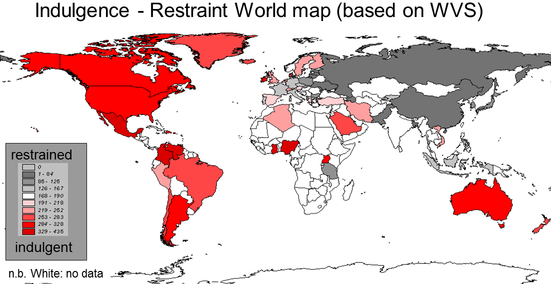
IvR-world-map-50.png?profile=RESIZE_710x

The last map (image above) compares indulgence and restraint. "In an indulgent culture it is good to be free. Doing what your impulses want you to do, is good. Friends are important and life makes sense. In a restrained culture, the feeling is that life is hard, and duty, not freedom, is the normal state of being" (source 2). 

Do you predominantly agree with these assessments? Are there any statements, generalizations, and opinions expressed in the reading that you find problematic?

I think some of these values will differ generationally. Many are also simplified; a culture could have different values for different aspects (political power vs. economic status). These dimensions also do not take into account that various different cultures may reside in one national region. Take the U.S. for example, I would assume Hofstede aligned the U.S. according to its Western citizens; it discounts many different experiences and people groups. 

Post #1

Readings:

  • Crystal, D.: How the brain handles language
  • Crystal, D.: How we mean and How we analyse meaning

Reflect on the readings:

Do you have any questions about the texts? Are there any claims that you find problematic? Do you think language is a purely biological phenomenon?

Crystal suggests that language was biologically induced through the physical ability of speech, and later innovated culturally through writing. Moreover, no, language in its modern form is not solely a biological phenomenon. 

What parts of the brain are most important for the production and comprehension of speech?

In general, people who are right-handed depend more heavily on the left hemisphere for language processing, but the right hemisphere still plays a part. This question depends on the validity of the theory of cerebral localization, which states specific areas in the brain have specific roles in the production & comprehension of speech. 

How do you conceptualize or process meaning?

Crystal states that a more effective way to analyze meaning in language is to simply analyze how meaning is expressed in language. This includes, but is not limited to: word choice, grammatical structure, sound/intonation (auditory difference between a questioning statement and a clarifying statement), spelling, and the expected answer to a statement (taking a statement literally or answering the statement's meaning). 

Crystal also states "isolated words do not lack meaning, Rather, they have the potential for conveying too much meaning." He believes a crucial aspect of meaning is not simply a single word, but how all aspects of conveying meaning intermingle with one another.  

Do these readings inspire any special insights or motivations that could help advance your foreign-language abilities, retention, and recollection?

These readings help learn ways of parsing out specific connotations (meanings) of various words in the target language, as opposed to assuming the English counterpart (if it exists) holds an equivalent meaning. The cultural aspects of language lead to meanings that cannot be translated in a single word, making the relationship between words in a translation all the more crucial.

Read more…

Mahsa Amini Protests

On the 16th of September (2022), Mahsa Amini (known by her Kurdish name Jina Amini to her family) died in a Tehranian hospital. Though the Iranian government claims otherwise, Amini's family contests she had no prior health conditions, making the fatal stroke she suffered strange, to say the least. 

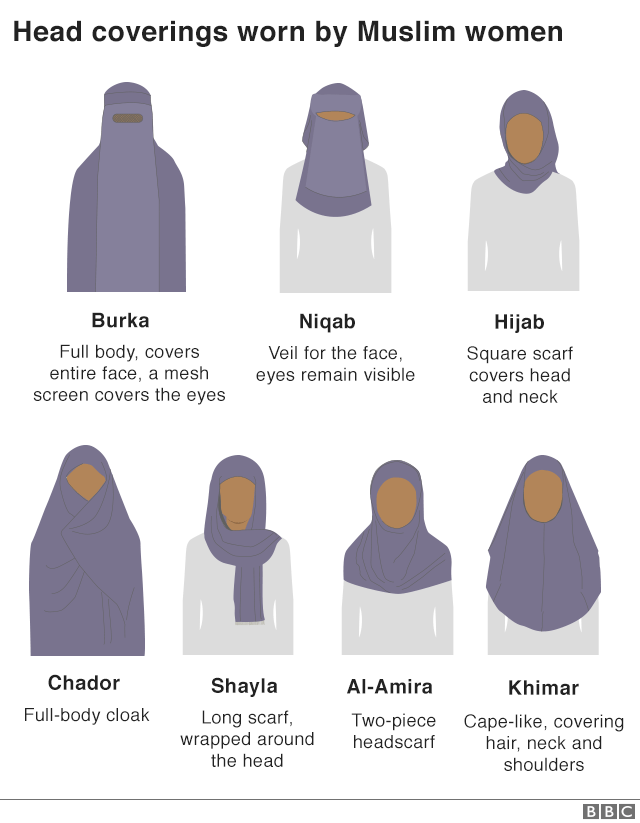
Some aspects of women's rights in Iran (and the 'morality police') must be explained in order to understand how these protests have come about. Shortly after the Iranian Revolution of 1979, the new ruler (some might say dictator) decreed all Iranian women must wear a hijab in accordance with Islamic law, despite the woman's faith or background. For context, below is a depiction of the different types of Islamic headwear:

_102875625_muslim_head_coverings_640_v1-nc.png?profile=RESIZE_710x"Boris Johnson's burka jibe: Why do some Muslim women wear the veil?" BBC News

This distinction is important as different regions in the Middle East mandate different types of headwear (a common misconception about Middle-Eastern countries is that all women are forced to wear burkas or niqabs, which is not true). The Guidance Patrol (colloquially known as the 'morality police') -- which is a sect of the Law Enforcement Command of the Islamic Republic of Iran (or FARAJA for short) -- enforces the mandatory dress code for women in Iran.

Amini was visiting her brother in Tehran. On the 13th of September, while out with her family, she was arrested by Guidance patrol; the police chief of Tehran would later make a statement attributing her arrest to overly tight paints and an improperly worn headscarf. She was transferred to the custody of Moral Security (another sect of FARAJA). There are eyewitnesses claiming Amini was beaten while still in the police van, though FARAJA denies this. Only two hours after being arrested, Amini's family was informed she had suffered a heart attack and a brain seizure, and was being transported to Kasra Hospital. Again, she was -- as described by her family -- a 22-year-old with no prior health conditions. Amini died, three days later, and was in a coma since her arrival at Kasra. 

Journalist Niloofar Hamedi covered Amini's coma (and eventual death), and the Iranian government, as a consequence, arrested him a short while after. Hamedi's coverage allowed the Iranian public to know of the circumstances around Amini's death; protests ensued later that day on September 16th (the day of Amini's death). 

Below is a video of tens of thousands of protesters gathering at Amini's death site, forty days after the tragedy occurred. 

If you have read any of my Monthly Language Learning Journals, you are already familiar with the Iranian government's response to these protests: a widespread shutdown of the internet and communication services -- the most intense one Iran has ever experienced. This was in an effort to disrupt protesters' abilities to gather, but it has far from silenced anyone. This is an ongoing situation, so, unfortunately, I do not have an ending to this historical event yet. Maybe one of my future cultural posts will be an update.  

References

BBC News. "Mahsa Amini: How one woman's death sparked Iran protests - BBC News." 5 October 2022. https://www.youtube.com/watch?v=EZMvrkU_eEY

Fassihi F, Engelbrecht C. "Tens of Thousands in Iran Mourn Mahsa Amini, Whose Death Set Off Protests," NYT. 27 October 2022. https://www.nytimes.com/2022/10/26/world/middleeast/iran-protests-40-days.html

Skopeliti C. "'This Generation is really brave': Iranians on the protests over Mahsa Amini's death," The Guardian. 27 October 2022. https://www.theguardian.com/world/2022/oct/27/this-generation-is-really-brave-iranians-on-the-protests-over-mahsa-aminis-death

Read more…

SDLC 110, F22 | Journal #3 (October)

October

Preface: Mahsa Amini protests (again)

Wow, already two months+ into the semester -- time is really flying! I wish I had a good update from the September post, but alas, I do not. The internet blockade is still going. I suppose it has only been about a month or so, but this time feels different than the shutdown in 2019 (caused by a hike in gas prices). As I mentioned in the September journal, that one only lasted about a week, and the current internet shutdown is on week seven. The primary mode of communication we use, Whatsapp, is almost completely blocked out. If we meet early in the morning, it seems to work, but the quality has dropped. Instead of twice per week, my language partner and I are meeting three times a week, so at least that is an improvement from September.

I think over winter break I will try to find another language partner on iTalki, but I want to wait until classes have died down so I can adequately explain how I want to learn; so for right now, I am just going to keep talking with my father as my primary language partner. 

PLO Lessons & Progress

In the last journal, I had reviewed/learned up to E31 (E=Elementary, please see August post for further explanation). I just finished E38, so only two more lessons at the Elementary level (E39 & E40)! Though I am definitely not where I predicted in my learning plan, I still think I am making good progress despite the circumstances. Before this past summer, I had made it to the Intermediate level, so I am going to talk a little bit about what I anticipate for the upcoming month (and the last learning journal). The jump from Beginner to Elementary on PLO was significant, as the main texts got longer, more complex, and more difficult. The jump from Elementary to Intermediate was intense if I remember correctly. Right now, I am going through about one lesson per session, but when I get to Intermediate, this may (and probably will) slow down, as the lessons are much longer, and start discussing more abstract ideas (economy, lifestyle, etc.), so the vocab might be harder to remember. I am getting ahead of myself, though, as I have not started Intermediate yet -- I assume if I keep the current pace that I am at, I will begin the Intermediate level around this time next week. 

The decreased number of sessions per week is definitely an adjustment, as I think it is harder for me to remember the vocab from previous lessons. Currently, the best way I am counteracting this issue is by listening to the audio files/main text videos on PLO when I would normally have a session with my language partner. PLO has some sample questions after each lesson that I previously ignored, but now I am taking those quizzes in place of my language partner quizzing me. 

In SDLC 105 we have finally started grammar! I am very excited, as I think this area has -- by far -- been my biggest struggle in Farsi. Though in the Elementary lessons it has not proved much of a hindrance, I know the Intermediate level will be much more involved, so I feel like I will be more adequately prepared to dissect it this time. 

Read more…

The Seven S's & Nowruz

Nowruz is the Persian/Iranian name for the Iranian/Persian New Year. Its meaning combines نو noh – meaning 'new' – and روز ruz – meaning 'day.' In a Tehrani accent/Farsi dialect, the pronunciation is [noːˈɾuːz]. It is rooted in Zoroastrianism, but it is wildly celebrated in Iran and other Islamic countries despite not practicing the Zoroastrian faith. Zoroastrianism was more or less the 'original' religion of Iran, before the 7th-century Arab conquests and the 1979 Iranian Revolution. It is an ancient monotheistic religion that has traces in other major religions today (Christianity, Islam, Judaism, and even Buddhism). Because of this, the Zoroastrian roots in Nowruz can to a certain extent be seen as ancient Iranian culture. 

Nowruz begins on the spring equinox (its timing is more similar to the Chinese New Year rather than the Western New year on January 1st). Every year, the exact moment at which the sun crosses the equator is calculated into a precise time, and this time marks the beginning of Nowruz.

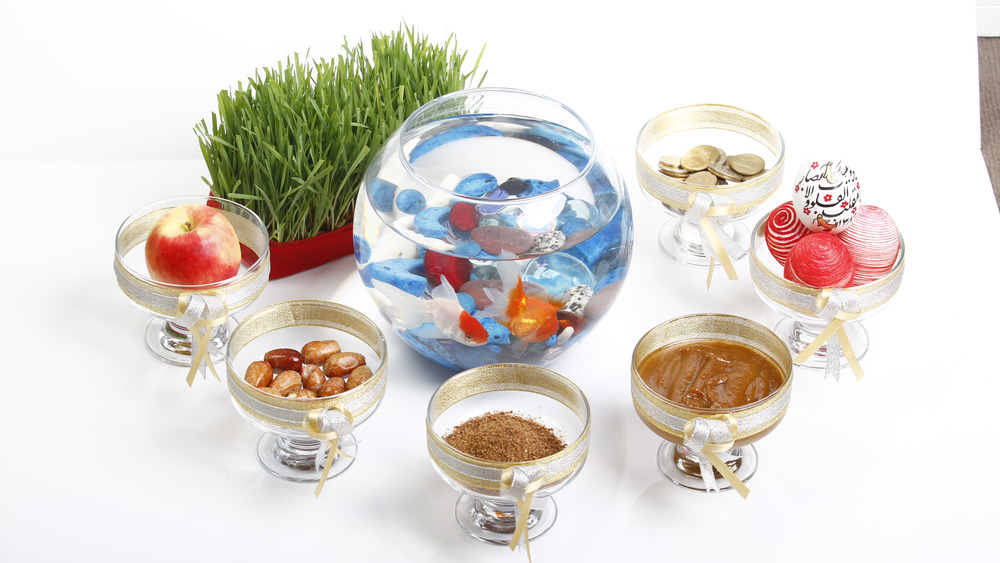
There are many different traditions and ceremonies leading up to and during Nowruz, but that is for another cultural post. For today, I will be focusing on هفت‌ سین (haft-sin), or the Seven S's. An example is shown below, which will be further explained. 

the-seven-symbolic-haft-sin-foods-1616005986.jpg?profile=RESIZE_710x

A custom for Nowruz is to prepare a table with seven items that all being with the letter س (sin), whose closest English letter equivalent would be 's.'  Here are some examples (any of these may be chosen, alongside other items listed in the paragraph below, as long as the total number of the items on the table ends up being seven):

  • سبزه (sabze), sprouting grass, lentils, barley, or wheat
  • سمنو (samanu), a sweet pudding made from wheat germ
  • سنجد (senjed), a Persian olive
  • سیب (serke), vinegar
  • سیر (sib), apples
  • سیر (sir), garlic
  • سماق (somāq), sumac, which is a Persian spice
  • سکه (sekkeh), coins 
  • سنبل (sonbol), a hyacinth
  • ساعت (sā'at), a clock

There are other things that may be placed on the table for the Seven S's that don't necessarily start with س (sin), like the following:

  • ماهی قرمز (hi-ye qırmız), goldfish (shown in the picture above in the middle)
  • تخم‌مرغ رنگی (tokhm-e morg rangi), painted eggs (for fertility)
  • آینه (āyina), a mirror (or a bowl of water)
  • 'books of wisdom'
    • sacred texts like the
      • Quaran,
      • the Avesta (the sacred text of Zoroastrianism), and the Bible,
    • culturally/historically books like
      • the Shānāme of Ferdowsi -- an ancient Iranian epic that I will write a cultural post on this later as it deserves its own,
      • or the Divān of Hafez.

Each item has different symbolic roots in Nowruz, please comment if you are curious about any of the items. 

References

Shapur Shahbazi A, "HAFT SIN," Encyclopaedia Iranica. 1 March 2012. https://www.iranicaonline.org/articles/haft-sin

United Nations, "International Nowruz Day." https://www.un.org/en/observances/international-nowruz-day

Read more…

SDLC 110, F22 | Journal #2 (September)

September

Preface: Mahsa Amini protests

The first full month of SDLAP has passed, and I feel like I was making great progress until about halfway through the month. Last week, on the 16th of September, the Mahsa Amini protests started. Before this point, I was meeting with my language partner almost every morning (ranging 5-7 times a week). This past week, we were able to meet twice. I don't know how the frequency of my lessons will affect my learning for the rest of the semester. We were still able to talk because my language partner is finding ways to circumvent the internet blockage with a VPN; that being said, however, this only works at certain points in the day, so the normal time we were meeting had to change, and it conflicts with the classes I take. 

Neither of us thinks it will last that long, maybe a few weeks. Protests not too dissimilar from this happened due to the increased gas prices in Iran (2019), and the internet blockage was only a week. I am a little apprehensive, though, because last time my dad (who is my language partner) was still able to use a VPN and avoid the blockage. This time it seems much more intense, but that is my opinion based on my past experience, not an article. 

I do want to note, for anyone that reads this, that a lot of the negative media about Iran is unrightfully generalized to include Iranians -- not just the government. So, although this has been a setback, I do not wish to reinforce any negative stereotypes about the country, or at least about the people that live in it. I just think this is an important aspect to appreciate about modern-day culture/politics in Iran, that there is a definite split between administrative affairs and then the actual opinions/beliefs of 'everyday' Iranians.

PLO Lessons & Progress

In my last post, I had made it up to Elementary Lesson 23 (please see August post for an explanation of PLO). Before the protests, we were averaging about 3-4 lessons a week, as some days we would do a new lesson, and others we would either continue the previous day's lesson or practice conversational speaking (using the topics of the previous lesson for some structure. By September 16th, we were planning to start E31, but had to postpone the session for a few days due to the political situation. Later last week, we finished E31, but that is as far as I have reviewed, considering the circumstances. 

Learning about articulatory phonetics in SDLC 105 is helping me contextualize/articulate some of the unique characteristics of Farsi. I am really excited to get more into points of articulation, as I think it might help with a few of the phones that trouble me. Nevertheless, I think my pronunciation in Farsi is one of my stronger sides, as I have grown up hearing the language.

I think my favorite lesson was E27, which was about the New Year. The lesson talked about Nowruz in Iran, the Spring Festival in China, and then the American New Year. It is a funny coincidence that I take Chinese at UR, so it was a sort of collision of worlds. I think I am getting a better grasp of the sentence structure, as the more lessons I learn/review, the more examples I have of different types of verbs.

For my concluding thoughts, I am just a little frustrated, as before the protests I finally felt like I was starting to return to the place I was at before the summer, only to have another setback. I hope everything cools down soon. 

Read more…

SDLC 105 | My Learning Plan

My Learning Plan

My plan might be a little different as most of my semester will be focused on finishing all the lessons on the website Persian Language Online, which consists of 3 levels of Farsi (Beginner, Elementary, Intermediate) totaling 60 lessons. Each lesson (generally) consists of a main text and two dialogues. 

"Beginner" comprises lessons 1-20; these are the shortest lessons of all levels, the main text being only a few short paragraphs. I have moved on from these lessons.

"Elementary" are lessons 21-40, this being the level I am currently reviewing. Though I have technically read every level, I consistently go back through them with my language partner to practice fluent speaking, using these lessons as a talking/listening exercise due to my familiarity.

"Intermediate" are lessons 41-60, which are quite difficult for me. They are very long, and sometimes it will take 2 or 3 meetings to get through one lesson, where is in "Elementary" it was rare to use more than 1 meeting to initially read through the text and dialogues. My goal is to finish PLO, but considering the spike in difficulty, for this semester I am aiming to progress to lesson 50 (as opposed to 60). I do not know if this is even practical, as each lesson becomes more difficult (and sometimes longer) than the last.

PLO provides cultural learning as well, which is why I think my task list is not as long as the template considering these lessons cover (theoretically) 60 different topics, though the "Beginner" lessons are quite short. 

My focus will be mainly on my first 3 tasks, PLO, spontaneous speaking, and beginning to learn writing. 

My Learning Plan.pdf

Read more…

Avestan & Zoroastrianism

In studying Farsi, especially in the context of Iran, religion & politics are nearly unavoidable due to Iran's history in the last 50 years. Iran, whose full name is the Islamic Republic of Iran, is not a secular country. The current legal system is heavily based on sharia (Islamic law). This includes, but is not limited to, mandating all women to adorn hijabs, despite their faith or background; a national prohibition on alcohol; and heavy censorship of media in efforts to only have pro-Islamic, 'modest' ideas. Islam's heavy influence on Iranian law and politics, at least in its modern form, is due to the 1979  Iranian Revolution. Now, I could write (and have) a 10-page paper discussing the intricacies of this revolution, so I will choose to focus on Zoroastrianism, the main religion in the region that would become modern-day Iran.

Zoroastrianism is debated to be one of the first monotheistic religions. It is more than three thousand years old (its origins date back even further), predating both Christianity and Islam by centuries. Its main ideas and beliefs can be seen throughout other major religions, such as Buddhism and Judaism (as well as Christianity and Islam). Zoroastrianism became the major religion of Persia, and remained so until the 7th century Arab Conquest, inducing a global Parsi -- the term for the Zoroastrian population -- diaspora. Zoroastrianism is deeply tied with ancient Iranian history, which can be seen throughout modern-day culture -- most notably, perhaps, in Nowruz, which is the widely celebrated Persian New Year. 

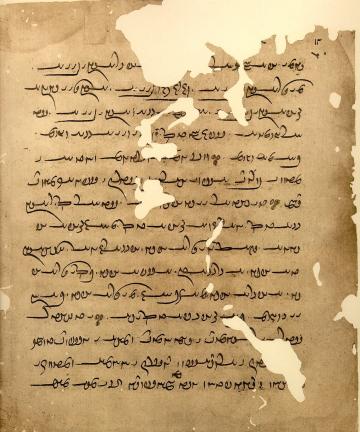
The origins of Zoroastrianism are not widely known. This might be due to the fact that it was orally passed down among Zoroastrian priests for more than a thousand years. Likely the first time the Avesta was written was in the Sasanian period. A special alphabet was devised to do so, forming the language/script Avestan, the language the Avesta is written in. The Avesta is the earliest (sacred) main text we refer to for knowledge about Zoroastrianism. 

Below is a digitized page from the Avesta (see here for more pages).

avestan.jpg?itok=ds5ThdiJ&profile=RESIZE_710x

"Avestan," University of Oxford

The Iranian languages are a branch of the Indo-Iranian languages, and the Indo-Iranian languages are a branch of the Indo-European languages. The Iranian languages are generally split up into three stages: Old Iranian, Middle Iranian, and New Iranian. Persian would be classified as a New Iranian language (alongside others like Pashto and Kurdish) -- just a note, I am specifically studying Farsi, which is a dialect of Persian, specific to Iran. 

Avestan, rather Old Avestan, would classify as an Old Iranian language, alongside Old Persian. Avestan is more specific to the Avesta and Zoroastrianism, while Old Persian was more widely used across the Sasanian Empire (an ancient Persian empire).

References

Crary, David. "Ancient but small in number, Zoroastrians confront depletion of their faith," PBS News Hour, 1 July 2022. https://www.pbs.org/newshour/arts/ancient-but-small-in-number-zoroastrians-confront-depletion-of-their-faith#:~:text=Beliefs,words%20and%20do%20good%20deeds.

Malandra, William W. "Zoroastrianism i. Historical Review Up to the Arab Conquest," ENCYCLOPÆDIA IRANICA FOUNDATION. 20 July 2005. https://iranicaonline.org/articles/zoroastrianism-i-historical-review


Read more…

SDLC 105 S22 | Reflection Paper #1

Parisa Mershon

SDLC 105: Introduction to Self-Directed Language Learning

Dr. Marsh-Soloway

August 28, 2022

Reflecting on My Language Journey

If I were not on the pre-med track, I would most likely be pursuing a career in linguistics. I could say my passion for language began in my elementary school days on Duolingo, but I am not entirely sure; I can say, however, that COVID-19 accelerated my drive to learn Farsi. At the time, my father was simply visiting family. Once the pandemic hit, the airport shut down, and his month-long stay turned into a year-long one, culminating in his decision to formally move back to Iran (where he is now). Learning Farsi is one of the ways we can stay in contact, and as I’ve grown older, I’ve wanted to try and bridge the cultural divide I have with my Iranian family 一 at least a little.

The other language I have been learning is Mandarin Chinese, which I started in my freshman year of high school and am continuing here at UR. I fell in love with writing characters and would spend many hours practicing. Chinese was the only non-Latin-based language, which, for some reason or another, has always been more intriguing to me (especially languages with a different writing system/alphabet, like Farsi). 

My likes and dislikes heavily depend on the language I am focusing on. In Chinese, I loved writing (both characters and grammar structures), as well as listening and reading. Speaking, however, has always been my Achilles heel, as the tonal system in Chinese is a considerable challenge for me. In Farsi, my pronunciation/accent comes much more naturally (possibly because I have heard the language most of my life), but forming sentences is comparatively more difficult. I would suppose this has to do with Farsi being a Subject-Object-Verb language, yet I am not entirely sure. 

It is rather difficult to say my dislikes, as I largely don’t have any. I enjoy working on my various challenges in language. Nevertheless, if I had to highlight one, speaking with other native speakers/public speaking in my target language has always been an area I am not quite fond of. I am not particularly invested in improving public speaking, but I feel as though my hesitancy to converse with other native speakers is holding me back more and more as I progress in each language.

I try not to ascribe to a particular learning style, as I am not convinced systems like the VARK Learning Styles are truly beneficial. In terms of general learning, spaced studying and mock assessments are beneficial. In terms of language learning, I find that long-form writing and conversational speaking (alongside the aforementioned study methods for vocabulary) are particularly valuable. In long-form writing, I can ascertain the limitations of the grammar I have learned. I can also start understanding which words have what connotations, and which words are more formal versus informal. 

Since my focus in the course is Farsi, I will not reflect on how I can improve my Chinese-learning methods. I think I should try to speak with other native speakers of Farsi (preferably those who are familiar with Iranian vernacular / colloquialisms). Though my father has been an excellent teacher, he moved to the United States when he was 17 (due to the 1979 Iranian revolution), and until 2019, had not stayed in Iran for more than a couple of months at a time. Consequently, his Farsi is slightly odd compared to others, as he has lost touch with certain cultural practices (such as being too direct/blunt). And as he always jokes, Farsi was the one class he failed in (Iranian) high school. I also have delved deep into writing, so I would like to practice both the script and the more formal language associated with it. 

Read more…

SDLC 110, F22 | Journal #1 (August)

August

It has only been one week, but I am already so excited to continue learning Farsi! I have started off strong and met with my Language Partner for about an hour five times this week. Because I was really busy in the summer, I was not able to meet much, so this week we have mainly focused on reviewing old material, and we will probably continue to focus on just reviewing for a while. Both of us think it’s much more important to adequately learn the material, move forward, and then keep reviewing old material so as to cement the vocabulary.

I use the website Persian Language Online (abbreviated from here on out as “PLO”). It is a free resource made by the Iranian Heritage Foundation. I have been using PLO for about a year now, and it has provided a lot of needed structure in my Farsi learning journey. It is separated into three levels (in order of difficulty: Beginner, Elementary, Intermediate), with a total of sixty lessons (twenty lessons per level 一 B1-B20, E21-E40, and I41-I60). Elementary lessons have a main text and two dialogues; the main text uses more formal language, while the dialogues use more conversational language. 

Because my language partner lives in Iran, where the government heavily censors the internet, I made all the lessons on PLO into a pdf file (PLO Elementary 21-40.pdf). 

I am currently reviewing the Elementary lessons (E21-E40). This week, I reviewed the first three lessons, which I think is what I will focus on for the rest of this journal. For reference, here is the layout of a standard lesson (E21).

12746897453?profile=original

Lesson 21 (shown above) introduces some basic vocabulary about hobbies, school, friends, and music. I have done this lesson more times than I can count, so we only spent one session on it. I read through it, practicing speaking at a faster pace. My language partner then asked some basic comprehension questions, which I answered (in Farsi), and then we finished off with me reciting the lesson, but saying it from my perspective (e.g. instead of saying I am 17 years old, like the narrator in the lesson, I said I was 19). I think I struggled the most with this, as my biggest struggle right now is formulating sentences (in terms of grammar).

I am hoping taking SDLC 105 will help me have a better method for tackling some of the grammar that is making me struggle. In Farsi, the sentence structure follows a Subject-Object-Verb/SOV order (boy ball throws), while in English it is SVO (boy throws ball). I feel like there is more that is confusing me, but I don't think I know enough about grammar to articulate it. I think the strategies I am using now are sufficient for the amount I know about language; again, as SLDC 105 progresses, I am sure I will modify some of my techniques, or at least be able to articulate the aspects of Farsi that are confusing me. 

Read more…