Maggie Dong's Posts (39)

Sort by

Cultural Post #4 - Abbreviations

Once as an activity for practice, Vivian listed out some 줄임말 (abbreviations) in Korean and asked me to guess their actual meaning or what they are short for. I knew some of them from the variety shows I'm watching, but it was also hard for me to guess if I've never seen the word before. Some of them are short for a whole sentence, while some of them are just short for two words. It was a fun activity that we both liked, so I thought it would be an interesting topic for cultural posts as well.

It is commonly mistaken that 줄임말 in Korean was invented lately when teenagers are just too lazy to type. However, in the 90s when 삐삐 (pager) was largely used, there were a lot of abbreviations in numbers for people to communicate conveniently. For example, 58486 is short for 오빠 사랑해 (I love you) because the pronunciation of the numbers is similar to that of the sentence. Another example would be 20000. When it is pronounced as "twenty thousand", it is similar to that of 비안 (sorry). There are hundreds of number abbreviations like these back then and I found it so interesting.

Now, the 줄임말 are mostly in words. They are updated very fast since people keep creating and spreading the new ones, so it does not necessarily mean you are trendy even if you use 줄임말. For instance, a very commonly seen one is called 청바지, which means "jeans" itself. But is also short for the sentence "청춘은 바로 지금", which is saying "our youth is now!" This sentence is a 건배사 that are words or sentences people say before taking a shot together. But now, this abbreviation and the 건배사 are relatively outdated. Young people tend to use more words like "인싸" (insider of a group), "아아" (iced americano) and even something like "ㅇㅇ" (ok, yes) in their daily life. Some abbreviations started out as something only young people would use, but then gradually became daily expressions, such as 심쿵 (my heart just skipped a beat), 남사친 (boy-friend), and TMI (too much information).

Sources:

삐삐 숫자 암호해석 : 네이버 블로그 (naver.com)

재미있는 건배사줄임말 우.아.미~ : 네이버 블로그 (naver.com)

줄임말 50개, 당신은 몇 문제 맞힐 수 있나요? - 머니투데이 (mt.co.kr)

[#기출문제] "친추? 친구 추행?!" 와썹맨 빼고 ALL 정답 가능한! 신조어_난이도 하 | #놀라운토요일 #Diggle - YouTube

Read more…

Language Learning Journal #4

Before the Thanksgiving break, Vivian and I recorded the podcast for the final in class. We summarized what we've learned this semester, what part of learning I enjoyed the most, and what I wish I have done more. It is always fun and relaxing speaking with Vivian in Korean because she is always being patient and encourages me to say more. Among all the interesting exercises we've done together, I love the video response practice and the fun question discussion one the most. For the video one, I was able to try out my listening as well as speaking and writing at the same time, and I love discussing my thoughts with my language partner after trying to understand the video on my own. The fun question discussion also provides opportunities for me to use words that I don't usually use in a daily conversation, so I could learn more vocabulary while practicing my speaking in Korean.


After the break, we met again simply to wrap up the semester and have some time to work on our final presentations. We practiced conversations by catching up with each other about our Thanksgiving break, and then we discussed what we are going to do for our final presentation. I was still looking for a certain topic, so Vivian showed me what she was planning to do and it looked really interesting.


This semester has been harder than anyone before. I had to get used to all the restrictions and limits put up because of the pandemic, and I was spending a lot of time on my classes and applications. But I am still glad that I took Korean with Vivian this semester, where I had the chance to not only practice my Korean but also spend some time with my friend. I do feel more confident speaking and writing Korean after this semester's practice, and I look forward to more practice of reading next semester.

Read more…

Cultural Post #3 - Mukbang

먹방 (Mukbang), short for 먹는 방송, means eating show. It is a type of show that started in South Korea a few years ago and gradually became a global trend. Now on YouTube and Tik Tok, there are tons of videos where the host eats a variety of food, usually in big portions as well, which are all very visually appealing.


Even before I knew there is such a thing called 먹방, I've seen people in Korean variety shows eating like a show. They would show the camera what the food looks like first (always in beautiful colors), and then eat nicely and cleanly while describing the flavors vividly. Every time I watch a Korean variety show or drama, I need to have some snacks beside me because every dish looks so good on the screen. It does not matter if I really like it or not, it is the way of them showing it.

12746895897?profile=original

Earlier this year, some Korean YouTubers for 먹방 opened their accounts on Chinese social media, when I knew about this culture and watched a few videos of theirs. The YouTuber with the highest views and recommendations is called "Eat with Boki", who has a million followers on Chinese social media and 7 million on YouTube (up to December 2021). In the video I watched, she ate a very large pot of 부대찌개 (budae jjigae, army strew) with ramen, ham, tofu, and a lot of other ingredients in it, with kimchi on the side and some big 계란말이 (rolled omelet). If I were to eat it, I don't think I will be able to finish them all in a day, but Boki finished it all in her video. It was quite astonishing to me because Boki is a girl about my age, but with a good appearance and a fit body.

기사 대표 이미지:유튜버 문복희 "절대 먹뱉 하지 않았다" 적극 해명

This semester, Vivian and I discussed some controversies on not only Boki but also the Mukbang YouTubers. Some pointed out that none of these YouTubers said explicitly that they received ads from some food companies, which is illegal in South Korea. There are also some controversies saying that the YouTubers edit their footage so that they could just chew the food and then spit it out. This is called 먹뱉 in Korean. Many people lost their trust in the YouTubers doing 먹방 for these reasons. To prove herself, Boki uploaded a video that she claimed to be uncut, which includes the whole footage of her eating and swallowing the food, but the comments are still not so friendly. The problem about 먹뱉 is not only about wasting food but also that they cause a lot of anxiety for girls living in a society that is already toxic about it. As an example, Boki shows by doing 먹뱉 that she can eat a lot of food while being fit, so now girls have a higher standard of beauty where they need to be pretty while having a lot of food, which is toxic, unhealthy, and I would say impossible to do for any human being. Therefore, when accused of the unnotified advertisement or fake eating, a lot of 먹방 YouTubers shut down their channels for months or apologized for their past actions.

Sources:

SUB)치즈가득 두툼한 치즈롤까스에 불닭볶음면 먹방! 새우튀김까지 리얼사운드 Cheese Roll Cutlet, Buldak&Deep-fried Shrimp Mukbang ASMR - YouTube

유튜버 문복희 "절대 먹뱉 하지 않았다" 적극 해명 | SBS 뉴스

유튜버 문복희 "먹뱉 절대 하지 않았다" - 스타투데이 (mk.co.kr)

먹방 유튜버 문복희의 ‘먹뱉’ 의심 정황이 새롭게 발견됐다 - 인사이트 (insight.co.kr)

What is 'mukbang'? Inside the viral Korean food YouTube trend (today.com)

Read more…

Language Learning Journal #3

Starting from week 8, Vivian and I agreed that I should start doing some reading and writing exercises. This week, we did some writing practices along with conversations. Vivian chose some emojis and pictures that were easy to recognize and commonly used in our daily life, and I needed to recognize them and then write down the Korean word for them. I was very proud of and surprised by myself that I was able to recognize most of them and write them down correctly. While we went over the word, Vivian would also point out some similar words, either in pronunciation or meaning. Even though I knew most of the words in speaking, some words are confusing in writing since they can be connected to the next word in the sentence or have a sound at the bottom that is very light when pronounced. I learned a lot from this exercise and I found it very fun to do.

For week 9, I worked on a worksheet made by Vivian, where I need to watch a video in Korean and write down my answers to her questions. It was a video from the channel Korean Englishman where they invited 김수미 (Soo-mi Kim) to teach them how to make kimchi. 김수미 is a Korean actress who debuted 50 years ago and has a very prolific career. In this video, she showed Josh and Joe how to make kimchi and made ramen with kimchi for them. I was able to understand most of what they are saying, and the video was so interesting that I want to try making kimchi myself too. When writing on the worksheet, I was able to write out mostly what I wanted to say, but there were some spelling mistakes, again, because of the connected sounds. Vivian fixed the mistakes for me and then I tried rewriting the whole sentence again. I love how we were able to practice listening, speaking, and writing in this one practice.

For week 10’s class, Vivian assigned a list of English songs to me and asked me to choose one to translate into Korean. I tried to do so but found all of them hard, so Vivian did the practice with me in class. We listened to the song first, and then we tried to translate it by half a sentence. I found that there were many verbs, especially verbs in phrases, that I didn’t know, which made the translation especially hard to do. Vivian was very patient when I was stuck, but I had to say it was a struggle for both of us. After translating a verse, I re-read our translation again, and it gave me a sense of accomplishment. We translated a verse and a chorus together, and I took notes of all the vocabulary that I need to learn. It was a hard but fulfilling practice.

For week 11, we started to do more practice on reading. This week, we read a news article together that is about the YouTube channel, Korean Englishman. We’ve watched some videos of theirs as practice before so I was familiar with the person on it, but I didn’t know there was a controversy about them too. For practice, we read the article line by line and translated the lines to English. At the end of each paragraph, I need to summarize the paragraph. I couldn’t read very fast, but I could understand the content after Vivian read it at a normal speed. Vivian encouraged me to do more readings so that my reading speed will be faster, so I’m thinking to spend more time on reading practices next semester.

Read more…

Cultural Post #2 - Street Food

During this Thanksgiving break, I traveled to Washington, DC with my friend and hung out with Jenna. We went to a big Korean market together and had 떡볶이 (tteokbokki) and 감자 핫도그 (potato hotdog) in the market. 떡볶이 is spicy rice cakes that are white and short. The ones we had were cooked in a long shape and then cut into small pieces when served. In the Korean dramas I've watched, they were cooked with the spicy red sauce only, but the one I had was served with beef, noodle dumplings,어묵(Korean fish cake), veggies, and an egg in a big pot and was a portion for two. I like it so much even though it was a little bit spicy for me.

 r/SeoulFood - Tteokbokki with a massive fried squid and beef brisket toppings!

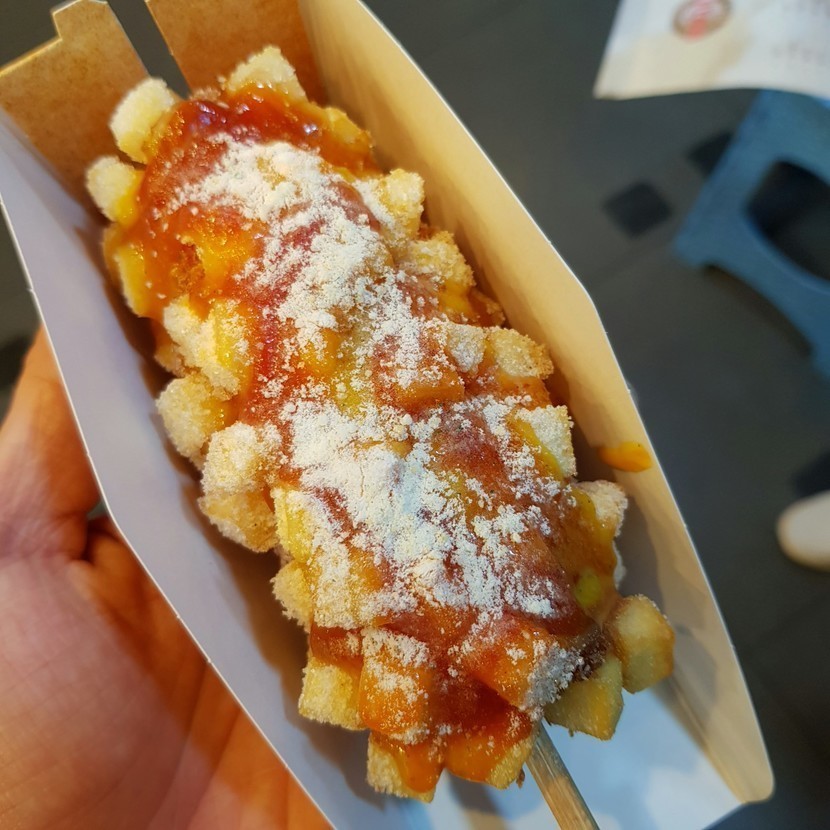
I also had 감자 핫도그 (potato hotdog). It was a fried hot dog covered with crispy diced potatoes and a little bit of sugar. It tastes very good with the crispy potatoes on the outside and soft hotdog inside. I also tried dipping it in the 떡볶이 pot as Jenna recommended, and it was even better. The sweetness of the sugar cover makes it taste less spicy with the sauce than the 떡볶이 and is very flavored. When I searched on YouTube, I found that there are also ones that are filled with cheese, and those seem to be really popular.

8d97b5b078.jpg


My very first impression of street food in South Korea came from K-dramas, where the teenage students would have some street food with their friends on their way home. This time when I researched about it, I found that there are so many different kinds of street food. Besides 떡볶이 and 감자 핫도그, they also have 튀김 (fried), 김밥 (kimbap), 붕어빵 (fish-shaped pastry), and so on. I watched a lot of videos of them and I found that a majority of the shops are located at 시장 (traditional street market), where there are a lot of food shops on the street and people can order some when walking by and then hold the food while they keep walking. This setting explains why most of the street food is made in small portions and thus easy to hold. The shops are also really small, sometimes they are just kitchens on wheels, so they can move around and change locations more easily. I found this very interesting to know, and I really want to try more kinds of it next time I travel to South Korea.


Sources:

[한글/ENG] trying KOREAN STREET FOOD! | korea mukbang vlog | 한국 먹방 브이로그 - YouTube

최고의 한국 길거리 음식 및 시장 가이드- IVisitKorea

만득이 핫도그 만들기 : 네이버 블로그 (naver.com)

감자핫도그(feat.명랑) | 뉴스트림 (newstream.kr)

Tteokbokki with a massive fried squid and beef brisket toppings! : SeoulFood (reddit.com)

KOREAN STREET FOOD - Gwangjang Market Street Food Tour in Seoul South Korea | BEST Spicy Korean Food - YouTube

보기만 해도 군침이 싹~도는! 길거리 음식 BEST 몰아보기 1부 / The best collection of delicious Korean street food Part 1 - YouTube


Read more…

Cultural Post #1 - Street Woman Fighter

Recently, a show called 스트릿 우먼 파이터 (Street Woman Fighter, often abbreviated as SWF or 스우파 in Korean) is becoming a big issue in South Korea. The show invited 8 crews of female dancers and ran competitions among them. For freestyle dance battles, one of the dancers calls out another one, and they dance to a random song together. Then the rest of the dancers will vote and rank the crews. They also have a lot of collaborations with singers and idols, where the crews either dance with the idols or choreograph for the singer’s song and perform. A part of the competition was to choreograph for a new song by the singer Jessi, and the choreography chosen by Jessi will be used as the choreography for the song forever and performed in her music video. As a fan of Jessi and dancing, I found it very interesting to see different styles of dances for the same song. The music video is very well made, and because of the high quality of the choreography, it has now become a trend on Tik Tok in South Korea.

Even before I watched the show, I love dancing and enjoy watching different kinds of dance performances. Even though I knew that there are a lot of excellent dancers in South Korea, there were not many ways for me to know about their stories and their lives. I did not know how they choreograph, how the crew works, and what they actually do for life, etc. After the show ended, I watched a lot of interviews and variety shows of the crew leaders. I am so glad to see that their stories are now heard by the public. Before the show, some of the dancers were known as the back dancer of an idol, but now they are more known as “dancers” themselves.

There are also a lot more opportunities now for them to introduce their dance and choreography skills to the rest of the world. For example, from a variety show named 아는 형님 (Knowing brothers), I learned that Lee Jung is the choreographer for a lot of K-pop idols, such as ITZY and TWICE. I love the dances and the performances so much, but I was never aware that she was the choreographer. They also mentioned in another interview that there is no such thing as copyright for dance in South Korea since it is very hard to identify if the moves are copied from another dance. Therefore, unlike songwriters, even though their dance got well-known and was performed by different groups a thousand times, the choreographers are paid the same amount. I believe it is now a starting point where they now have the opportunities to share their stories and thoughts on things like these.

Sources:

(ENG) "뽐낼 건 뽐내야지" 춤 알려달랬더니 숭한 것만 잔뜩 알려주고 간 스우파 리더 쌤들ㅋㅋㅋㅋㅋ / [문명특급 EP.221-1] - YouTube

(ENG) 전국민이 다 춘 헤이마마 춤, 이 정도면 노제 씨 한강뷰 아파트 한 채는 마련하셨겠지? (순수한 궁금증) / [문명특급 EP.222-2] - YouTube

Jessi (제시) - Cold Blooded (with 스트릿 우먼 파이터 (SWF)) MV - YouTube

[EN]믓찐 언니들 YGX x 제시가 만났다 토크도 춤처럼 완급조절이 가능한 일?! 본업왕잘 갓벽 YGX의 대꿀잼 인터뷰!《제시의 쇼!터뷰》 EP.76 by 모비딕 Mobidic - YouTube

[ENGSUB] Knowing Bros Ep 307 Part 4 - YouTube


Read more…

Language Learning Journal #2

We did more speaking exercises in week 4. We started by catching up with each other, and then we did a conversation exercise on the issues that recently happened in Korea. Vivian mentioned a Korean artist's scandal lately, so we discussed our opinions and feelings towards it. We then moved on to a culture in Korea - mukbang, which refers to the YouTube channels where the YouTuber eat a lot of food in one video. Some eat only one kind of food in one video, and some eat a variety of food - but in common they eat a huge amount of food. I've watched few mukbang videos before, but Vivian has watched it a lot for 대리만족, which means gaining a sense of satisfaction by seeing somebody else doing it. I didn't know before Vivian told me that mukbang started in Korea at first and then went popular around the globe.

Vivian introduced me the concept of mukbang and showed me a channel that is really popular on YouTube. It is a girl who looks pretty and slim but eats a lot. She eats the amount of my three meals in that one video. We discussed the message that this type of video is conveying - that you need to eat a lot but stay slim and pretty. This is a very unhealthy but common idea in Korea but also in many East Asian countries. There are also scandals about the mukbang channels. People have found that quite a few mukbang YouTubers have been advertising for brands without telling their audience, which is illegal in Korea. In Korea, if you are advertising something, you have to let people know, either explicitly or implicitly. Another scandal about the mukbang YouTubers is fake eating, that they put the food in their mouth, chew it, and spill it out. And they edit the videos so the swallowing or spilling out part is not included in the whole video. These two scandals raised an issue of untrust in YouTubers in Korea, and some YouTubers just shut down their channel because of this.

I then read through a news article on the mukbang issue that Vivian found. It was still very hard for me to read - there were quite a few phrases that I've not encountered. What we did was I read it first, Vivian read it again, we went over the vocabs or phrases I don't understand, and then I tried to translate the whole sentence into English. It was a struggle for me, but I did learn a lot of new phrases from the passage.

For weeks 5, 6, and 7, we each picked an episode of Korean drama we wanted to watch and watched them together. I started with the last episode of Hospital Playlist, which is my favorite drama of the year. Then Vivian recommended the Squid Game, which ranks first on almost all regions on Netflix right now, but it was too scary for me. This week, we watched Hometown chachacha, which is a comedy romance drama that I really enjoy. During each class, we would turn off the English subtitles and have the Korean one. I could understand most of the plots, but there were times when I was just lost and couldn't guess out the phrase I didn't understand. We would pause in the middle and Vivian would explain it to me, either what is going on or what the important phrase was. I was really motivated by this type of class because I always want to know what happened so I would really focus on listening and reading the lines. I've been taking notes about the words I didn't understand and I need to review them frequently so I don't forget.

Read more…

Language Learning Journal #1

For the first week, I just filled out the form for our preference for language partners. I did watch a few episodes of variety shows in Korean to help me get used to listening to Korean.

Starting from Week 2, I started studying with Vivian, who is my language partner this year. On our first day of class, Vivian did a self-introduction about her family, hobbies, and her study abroad experience in Korea last year. She talked mostly in Korean and I was able to understand most of it. When I met words or phrases I didn't understand, I would guess them first and then ask Vivian about them. Then I would jot them down on my notes. I was quite surprised by myself - I couldn't take Korean last year because I was studying abroad, but I could still understand most of it. I then tried having a conversation with Vivian about my study abroad experience as well. I stumbled and had vocabs that I didn't know how to say, but Vivian helped me with them. She also asked me what kind of practice I wanted to focus on the most, my concerns if I have any, and of course, the topics that I am interested in. I really liked the introduction and I was very excited about the coming classes.

In week 3, we had a conversation practice. We started by talking about our past weeks, and we discussed the d hall food as well as the new building on campus. Vivian prepared some fun questions for us to discuss, such as the type of animals you wanna be, our 이상형 (ideal type), and so on. We then went over some Korean slang that is commonly used when people type, and that was a fun exercise too. Then to learn more about Korean culture, we watched an episode of Korean Englishman on drinking in Korea. I enjoyed the class with Vivian overall and I like that I am able to practice speaking a lot through our conversations.

Read more…

Cultural Post 4 - Drinking Games

After learning about the drinking manner with Jenna and Christi, I started to wonder about the Korean drinking game. It always seems to me that even though there are so many drinking games in Korea, people know about them all. I have heard about some of them, but I want to learn more about the details.


One of the most popular and commonly played is called 아이엠그라운드 (I am ground) game. There are four beats where you clap at different places. People sit in a circle for this game and clap together. The first round is self-introduction when people say their names on the last two beats. After that, one person says his/her name first, and then say another person’s name followed by a number less or equal to four. The person who is called out needs to say his/her name on the beats, and then call out somebody else again. One person is out if he/she is off the beat, calls a wrong name, or if he/she calls somebody who is already out. This is a good way for people to make friends when they are hanging out with a group of people whom they are not yet familiar with, such as friends of a friend.

 12746889676?profile=original

Another classic drinking game is 눈치 (sense) game. In the game, one person stands up and calls out “one!” out of a sudden. Then, each person calls out the number that is one step bigger than the number called out before while standing up. If two people call out the same number or stand up at the same time, they are out together. If everyone calls out a different number until the last person, then the last person is out. This game is fun because there is always tension in the air when people are trying to be the next one standing up. It is also more convenient for people to play since they don’t have to sit in a circle to play this game.


A game that I have tried with my friends is called 바니바니 (bunny bunny). People sit in a circle and start with one person saying “바니 바니” twice. On the first 바니바니, the person points to himself/herself, and on the second one, point to somebody else in the circle. The person who is pointed at will repeat the “바니바니” and pass it to somebody else again. Also, whoever sits right next to the person who is pointed at should say “당근! 당근!” (carrot carrot) when the person in the middle is saying “바니 바니.” Whoever forgets to do “당근! 당근!” or didn’t catch the “바니 바니” passed on to him/her will drink or even take a shot.

 12746890059?profile=original

There are many general rules for the drinking game. For example, whoever loses the game is taking a shot. Before the person drinks, other people on the table will sing a drinking song, such as “술이 들어 간다! 쭉, 쭉, 쭉쭉! ” (Here comes the drink! Drink, drink, drink, drink!), which makes the drinking more fun and interesting.


Sources:

https://www.youtube.com/watch?v=XkmqpTNVqyI

https://www.youtube.com/watch?time_continue=3&v=2FBajA_MLWY&feature=emb_logo

https://10mag.com/10-korean-drinking-games-you-have-to-try/

http://whatakdrama.com/best-korean-drinking-games-how-to-play/

Read more…

Cultural Post 3 - Cafe

When I traveled to Korea last year, I noticed that there are so many coffee shops even on one street. But even before that, I’ve learned a little about Korean coffee culture from its dramas. When a couple goes out to date, they would meet in a 카페(café) and order two cups of coffee. There are also vending machines for coffee in colleges or on the rooftop of the building, where people can have a small cup of coffee and chat with their friends.


From a drama I’ve watched, I learned that Koreans love to order “아아”, short for 아이스 아메리카노 (Iced Americano). It is so commonly ordered that it has a shortened word for it. Even in winter, people love ordering it with ice. However, according to the Kraze, coffee was introduced to Korea about 121 years ago. The first person in Korea who tried coffee was Emperor Gojong, after which coffee shops and cafés started to appear in Korea. Now, a lot of young people or couples would go to a coffee shop and chill for an afternoon.


12746887272?profile=original

Nowadays, Korean cafés have grown so much that this industry becomes very competitive. Every café wants to distinguish itself from others, and thus more cafés are trying to have their theme or concept to make people stay and remember it. A lot of Korean cafés are good places for photo takings, which would attract more young people who are active on social media. Many cafés will have white walls with simple wooden decorations, which creates a healing atmosphere as soft music is played in the background. Despite the well-decorated shop, the display of the coffee is important too. If it is not for takeout, coffee will be served in a glass bottle, usually with a wooden plate under it as well. There will also be small cakes or bread served beside the coffee.

 12746887657?profile=original

There are also many themed cafés in Korea. For example, there is a snoopy-themed café in Seoul. The cups are painted with the Snoopy characters, the cookies are made in the shape of Snoopy, and there are many decorations related to Snoopy as well. In general, it is a cute shop that would attract young people there to hang out and chat with their friends. There are many other themes designed by the cafés in South Korea, such as vintage, Cotton Candy, and Line Friends. They are called the “Instagrammable cafés” since people would go there for good photos to post on Instagram. This café culture is formed in South Korea in recent years. I want to try it out with my friends someday and I think it would be really interesting.


Source:

https://www.youtube.com/watch?v=xyDfoS9E6I0

https://www.youtube.com/watch?v=o-ncNbguX8M

https://www.youtube.com/watch?v=4DY6MyDYhx4

https://www.youtube.com/watch?v=r0LdUlGewLQ

http://www.thekrazemagazine.com/latest-updates/2019/5/12/the-caf-culture-of-korea

Read more…

Language Learning Journal #8

The last two weeks of classes are used to wrap up the semester. I video chatted with Jenna, my language partner, and did the podcast interview to reflect on the semester.

My plan for this semester of Korean is to improve my language skills while learning more about the interesting aspects of Korean culture. For the first half of the semester, I met with Jenna and Christi, and we did more practice on reading and conversations. Jenna would print out a news article or a weather forecast for us once a week, and we would read through the material line by line and tried to translate it. It was definitely challenging to us at first since sometimes there might be hidden meaning under the expression. Different from my first language, Koreans would say the sentences in a less direct way, which takes one step further when it comes to translation. I remember when we were translating a long sentence from a news article, it took us some time to figure out the logical connection between the parts. It was also not easy for me to get used to the formal expression and the vocabs when we were trying to interpret the weather forecasts.

I enjoyed the conversation practices a lot. Each time Christiana and I would divide our roles and read the lines for each role. We would learn some new vocabulary in a specific scenario before the conversation, and then find them in our lines. I found myself good at guessing a rough idea of the meaning of the sentence, which gave me some confidence in the practice. It was also a very effective way for me to learn new words as I used them in our conversation. I miss doing this practice with Jenna and Christi a lot as we moved on to the online instruction.

For the second half of the semester, we did a lot of cultural learning. We started with learning about the drinking manner in Korea, which turned out to be more complicated than I thought it would be. We then watched a Korean web drama together, which is a new way of drama that I was not familiar with. As the tempo of society gets faster, people don’t have the time and patience to watch one episode from a traditional drama for an hour or even longer. Therefore, web dramas are becoming more and more popular. They are much shorter in length compared with traditional dramas and thus more convenient for people to watch on their commute. I’ve also noticed that some variety shows are trying out a similar way too. Some TV programs have only 5 minutes on TV, so it gets to condense all the funny parts and thus attracts more people to watch. I’ve practiced watching a short Korean variety show on YouTube without subtitles, and I was surprised that I could understand most of it. This has been my goal since I started learning Korean, and I’m glad that I can feel my improvement. I’m now more confident in my listening and conversations, which is satisfying.

Read more…

Language Learning Journal #7

As I mentioned to Jenna as a goal of my Korean learning this year, I want to learn more about Korean cultures. This week, I learned about the 고스톱 (Go-stop) game, a traditional card game in Korea. I’ve seen old people playing this game in Korean dramas during the festivals, but I never got to understand the rules of it. It always seems that everyone has their own sophisticated strategy for the game, which looks cool to me.

Jenna introduced the basics of the game to me – the cards. The cards are named 화투, where 화 means flower, and the whole word means “flower cards”. All have them have drawings with styles in sync. There are 48 cards in total, categorized into 12 different months, so there are 4 cards for each month. The cards from each group or family have different names. For example, the cards of January is called 송학, which means crane, and thus there is one crane drawn on a card from this set. In the game, there are four different kinds of cards: 피 (shell), 띠, 열끝/멍, and 광 (light). However, it is not that each family will have all four kinds of cards. Instead, in each family, there is either a 광 or 열끝, one 띠, and two 피 cards. For each kind of card, the drawing on the card will have different details. For example, 띠 cards have red or blue ribbon across the drawing, and 광 cards have a small Chinese character written at the corner of the card.

I then went to YouTube and tried to learn more about the rules. I watched several videos, but it is still very confusing. When the game starts, 6 cards will be shown on the table and each player will have 7 cards to their own. The general rule is that each player is using their own cards to win the cards on the table and getting points. When a player gets to 3 points, he/she gets to decide if he/she is going or stopping. As they go more, they will earn more points if they are winning points from the next round. However, if they do not get any points and the other players do not get any points, this round will be not valid and the scores at the next round will be doubled.

I really want to try this game once, not with money since that would be illegal gambling. I believe it will be easier as I try it more and figuring out some strategies for winning points without making the round null. I love that this game can bring family members and friends closer and it allows you to chat as you play. I hope I get to try this game someday with my friends.

YouTube video that I watched for instruction:

https://www.youtube.com/watch?v=EfDURLM7hBM

Read more…

Language Learning Journal #6

For the first week, I spent most of my time traveling home and staying in the hotel for quarantine, so I reviewed the news articles and the conversations that we have practiced with Jenna. I met some words that look familiar to me and give me a general idea of the meaning, such as 전공 (major) and 쓸모 (usefulness). After reading through the words besides the translation, I practiced memorizing them and then started to read the conversations. The conversations helped by providing a context for the words so that I learned these words better. I also read over the news articles and the weather forecasts we practiced earlier in the semester, which is a lot more challenging than the conversations to me. There are a lot of official phrases and expressions in the articles. I found myself getting more and more used to the formal expressions after each practice, and I noticed some expressions commonly used in the weather forecasts, such as 예보했다 (forecasted) and 증가 (increase), which helped me with my reading.

Then, I practiced my listening by watching two 12-minute long videos in Korean without subtitles on YouTube. It turned out better than I thought – I could understand 80% of the conversations, and I could guess the other 20% based on the context. I was surprised when I was about to finish watching it. There are also some short sentences shown on the screen as notes. When they jump out, I would stop the video until I read them over and understood what they meant. I could feel myself faster in reading in Korean by this practice, which was encouraging to me. Besides this, it was very interesting to me as I encountered many brand names in English that are interpreted by Korean characters. I would read out the characters first and then guessed out the represented brand, 발렌시아가 for Balenciaga, and디올 for Dior. It was not hard because the pronunciation is a little bit different from the original one and only has more ending consonants than expected. After finishing the practice, I watched the two videos again with Chinese subtitles. I stopped at the places where I did not quite understand by guessing and read over the phrases and vocabs and matched them with the subtitles. I found this practice challenging but fun, so I plan to do this more often for future practices.

After the practices of these two weeks, I gained more confidence in my reading and listening in Korean, especially in a conversational environment. As I watch Korean variety shows in my spare time, I would stop when there is a written phrase appear on the screen. I would then read it over and match the parts with the translated subtitle. It is super helpful for my reading practice as I now can read short phrases without stopping the show. I would recommend it to anyone who is learning Korean and is very interested in Korean variety shows like me. I mentioned this to Jenna later, and she thinks it’s good too.

Read more…

Language Learning Journal #5

During the spring break, I watched a Korean drama named “쌉니다 천리마마트” (Pegasus Market). This is a drama that is different from all the Korean dramas I’ve ever watched. Looking for something to do during the break, I picked this drama to watch since it has two main actors that I knew to be good: 김병철, who took part in the Sky Castle, and 이동휘, who played a part in 응답하라 1988 (Reply 1988). Both of these dramas are well produced and popular in Korea and China, so I expected the Pegasus Market to be good in a similar way. However, it turned out to be completely another style.


The drama started with정복동 being demoted to the Pegasus Market by his boss. The Pegasus Market is regarded as the worst business owned by the company. Even though the market is at the corner of the most crowded street in the town, few people walk into it. It has two employees, but they do nothing at work. This is an unbearable situation for 정복동, who has worked hard for the company during his entire career. As a result, he wanted to revenge the company by wasting all its money on stocking at the market and hiring unhelpful workers. However, as the story goes on, whatever 정복동 does to try to ruin the market or the reputation of the company, the result always turns out to be opposite to his expectation. The market starts to grow and becomes famous in the town unintentionally under 정복동’s lead.


I quit after episode 2 the first time I was watching it. It appeared to me that this drama mixes so many irrelevant elements that the story appears messy and illogical, such as an ethnic group of people with a superpower, a 깡패 (gangster) who needs the salary for his grandma, and an old man who lost his job due to the Korean financial crisis. All these people are now hired at the market and planning out wired events. However, as I kept watching it the second time, I realized that they are all representations of the neglected group in society. Also, there is a theme hidden under the main story in each episode. One is criticizing the insufficiency of care for the old and children in Korea. Another talks about people being judgmental of other people’s looks, and so on. Instead of the massive fancy effects or the romantic couples that are common in other Korean dramas, the hidden themes make me focus on the story while noticing the problems in the society that the writer wants to address.


The drama is rewritten from a webtoon, so it has the power of turning impossibilities into reality. There are also a lot of scenes in the drama where people sing and dance together as if they are in musicals, which is fun to watch. Overall, the drama is funny and healing with some themes hidden behind. I would say 천리마마트 is a creative Korean drama that introduces me to many cultural aspects of modern society in South Korea.

Read more…

Language Learning Journal #4

For the week before, I practiced conversation with my language partner, Jenna, and learning partner, Christiana. Jenna printed out a handout of conversations of two college students talking about the semester so far. We read through a list of vocabulary first, including some related words such as (semester), (class), and (major). We also learned the words for some subjects or majors, including chemistry, computer science, and finance. For each word, we would read it out loud first and then guess its meaning by its pronunciation. There are some words that are very similar to English, which makes them easier to remember. There are some words that sound like Chinese as well, but they turned out to have completely different meanings, which would sometimes confuse me a little bit. As we went into the conversations, however, the vocabs make much more sense to me. Christiana and I chose a character each and read through the conversation line by line. After finishing reading the sentence, just as we did for the list of words, we would guess a rough translation for the sentence. Then, we looked into the sentence more closely and figure out its transition, logic, and phrases used. We all agree that this is a really effective way of learning new words as well as having conversations. When I was confused about a particular word, we would refer back to the list of words we just learned or wrote down the new phrases on it, which helped me learn the new words faster. We love this kind of practice and it builds up our confidence in speaking too.


This week, we watched a Korean Web drama named “XX” together. Different from the most commonly seen Korean dramas with twenty or more episodes and an hour and a half for each, the web dramas are much shorter. They have usually around or even less than twelve episodes, and each episode takes around twenty minutes. Nowadays in this fast-speed society, not a lot of people would spend twenty hours on one drama – it’s too much time commitment. Instead, the web dramas are much shorter and easier to watch on commute. As more and more people start to watch web dramas, the quality of web dramas improved a lot over the past five years. Compared with the first web drama I watched three years ago, “XX” is well-made with higher quality in its soundtracks, choices of actors and actresses, and storytelling. Another interesting thing I noticed in web dramas is that they are slightly more obvious in promoting the products they are sponsored in when compared with TV dramas. In TV dramas, if the actor or actress is sponsored, say by a clothing brand, then they would wear this brand for a larger portion of time while fitting into the settings and characters. The brand name would appear at the very end of the episode but not in the drama. On the other side, the web dramas would actually show the brand name and its products in a scene and have the main characters talking about how they like them. This also shows how the web dramas have a really limited time for their audience to stay focused and interested, so they have to send out the messages in a more direct way. I love learning about these cultural topics and discuss them with my partners.

Read more…

Cultural Post #2

Yut Nori Game

12746884883?profile=original

Yut Nori (윳놀이) is a traditional Korean game usually played during the Korean Lunar New Year (설날). It is considered a fun traditional game to build bonds with families and spend some time with them. It could be individuals playing against each other or in teams. In each game, there are usually four players or four teams sharing the same game board. Each team has four of its own distinct tokens, or mals (“말”, means “horse”) and starts the game with its mals at the home position of the team. As the game goes on, they win if they are the first to have all four pieces getting back to home.

There are four wooden yuts (윳) in the game. The wooden yut sticks are specially made for the game. While one side of a yut is made flat, another side has a round curve. For each round, a player throws the yuts into the air at once, and the yuts should land on the board. If not, they have to throw it again. Then, the player counts the number of yuts with the flat side up. The number of yuts with flat side up decides the number of moves the person’s mal is going to move on the board.

12746885064?profile=original

If the mals have one facing up, the player moves once. If two mals are facing up, the player moves twice. Similarly, when three mals have their flat sides up, the player moves three times. The interesting part comes when the player has four flat sides up when the player can move one of his/her mals for four steps. After that, he/she gets to throw the yuts again. If all the yuts are thrown to be facing downwards, then the player can move a mal for five steps and throw the yuts again as well. The names for the results from one to five are pig (도 ), dog (개 ), sheep (걸 ), cow (윷 ), and horse (모 ).

The rules for the mals on the board are very interesting too. If a mal from another team comes to the same position as a mal of your team, then that mal of yours will be taken from the board and start from home again. If two mals of yours meet on the board, they can move together as one mal, which will make you go back to your home position faster, but it is also risky that someone else’s mal might take both of them off the board at the same time. In addition, if a mal lands at the corner of the board, then the player can choose to go from the central shorter routes to go back home faster.

12746884896?profile=original

People play Yut Nori (윳놀이) in many Korean variety shows and I have been wondering for years what the rules are and how they know how many steps they get. When I tried to learn it from what they threw, it was really confusing because they called each throw different names and such. I’m glad that I now have a chance to really learn the rules and understand the game. It would also be really interesting to see Koreans playing this game with their own strategies.


References:

https://www.youtube.com/watch?v=G90o0ai57EM

http://en.trykorea.com/article/about-korea/8/74/

Read more…

Language Learning Journal #3

For the second class of this semester, my language learning partner, Jenna, printed out a news artificial published online that discusses the recent Coronavirus and the effects it brought. The article, similar to the news report we went over the week before, is written in a very formal language with large use of vocabulary that I have not seen. We read the lines out loud line by line first and then went through the words and phrases that we are not familiar with. We did encounter some phrases that are appeared in the weather report as well, but there were still so many vocabularies that are not commonly used in conversations that it took us some time to read through the sentences. After that, we tried to interpret the meaning of the whole sentence. Even though we were given the meaning of every word in the sentence, it would still take us some work to translate the whole sentence because there are many conjunction words or phrases that are implied. Sometimes the sentence might look like a long list of nouns and adjectives because of the hidden logical words. I do believe that with more practices like this throughout the semester, we will learn more vocabulary and be more comfortable reading the published articles with professional language.


For the past week, we learned about the final consonants (받침 ) and also the drinking culture in Korea. With the Korean lessons taken back home, I thought I should be already familiar with the final consonants, but it turned out that there are more rules and exceptions than I expected. For example, I did not know that ㄷ (d) sound is pronounced ㅈ (ji) when it is followed by the vowel ㅣ(i). Similarly, ㅌ (t) sound should be pronounced as ㅊ(ch) with the vowelㅣ(i). I did not pay attention to these before. In addition, we also went through the double 받침 combinations, and the rules for these are a lot more complicated. For example, for the double final consonant ㄹㄱ, the first syllable pronounces ㄱ while the consonant in the next syllable will sound stronger. These rules with exceptions are a lot to memorize.


I suggested the drinking culture to Jenna because even though I have seen a lot of people drinking soju (소주 ) on a Korean variety show or drama, I did not get a chance to learn about every detail of the drinking manner. Jenna printed out a handout for the vocabulary regarding drinking and a list of drinking manners in Korea. There are so many that I would not even notice if others don’t mention it to me. For example, when drinking with an elder, you need to wait for the elder to put down their drinking glass before you put down yours. We also watched a YouTube video together that shows how an English man learns about drinking culture by drinking with a Korean elder. It was very interesting to see him doing all kinds of wrong things first and then called out by his friend. It also helped to learn the manners better because he was making the mistakes that I would too if I was in that position.

Read more…

Language Learning Journal #2

Last week, I worked with my language partner and peer on the weather reports. Firstly, we read through a weather forecast line by line and tried to understand each sentence. It took us longer than we expected. We have also spent some time on the vocabulary for weather forecasts such as "rainfall amount," "highest and lowest temperature," and "cloudy." There are many new phrases related to weather forecasts as well, including the verbs for rains and snow "dropping" and "to be reported/ forecasted."  To help us get better at reading in Korean, we decided to do similar readings every week so that we can get more used to the phrases as well as the expressions used in such a formal news article. Jenna has also been introducing the usage of words and grammar to us, which is helpful too. It is a challenging task, but I am also going to learn a lot from it.

After reading the article, we went through a conversation talking about the coronavirus concerns that started from Wuhan, China. We talked about washing our hands more often and wearing masks when going out. We will spend more time on it next week as well as a news article about the coronavirus in Korean, and I'm looking forward to that. 

Read more…