
Here is the podcast with Jimin, Elliott, and June.
Hyeon Jun Jo's Posts (55)
Sort by
In this cultural post I want to talk about PC bang in Korea. PC bang literally means PC room and it is also known as internet cafes. It is a café where you can play multiplayer computer games for an hourly fee. Although access to personal computers and internet are extremely available in Korea, PC bang is very popular as it provides a social meeting place for gamers to play together with their peers. Another characteristic that makes PC bang so attractive is its ability to offer access to expensive and powerful high-end computers or gaming PCs, designed specifically for video gaming, and exceptional internet speed optimal for the best gaming experience. PC bang also provides all types of food ranging from as simple as cup noodles to actual restaurant menus such as black bean paste noodles (짜장면). Additionally, it is open 24/7 which attracts all the night hour gamers as well. It essentially provides everything you need for optimal gaming experience. As PC gaming culture in Korea is very important, PC bang continuously improve to provide better and more services to customers.
The concept of PC bang was first introduced around the 90s and it was a popular idea for new entrepreneurs during the IMF situation. PC bang is still very popular to a large range of age groups including children, teenagers, and young adults. Few problems were raised due to PC bang such as how users including children fall into game and internet addiction, causing damage to other aspects of life. PC bang exists in other countries, but it is definitely the best and the most developed in Korea without a doubt. What’s more attractive is the in-game benefits that the PC bang can offer. Almost all games in Korea offer PC bang exclusive items and events that promotes gamers to visit PC bang more often. Another element that has contributed to the popularity of PC bangs is the lack of private space for young adults at home. Many Koreans live with their parents until they get married, reflecting Korea’s traditional Confucian extended family system. In addition, with the harsh education system and culture in Korea, many young adults feel like they are under strict rules at home, further influencing young adults to feel the lack of privacy. Korean youth are usually released from the surveillance of the watchful eye of their parents when they become college students or get a job, but freedom does not resolve their lack of privacy, particularly when it comes to romantic relationship in Korea. As a result, PC bang is able to provide the necessary privacy and a way to stress relief for many people.
I have been to PC bang myself in Korea and United States. PC bang in Korea is definitely better because it provides more services there. I remember when I was little, I used to play games with my friends in a local PC bang all the time. The gaming environment is really different in PC bang compared to playing games at home. It almost feels like I can play much better in games when I’m there. If you are a PC gamer, I highly suggest you try out gaming in PC bang.

Due to the coronavirus situation, I have been spending a lot of time watching videos at home. While streaming through different Korean shows with my parents, I came across a TV show called “Mr. Trot”. It is a competition among trot singers including professional and non-professional singers. The winner wins a prize money and also receives a chance to record their single. There have been many shows that have been made in the music industry starting with many audition programs like “K-pop Star”. However, normal competition shows like “Mr. Trot” started to become popular as well. Singing competition shows like “Show Me the Money” grabbed a massive attention from the entire country and even internationally. These competition and audition programs generally targeted young audiences by focusing on music genre that younger generation listen to such as pop and rap. Unlike these previous popular shows, “Mr. Trot” focused on the trot music which is very popular among older generation.
Trot music, also known as Ppongjjak (뽕짝), originates from Korea during the time under Japanese colonial rule in the first half of the 20th century. With the trot genre having its history of about 100 years, the singing style has been continuously changing. With the rise of K-pop and other genres during the 90s, trot began to lose its popularity and was viewed as more old-fashioned. Recently trot began to regain its popularity due to singers like Hong Jin Young and Daesung targeting younger listeners. The traditional trot music generally contained lyrical contents about love, parting and longing for sweet home as it depicts colonial tragedy during the time. Also, unlike the popular K-pop music today, trot music is mainly performed by one singer or as a duet. It is rare for trot singers to play any instruments while singing and it does not have any heavy choreography. It is a genre focusing a lot on the actual singing component rather than attractive performance.
With “Mr. Trot”, we can see another change in trot style. Younger singers are producing trot music and starting to focus more on performance. It is moving away from the old-fashioned characteristics and trying to integrate more younger population. The show achieved one of the highest view rates among all TV shows aired on TV. Close to the end of the show, it was able to gain almost 8 million participating votes to decide the winner. Modern trot is becoming to be associated with lighthearted fun and many singers including K-pop singers are adopting trot songs, contributing to the expansion of the fan base to a younger generation of listeners. This is evident from the large voting participation from younger generation around my age. The singers on the show is also expanding the concept of trot idol which is becoming more accepted today. After the show concluded, the competition participants gained much popularity and began to show up in many other entertainment shows, confirming the growth of popularity among trot idols. With trot continuously changing throughout the history of Korea, it is still making history today. If you are not familiar with the trot music in Korea, I highly suggest listening to modern trot music. I personally didn’t like the traditional trot music, but it is really catchy and I’m starting to feel differently about it.
Here's one song from the show:
https://www.youtube.com/watch?v=s5Pbx9LrsDk
and another by a modern trot singer:
It is already the end of the spring semester and it went by so fast. I have come so far in my language learning journey and I know that this isn’t the end of it. I don’t think I will have the opportunity to take this class again, but with everything I learned so far, I know I can continue on my own. Jimin and I took our time to discuss my progress so far and I am surprised how much I grew this semester. We also spent some time reviewing all the materials I learned this semester. I still had some trouble with one of the grammar lessons and Jimin was able to clear up some confusion. Another thing we did was checking how much faster I can read now. In the beginning of the semester, we measured how fast I can read by timing my reading of one article. We timed it again at the end of the semester with the same article and saw a significant improvement in my reading speed. After reading so many articles throughout the semester, I began to read while word-chunking which is the act of reading multiple words at once. Before, I was so focused on reading each word one by one, but now, I am able to take in several words at a time. Additionally, being familiar with the vocabulary also increased my reading speed. This is a significant improvement in my journey, and I was happy to know that I have accomplished one of my goals this semester. Although it is hard to measure other goals, being able to measure my improvement and knowing that I have achieved it definitely boosts my motivation. I really want to thank Jimin for being my language partner this semester and I appreciate all the effort she put in for me.
On my own time, I took some time to explore the business website. I know I have a lot to learn but I’m happy to know the direction I want to take and how to begin my journey alone. Also, my parents have told me that I am improving so much in speaking and I am very proud of myself for that. I have put a lot of effort to speak more frequently and the hard work definitely paid off. Communicating with my parents helped a lot, especially during the time I spent at home throughout the quarantine. One thing that my parents have told me is that I am speaking more and more in Daegu dialect. Because my parents speak in Daegu dialect, I was able to absorb a lot from them. I have noticed that my Daegu dialect only come out around my family which is very interesting to me. It really shows that the way people talk around you affect the way you talk. This wasn’t one of my goals this semester, but I am happy to know that I have learned some Daegu dialect. I am hoping that I can reach a point where I can choose to speak either the Daegu or the Seoul dialect. With some new goals I found this semester, I look forward to continuing my Korean learning journey.
Jimin and I were able to read a lot of news together about current events in Korea. We talked about the legislative election coming up on April 15 under the new electoral system. I don’t have much interest in politics in Korea, but it was still worthwhile reading. We briefly talked about how the current Moon party is trying to change free Republic of Korea into a socialist party. We were also able to research on some controversial topics related to this election. It was about how the Moon party is acting against the free democracy by ordering elderly population in Daegu region to self-isolation on account of the coronavirus. The main concern was that this would reduce the votes by the conservative party. It was interesting to learn how the political fight was being formed around the ongoing coronavirus situation. Although I don’t know enough to form my own opinion, it was good to know about the political power struggle in Korea. I was able to discuss some of it with my parents and it definitely is a new knowledge that is worth knowing. Other than the election, we talked about the 6th anniversary of the Sewol ferry disaster that is coming up on April 16. This is a very sensitive topic in Korea, and I know when I heard of this news then, it was really heartbreaking. It surely is one of the biggest events that took place in Korea in recent years and if you don’t know about it, I really suggest taking the time to learn about it. Next, Jimin taught me the spacing rules in Korean writing. I remember learning this last year and it is still confusing for me. It is something that I really have to master and get used to. Jimin provided a worksheet with sentences containing incorrect spacing and I had to find the incorrect spacings and correct it. Constant practice does help me familiarize the rules and it will take more practice for me to write without spacing mistakes. I used to apply some of the spacing rules without recognizing them, but because I am aware of these rules now, I feel much more confident in my writing.
I decided to listen to more business-related news on the radio this week and it was quite difficult to follow everything as I lack the professional language. Business language is one of my biggest interest in learning Korean. I want to be able to comprehend business news and this was my first step towards getting familiar with it. I really hope to further improve in this area so that I could use it in my future career life. I still have a long way to go and this is just the start but researching on my own and learning about it is really fun especially because it’s a subject that I really like. Going forward, I will try to read more business articles in the future and expand my knowledge on it. I found a great business news website (businesskorea.co.kr) that has both English and Korean version and I’m excited to explore more with it.
It is really unfortunate to be under quarantine now, but my language learning journey still continues on. With April approaching, Jimin and I was able to talk about 만우절, which is the April fools’ day in Korea. It is exactly same as it is in United States, but I found something very interesting in an article we read. Korea had a similar day in its history during the Joseon dynasty. On the first day of snow every year, the subjects of the King would be allowed to say a light lie to the King without any punishment. We also talked about how Korean BJs (Korean streamers) and celebrities use April fools’ day to present fake news to pull attention from the media. Besides reading articles, Jimin taught me more Chinese characters used in Korean. This also gets me frustrated as well but less than the spelling rules. Each Chinese character has its own meaning and they are combined to make a word. By knowing what each character means, you can expect the meaning of a word that you don’t know. For example, the character”인” means manpower and the character “력” means power. By combining the two characters, the word “인력” is formed which means man power. However, these are relatively easy to learn, and the four-character words are a lot more difficult to learn and harder to guess its meaning. Part of the learning is simply getting familiar to the characters and recognizing them in different words. I did a lot of exercises which a word is given, and I would have to write the correct meaning of the word. The four-character words are more difficult to simply guess as it usually means a whole phrase, so I practice them similar to learning other normal vocabulary. These characters also make up most of the professional language used in Korean, so it opens up a way to learn these professional languages as well.
With the COVID-19 situation, I listen to the radio very often with my parents, trying to keep up with the current news both in United States and Korea. There’s been many cases in Daegu where many of my relatives live and I hope the situation in Korea gets better. Using radio and podcast is really a good way to practice listening as it doesn’t have any visual support. I’m really getting used to listening Korean even though I lack the knowledge in professional language. However, I continue to expand my professional language with the help of my parents. Whenever an unfamiliar word come up, I would ask my parents and add it to my vocabulary list to review it later. With the quarantine, my parents have been a good source of learning and they allow me to practice speaking so much because I am forced to use it all the time. Although I am not able to meet with Jimin physically, a lot of my learning has been coming from watching videos and reading articles. As I stay at home, I think I will have a great learning experience as I get more exposure to the language at home and culturally integrate myself.
During the spring break, I was able to use Korean so often. I communicate with my family in Korean only, and being back in an environment where I use Korean more often than English helps me practice the language. Back home, I feel very integrated to the Korean culture as I eat Korean food and watch Korean shows with my parents. Furthermore, I have to show Korean manners and etiquettes which is another aspect of cultural integration. I watch a variety of Korean TV programs and movies with my family. I watched a Korean comedy show called Infinity Challenge which is a show that I have been watching since I was a kid with my parents. In this show, they use a lot of slangs and phrases that is popularly used in Korea and listening to it makes me feel more comfortable and natural to use it in my speaking. Koreans come up with new slangs and phrases very frequently and even people who live in Korea have a hard time keeping up with them. Shows like this is a good way to stay updated in continuously growing Korean language. Furthermore, this show includes a large spectrum of cultural things in Korea that I am not familiar with and it is really a good way to further progress in my cultural journey. Because this is a comedy show, I learn a lot of the Korean humor points that are different from American culture.
I was able to catch up with Jimin this week and learned about Korean spelling rules. I get really frustrated with Korean spelling rules because there are so many of them. I can learn it one day and forget it really easily. For example, the combinations of letters “데” and “대” are used in two different ways. What makes it really hard is that it sounds exactly the same but in writing you will have to know which one to use. The first combination is used to describe something that happened in the past and the second combination is used when communicating something that another person said. Also, there are rules for words that are just so confusing because it applies to some words and it changes for another. Writing is definitely the hardest out of listening, writing, and speaking because I do the least of it, especially with correct spelling. Many informal communications in writing such as messaging a friend or posting comments on Youtube is done without following any strict spelling rules and grammar. Koreans like to use a lot of abbreviated terms and sometimes only write the consonants implying the word it is supposed to mean. This is something I really need to get familiar with as well as it is used often in various settings. I practice these rules by writing sentences out and applying the rules, but it is something I need to review regularly so that I don’t forget them. As I continue to practice writing in Korea, I am familiarizing myself to a lot of things and I can feel it becoming more natural as I try to use them even in informal communications.
I can’t believe it is already halfway through our semester. I have noticed so much change in my Korean familiarity and comfortability. Last week, I started to use an app called Duolingo in my free time. Some of the high-level lessons in Duolingo really does test my ability in grammar and spelling. It is quite challenging and fun. Duolingo is another way to get a regular practice of my Korean, especially in writing and reading. Another thing that’s great about it is that it lets you pick a topic of your choice. I been trying to do two lessons a day, but sometimes the reset time isn’t quite right with my sleeping schedule, making me lose the streak. The streak is one of the things that make it attractive. It’s a small goal that is achievable and make you more competitive among your language learning community in the app, similar to a snapchat streak. I really recommend trying this app if anyone hasn’t tried it before. I think it is really important to find different ways to practice your language to make it more fun for yourself and engage in an effective learning experience.
Another thing I been trying to do past two weeks is listening to the Korean radio. There are so many types of radio and some are really funny, and some are really soothing to listen to. I especially like the funny stations and the news stations. It is an amazing way to practice your listening skill. If you are not a person who likes to listen to a radio, there are radios specifically for starting and ending your day. I tried having it on while I was getting in bed, and it was a lot better than I thought. Many of them play some nice Korean music and it helped me fall asleep. Now, if you’re into the K-pop industry and various idols out there, there’s so many radio stations featuring many idols and celebrities. I hope you guys give it a try and explore with it.
Jimin and I have been continuing to practice idiomatic expressions and reading different articles. We read some recent newspapers and there are so many articles on coronavirus in Korea. Number of coronavirus cases keeps on rising today, and CDC has raised a level 3 alert for South Korea. I have so many families and friends in Korea, especially in the city of Daegu where the recent breakout occurred. Reading these newspapers really scare me sometimes and I hope the situation gets better as soon as possible. Everything aside, my language learning experience has been great past two weeks. With continuous practice with the idiomatic expressions, I am now able to refer to different expressions in different situations that I come across. My reading and writing are improving as well with the new approach with Duolingo on my own. Finally, I’ve become so comfortable listening to Korean while watching videos and listening to radios. As I find new ways to explore my language learning career, it makes me so happy that I could apply my Korean skill in so many ways, and that encourages me even more to study and practice harder.
Sikhye:
Maesilcha:
The semester is going by so fast and my Korean is improving just as much. Jimin and I began to study some Korean idiomatic expressions. Even though I try to study these expressions as often as I can every semester, there’s just so many out there to learn. Because it is not often used in a regular, informal conversations, I feel like it is hard to retain them once I learn them. Making vocabulary cards does help a lot but it is hard to find practical use of them. I do find some expressions in some of the videos that I watch, but some are expressions that I have never heard before. To be more interactive with these expressions, I began to watch Korean variety shows with quizzes related to these expressions. It is a lot more exciting and easier to retain once I engage myself to follow along a game. In addition, it is helpful to see many examples and different usage of these expressions. It helps me learn when and how these expressions are appropriate in different conversations. Jimin helps me so much in finding significant hints to learning these expressions. Identifying same letters used in different expressions can generally help me lead to its meaning. As I start to remember more letters, my learning speed improves by a lot.
In celebration to the new Korean Oscar winning movie Parasite, we watched some of the movie and read articles about the movie. I truly recommend watching this movie if anyone did not watch it yet. It depicts a lot of controversial topics of Korean society and it is very engaging with all the details put together in every scene. There are several debates about the meaning behind the movie. Although the title itself represents the message of the movie, it is up to the audience to decide whether the poor or the rich is the parasite. It was really fun and exciting to read all the thoughts on the movie and reading something so interesting really helps with my motivation to read Korean articles. I already feel like I have improved so much and found myself much more comfortable reading Korean.
Finally, I continued to speak Korean as much as possible with Jimin and other students. My parents were really surprised and proud that I was using so much Korean with them. This past week, I was helping my parents translate some documents that they needed, and I was surprised how I was able to handle both languages so comfortably. It took a bit of time to do it, but I felt comfortable doing it. I have always avoided these kinds of tasks and asked my brother to help my parents. In order to expose myself to more Korean usage, I gladly assisted my parents. I felt that the exchange between Korean and English in my head was very natural and it didn’t feel like there was a barrier in between. Although I had to look up some technical terms that I didn’t know, I was able to learn a lot of new vocabulary through this process. I think it is a significant improvement that I am taking more initiatives and am willing to use Korean whenever possible.
One of my goals this semester was to speak and use Korean more often in my daily life. Surprisingly, I was able to speak and write Korean very often this week. I have been texting my parents, my brother, and Jimin in Korean throughout the week. Texting is not the best way to practice formal Korean grammars, but it is a great way to learn Korean culture. There are a lot of Korean abbreviation and unique way of texting in Korean and I was able to learn a lot of new abbreviation from Jimin. It’s amazing how Koreans can communicate with really short text, and it could be as short as two hangul letters. I tried to practice my formal Korean writing with my parents and focus on grammar and spelling when I can. I really appreciated how my parents tried to help me improve by giving me helpful feedbacks. I have also decided to call my parents twice a week which will really provide me with more opportunities to talk in Korean. In addition, I went to Grand Mart this weekend and had a light conversation in Korean with the cashier while ordering my food. Although I am finding a lot of opportunities to practice Korean, I still find that I am forcing myself to use Korean. As I progress through the semester, I hope I can feel more natural to speak Korean. I recognize that it is not something that could happen in such a short period, but I already know that I will improve a lot after this semester.
This week with Jimin, I have read some Korean news articles from Naver. We tried timing it and improving the speed by reading each article three times. We found that when I read the article out loud, I read it like a machine, going through it word by word. Although I have no problem understanding the article, this may be one of the factors that is slowing me down. I should be trying to read the article sentence by sentence, understanding the single complete thought in each sentence expressed by the writer. Evaluating word by word and trying to put the pieces together after reading a sentence is definitely a slower process. It’s not that I do that all the time, but, sometimes, I simply need to break it down by words. This is a problem with familiarity since I don’t read Korean so often, and I know I can improve as I read more throughout the semester. In rare occasions, I would find some words that I don’t recognize. Therefore, I created a vocabulary list that I can fill with these words. So far, I can say that my semester is looking great. I realize that I am slowly getting more comfortable talking and reading Korean and I can only see room for more improvements in the future. Throughout the semester, I hope I can grow more natural talking in Korean, and I look forward to reading more complex reading materials.
Charye:
https://www.youtube.com/watch?time_continue=4&v=oh2TdzdzB4g&feature=emb_logo
Sebae:
https://www.youtube.com/watch?time_continue=1&v=dGbBr4TSQYs&feature=emb_logo
This is a very popular folk tale in Korea called "Sun and Moon". The story starts with a mother going back home to her son and daughter from a festival, carrying a basket of rice cakes. A tiger appears in the mountain and asks for rice cakes. The tiger appears multiple times until the mother runs out of rice cakes to give and the tiger eats her. The tiger dresses like the mother and goes back home where the two siblings are. The older brother realizes that it is not the mother and runs away with his sister through the back window. The tiger chases after the siblings and the siblings use an axe to climb a tree. At first the tiger could not climb the tree and the siblings laugh at the tiger. However, the sister accidentally tells the tiger that he can use the axe to climb the tree. Now that the tiger knows how to climb, the siblings were in great danger again. The older brother prays to god and a rope comes down. The siblings hang on to the rope and fly to the sky. The tiger also prays for a rope, but a rotten rope is sent down. The tiger climbs on and the rope rips apart, making the tiger fall to the ground. In the end, the older brother becomes the moon and the sister becomes the sun.
Animated Video of Folk Tale:
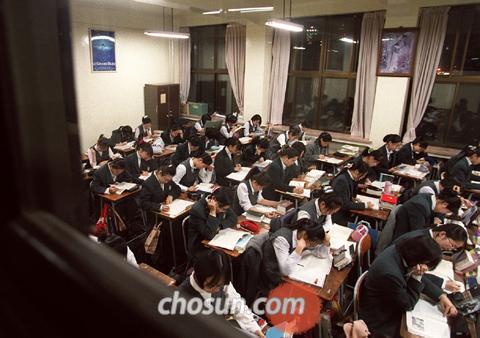
Student life in Korea is very different from student life in the U.S.. The difference is very apparent in the years before college. First, the concept of homework is less emphasized in Korea. Students aren't really given homework because they are simply expected to study. Once the student gets home, they would only have enough time to go to bed. High schoolers in Korea would go to school early in the morning and come back late night. That is because they would have classes during the day and self study sessions after school in the school. The thing about these self study sessions is that students are expected to stay and study as if it is a class. This long day does not only account for high schoolers but even elementary and middle schoolers. Young ones would go to class and commonly go to private tutors right after. This concept of private tutor is not like in the U.S.. It is actually just school all over again. Because they study so much anyways, homework is meaningless in Korea. Korea also has a ranking system whereas U.S. has an excellent merit system. The ranking of each student becomes very important during college application time and due to this ranking system, competition is very hard in Korea.
Taekwondo is a Korean martial art that is mainly focussed on various types of kicking techniques. In Korea, Taekwondo is so popular that you'd be an outlier if you've never tried it. Not all continues the practice, but it is a sport that everyone has tried in their childhood. Although it is a martial art, it focusses on a lot more than just physical fighting. Parents in Korea would send their child to Taekwondo to learn to respect and train their mind. It wouldn't be wrong to say that Taekwondo is a internal/mind training rather than a physical training. I also did Taekwondo when I was young and continued for about 10 years. In my opinion, it does lose some practicality as many would say the techniques are for show, but it is a great exercise for both internal and external.
Korea is really well known for street food. In every outdoor street markets, there would be a lane of various food where you would walk and eat as much as you want. These are constantly made fresh and usually you would see many elderlies holding their stand. The food culture in Korea is very convenient. It has 24 hours delivery of almost anything you can think of.
Here's a small tip. If you are nice to the seller, they would give you a little more for free. In Korean culture this "service" is quite common between the buyer and the seller. The seller would give you "service" if you are nice, pretty, or just out of good mood. Even the buyers usually asks for "service" and most of the time the seller would give you that "service". Whats a bit odd is that the buyer can ask for "service" as it is quite weird to ask for more in U.S.. Even in Korean restaurants in the U.S., the restaurant might give you something as "service" ("on the house").

This is one of my favorite Korean dish and you can easily try this at Grandmart. It is a meat dish with pork and various vegetables inside. It is spiced with Gochujang (spicy sauce) and it really makes your taste buds go crazy. Like a lot of Korean dishes, you would simply eat it with sticky white rice and that is a fine meal itself. I would get this menu at least 50% of the time I go to Grandmart and I hope everyone can try this delicious food. It is quite a bit spicy so I recommend people who aren't so good with spicy food try eating bulgogi which is beef and vegetable mix spiced with soy sauce.

On April 4, 2019, there was a really massive forest fire that destroyed the town of Goseong in Gangwon province. It destroyed 120 homes and caused two deaths. Almost all residence within this town were elderlies and the damage was devastating. There has been a lot of donations and support groups so far and I really hope the situation gets better.
One story of a victim truly touched my heart. This old grandpa had been saving money for his entire life to give it to his son, but the fire turned it into ash over just one night. He was hopeless, and it was decided that it wasn't even allowed for compensations by the government.
Short Article:
https://www.bbc.com/korean/news-47823400
Link to news:
This is the most popular spring song in Korea. It is by far the most played song in Korea during the spring season, especially during the cherry blossom period. Everyone in Korea knows this song and it is always played in festivals and outdoor events during the spring. It is very easy to sing along and creates a happy mood immediately. I hope everyone can get a chance to listen to this amazing song.
Lyrics with translation:
그대여 그대여 그대여 그대여 그대여
오늘은 우리 같이 걸어요 이 거리를
밤에 들려오는 자장노래 어떤가요
몰랐던 그대와 단 둘이 손 잡고
알 수 없는 이 떨림과 둘이 걸어요
봄바람 휘날리며 흩날리는 벚꽃 잎이
울려 퍼질 이 거리를 둘이 걸어요
봄바람 휘날리며 흩날리는 벚꽃 잎이
울려 퍼질 이 거리를 둘이 걸어요
그대여 우리 이제 손 잡아요 이 거리에
마침 들려오는 사랑 노래 어떤가요
사랑하는 그대와 단 둘이 손잡고
알 수 없는 이 거리를 둘이 걸어요
봄바람 휘날리며 흩날리는 벚꽃 잎이
울려 퍼질 이 거리를 둘이 걸어요
봄바람 휘날리며 흩날리는 벚꽃 잎이
울려 퍼질 이 거리를 둘이 걸어요
바람 불면 울렁이는 기분 탓에 나도 모르게
바람 불면 저편에서 그대여 니 모습이 자꾸 겹쳐
또 울렁이는 기분 탓에 나도 모르게
바람 불면 저편에서 그대여 니 모습이 자꾸 겹쳐
사랑하는 연인들이 많군요
알 수 없는 친구들이 많아요
흩날리는 벚꽃 잎이 많군요 좋아요
봄바람 휘날리며 흩날리는 벚꽃 잎이
울려 퍼질 이 거리를 둘이 걸어요
봄바람 휘날리며 흩날리는 벚꽃 잎이
울려 퍼질 이 거리를 둘이 걸어요
그대여 그대여 그대여 그대여 그대여
English Translation:
You, you
You, you
Today, let’s walk together on this street
How is this lullaby that
You hear on this night?
I hold hands with you, whom I didn’t know
As we walk together with this unknown trembling
As the spring wind blows
The scattering cherry blossom petals
Spread out on this street
As we walk together
As the spring wind blows
The scattering cherry blossom petals
Spread out on this street
As we walk together
Oh yeah
You, now let’s hold hands on this street
How is this love song
That you hear right now?
I hold hands with you, whom I love
As we walk together on this unknown street
As the spring wind blows
The scattering cherry blossom petals
Spread out on this street
As we walk together
As the spring wind blows
The scattering cherry blossom petals
Spread out on this street
As we walk together
When the wind blows
My heart sounds to
Pound without knowing
When the wind blows
From way over there
I keep seeing you
When the wind blows
My heart sounds to
Pound without knowing
When the wind blows
From way over there
I keep seeing you
There are many lovers who are in love
There are many unknown friends
There are many scattered cherry blossom petals
I like it
As the spring wind blows
The scattering cherry blossom petals
Spread out on this street
As we walk together
As the spring wind blows
The scattering cherry blossom petals
Spread out on this street
As we walk together
You, you, you, you
Link to "Cherry Blossom Ending" by Busker Busker
